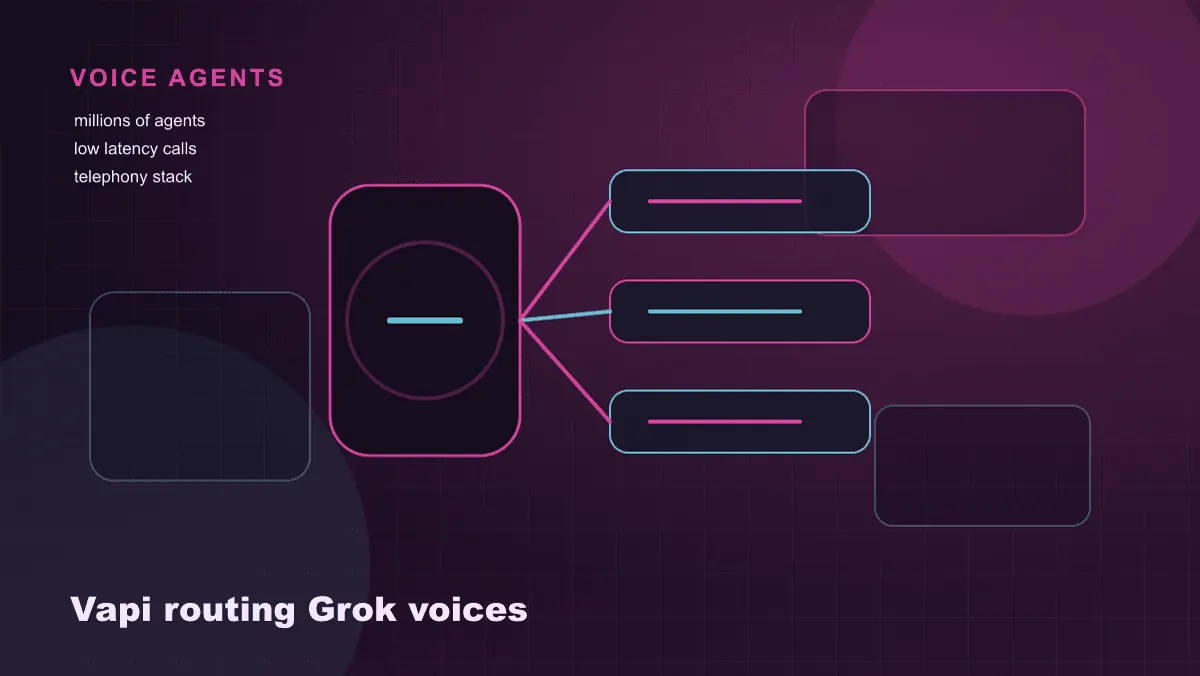
xAI enters the heart of Vapi and turns synthetic voice into standard infrastructure for millions of agents
The voice agent war is no longer about proving that a machine can talk. That has passed. The real dispute now is knowing which stack can sound natural, respond quickly, operate at scale and fit into the budget of companies that need to serve real customers. In this market, winning a strategic integration matters more than a pretty benchmark, because distribution defines what becomes an invisible standard.
It was exactly this type of movement that xAI announced on June 3, 2026. In the post “Grok Becomes the Voice of Vapi”, the company announced a partnership so that Grok becomes the default engine for the 12 central voices of the Vapi platform. According to xAI itself, this brings its voice layer to more than 2.5 million agents already built on top of Vapi. Instead of just selling a speech API, the company enters directly into one of the main voice agent deployment pipelines.
What happened
The ad relies heavily on perceptual quality. xAI claims that Vapi carried out an independent blind evaluation in which Grok Voice came out on top in a head-to-head comparison with other providers. The text also cites a side-by-side poll on X, with more than 4,500 participants divided practically half and half when trying to distinguish Grok's voice cloning from an original human voice. These signals are not equivalent to an academic paper, but they serve to communicate the central thesis of the partnership: a highly natural voice as an immediate competitive differentiator.
The wording of the ad is important. Instead of focusing just on isolated TTS, xAI talks about bringing “frontier voice quality” to millions of Vapi agents. In other words, the product that matters is not the speech itself, but the speech operating within service, sales and automation systems. This repositions voice as a functional infrastructure for agents rather than a cosmetic resource for interactive demos.
The technique behind
From a technical point of view, an agent's voice needs to balance several attributes at the same time: convincing prosody, low latency, stability throughout the conversation, emotional fidelity and predictability when there is tool calling or more rigid flows. If the voice sounds natural but takes too long, the conversation falls apart. If you respond quickly, but with flat prosody, the system sounds mechanical. The fact that xAI highlights “naturalness and emotional range” suggests that it is trying to win not just in intelligibility, but in conversational presence.
There is also the distribution architecture. When a provider becomes a standard engine within a platform like Vapi, it inherits volume, use cases and feedback on a much larger scale. This tends to speed up optimizations in accent, fallback, stability and tooling. In theory, it also reduces friction for those who have already built agents on Vapi and want to improve the experience without redesigning the entire backend. The voice stops being a part that can be changed for each project and starts to operate as a standardized base layer.
Why this matters
For companies, the practical impact is on customer service and commercial automation. Bad voice agents fail at one simple point: people hang up or ask for a human too quickly. If speech quality rises a noticeable step, the user's tolerance window increases and more flows become viable. This doesn't mean that naturalness solves everything, but it improves one of the product's most visible frictions.
There is also a market effect. By defaulting to a platform with millions of agents, xAI gains distribution that is difficult to copy with direct marketing alone. For competitors, the threat is not just losing an enterprise customer; is losing its place as the default choice in new deployments. In platform ecosystems, default has enormous power because it reduces decision, integration and perceived risk for those just starting out.
The future it anticipates
The plausible future is to see voice AI competition migrate from simple speech synthesis to full conversational stacks with memory, controllable emotion, business rules, observability, and intelligent handoff. A more natural voice is just one piece. The winning stack needs to handle interruption, resumption, consent, compliance, authentication and cost per minute. The partnership with Vapi suggests that xAI understands this and prefers to occupy the center of distribution now, before the market consolidates patterns that are difficult to dislodge.
The most interesting inference is that the true product may not be “voice”, but operational credibility for telephony and customer service. If voice agents become routine in support, lead qualification and internal services, the supplier that delivers naturally with production predictability will have a huge advantage. In this scenario, voice APIs are treated as critical infrastructure, almost like specialized speech databases.
What to watch out for
There are still many questions. The blind evaluation cited by xAI is promising, but the market will want to see how the quality holds up in noisy environments, multiple languages, accents, long shifts and integrations with corporate tools. It is also worth observing the total cost of the operation, because an agent's voice involves more than the model: telemetry, telephony, STT, orchestration and external tools continue to weigh on the budget.
Another point is security. The more convincing the synthetic voice, the greater the responsibility for authentication, consent, and prevention of misuse. The partnership shows real product advancement, but it also pushes the sector to a phase where “feels human” stops being just technical praise and becomes a matter of governance.
Sources
- https://x.ai/news/grok-vapi
- https://x.ai/news/grok-stt-and-tts-apis