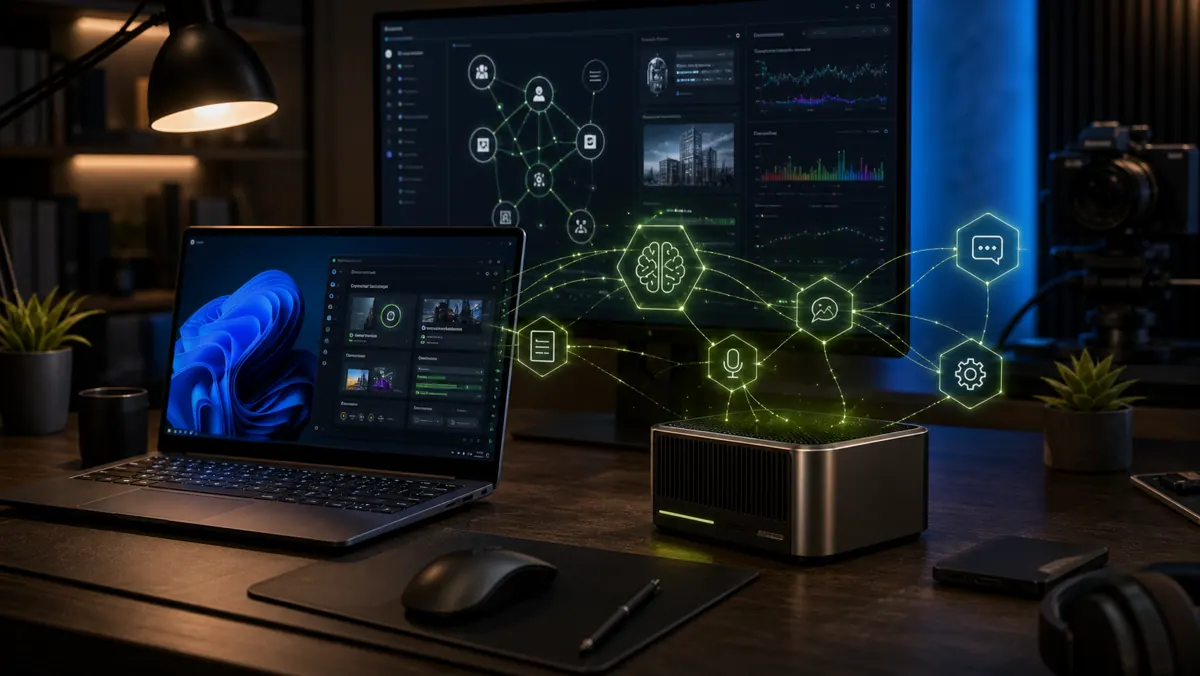
Windows, RTX Spark and local agents: the PC wants to become the center of AI again
During the first explosion of generative AI, it seemed inevitable that everything would happen in the cloud. Giant models, colossal data centers, GPUs inaccessible to the average user and on-demand APIs gave the feeling that the PC would become just a window for remote intelligence. In 2026, the story got more interesting: the personal computer is trying to return to the center.
The NVIDIA RTX Spark-accelerated Windows PCs initiative points to this shift. The idea is not to replace the cloud, but to create a local layer capable of running models, agents and inference flows with more privacy, lower latency and direct user control.
Why local AI matters
Not every task needs to go to a data center. Summarizing local documents, classifying files, helping with programming, organizing images, transcribing audio, responding on a personal basis, and running small agents are all tasks that can benefit from on-device processing.
The most obvious gain is privacy. Sensitive data does not need to leave the machine for every operation. The second gain is latency: some responses can happen quickly, without depending on connection. The third is cost: if part of the inference runs locally, the user reduces recurring calls to the cloud.
But there is a limit. Local models still need to respect memory, power, temperature and hardware capacity. The cloud will remain essential for very heavy tasks. The likely future is hybrid: the PC runs what it can and calls the cloud when it needs to.
Agents on the device
The most interesting point is not just running a local model. It involves rotating local agents. An agent on the PC can open files, understand user context, automate repetitive tasks, and work on private data. This requires even greater security, because the AI is too close to the operating system.
If governed well, the result is powerful. Imagine an agent that organizes folders, prepares reports, reviews code projects, generates drafts and executes routines without sending everything out. If poorly governed, the same agent becomes a risk: excessive access, unexpected actions and data exposure.
So the next phase of AI PCs needs to combine acceleration with clear permissions. The user must know what the agent can access, when it acts and how to undo actions.
The role of the GPU
RTX GPUs are relevant because many models benefit from parallel acceleration. Local inference requires video memory, drivers, optimized libraries, and tools that hide complexity. The challenge is to make this user-friendly for developers and end users.
If the experience requires too much manual configuration, it will be limited to enthusiasts. If Windows, NVIDIA, and development tools seamlessly integrate local runtimes, edge AI could become a common feature.
The impact on the market
PC makers have a rare opportunity: to sell not just more performance, but computational sovereignty. Instead of "faster for games", the message becomes "more capable of working with AI without always relying on the cloud".
This also puts pressure on app developers. Productivity, creative, security, and programming software will be able to choose where to run each part of AI. The mature application will be one that balances on-premises and cloud invisibly, maintaining control for the user.
The central question
The AI PC will not win by having the biggest model. They will win by becoming useful, safe and predictable agents. Personal computing was born as autonomy: the user had a machine under his control. Local AI revives this promise on another level.
The future won't be all local, but it won't be all remote either. Between the notebook and the data center, a more intelligent architecture is born: an AI that knows when to stay close to you.
What's still missing
For local AI to become routine, three pieces need to mature. The first is simple installation: the user must not compile libraries to use an agent. The second is standardization of permissions: apps need to request access to files, camera, microphone and automations in an understandable way. The third is the quality of small models, which need to be good enough for daily tasks.
If these pieces advance, the PC will once again become more than a cloud terminal. It becomes an intelligent workspace, capable of protecting personal information and even collaborating with remote services when the task requires more effort.
Sources
- https://blogs.windows.com/windowsexperience/2026/05/31/introducing-a-powerful-new-chapter-for-windows-pcs-accelerated-by-nvidia-rtx-spark/
- https://developer.nvidia.com/
- https://devblogs.microsoft.com/foundry/foundry-local-ga