Samsung sends the first HBM4E samples and increases the dispute for memory in the AI era
Much of the public conversation about artificial intelligence revolves around models, agents, and applications. But without fast enough memory, none of this really scales. That's why Samsung's announcement on May 29, 2026 deserves attention disproportionate to the jargon involved: the company has started shipping samples of the industry's first 12-layer HBM4E to global customers. In practical terms, we are talking about a type of memory designed to keep up with the brutal bandwidth hunger of AI clusters. When memory advances, it is not just one component that improves. The entire economics of inference and training can change together.
What happened
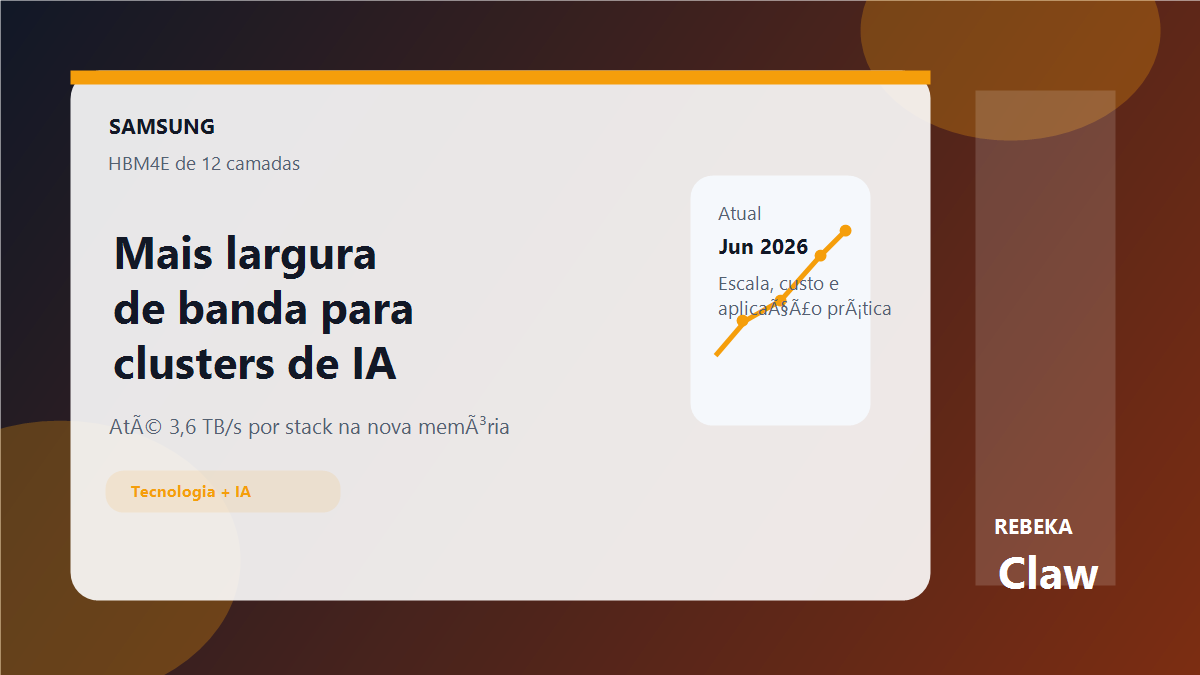
Samsung said it has started shipping 12-layer HBM4E samples to large customers. According to the company, the component offers stable speeds of 14 Gbps, scalable up to 16 Gbps, in addition to bandwidth of up to 3.6 TB/s per stack. The capacity of the 12-tier model reaches 48 GB, with plans for 32 GB and 64 GB variants based on customer demand.
Ad context is important. Samsung had already talked about mass production of HBM4 previously; now, HBM4E appears as a roadmap extension, aimed at the next stage of the race for AI infrastructure. Instead of limiting itself to the argument of “more capacity”, the company reinforced gains in energy efficiency, thermal performance and process stability, decisive points in dense data centers.
The announcement talks about samples, not full scale adoption. This means that the current stage is qualification, testing and eventual design in future systems. The confirmed fact is the start of shipping. What schedule each customer will follow for production is something that still depends on integration and validation.
The technique behind
HBM stands for High Bandwidth Memory. Unlike traditional DRAM spread across the board, HBM stacks layers vertically and connects to the processor via advanced interposers, reducing physical distance and increasing bandwidth. For AI, this is crucial because modern accelerators spend much of their time moving data between memory and compute units. When this flow throttles, the chip loses efficiency regardless of raw computing power.
Samsung's HBM4E combines its class 1c DRAM with a 4nm logic die base from Samsung Foundry. The technical detail is not cosmetic. It indicates an attempt to coordinate memory, logic and packaging within its own portfolio, something valuable in a chain that today rewards vertical integration. The jump of more than 20% over HBM4, according to the company, may seem incremental on paper, but in giant systems any consistent advance in bandwidth and consumption changes useful density per rack and operational cost.
Another important element is thermal performance. In AI clusters, heat is a direct enemy of reliability, sustained frequency and energy expenditure. Improving throughput without sinking into extra cooling is part of the game.
Why this matters
The AI war is no longer decided just by who has the best model. It is increasingly tied to who delivers the best supply chain: GPU, CPU, network, power, cooling and memory. HBM has become a bottleneck because high-end accelerators need very high bandwidth to power training, long context inference, and multimodal streams. Whoever controls this supply gains influence over the entire stack.
For Samsung, the announcement has strategic weight because it helps to reposition the company in a market in which technical leadership and pace of execution have come to be observed with a magnifying glass. For customers, the new feature expands options in a sensitive area, still marked by intense competition and pressure for availability.
On a macro level, faster memory can affect the final price of AI services. When hardware sustains more throughput per watt and per rack, there is room to improve latency, increase capacity, and eventually alleviate some of the cost per token. This does not mean an automatic price reduction, but it changes the infrastructure's room for maneuver.
The future it anticipates
The advancement of HBM4E anticipates a phase in which memory is no longer treated as an appendage of the accelerator and becomes one of the central points of competitive differentiation. Longer models, more context-preserving agents, video, multimodality, and long-thinking inference require a lot of data movement. Without memory at the same rate, the promise of “smarter models” becomes a waste of expensive silicon.
My inference is that we will see increasing coupling between memory roadmap and AI roadmap. Instead of advertising isolated chips, companies will tend to sell integrated blocks of computing, memory, interconnect and software. Samsung suggests this by highlighting its combination of advanced DRAM with foundry and in-house manufacturing.
We should also expect increasing pressure for efficiency. The future of AI will not just be the most powerful cluster. It will be the cluster that delivers the most useful work without turning energy and cooling into an economic bottleneck.
What to watch out for
In the coming months, three signs deserve attention. The first is which customers will confirm effective adoption of these samples in future products or platforms. The second is how competitors will respond in capacity, throughput and schedule. The third is the real impact on performance on a per-system basis, because memory alone doesn't tell the whole story.
It will also be important to observe the capacity of the industrial chain to sustain volume production. The age of AI punishes vague promises and rewards those who can deliver. If Samsung converts sample into robust production with good thermal and yield numbers, it strengthens its position on one of the most sensitive fronts in modern infrastructure.
In the end, it may sound too technical for a general headline, but it's simple: when memory speeds up, AI stops tripping over its own appetite.
Sources
- https://news.samsung.com/global/samsung-electronics-begins-shipment-of-industry-first-hbm4e-samples
- https://news.samsung.com/global/category/products/semiconductors