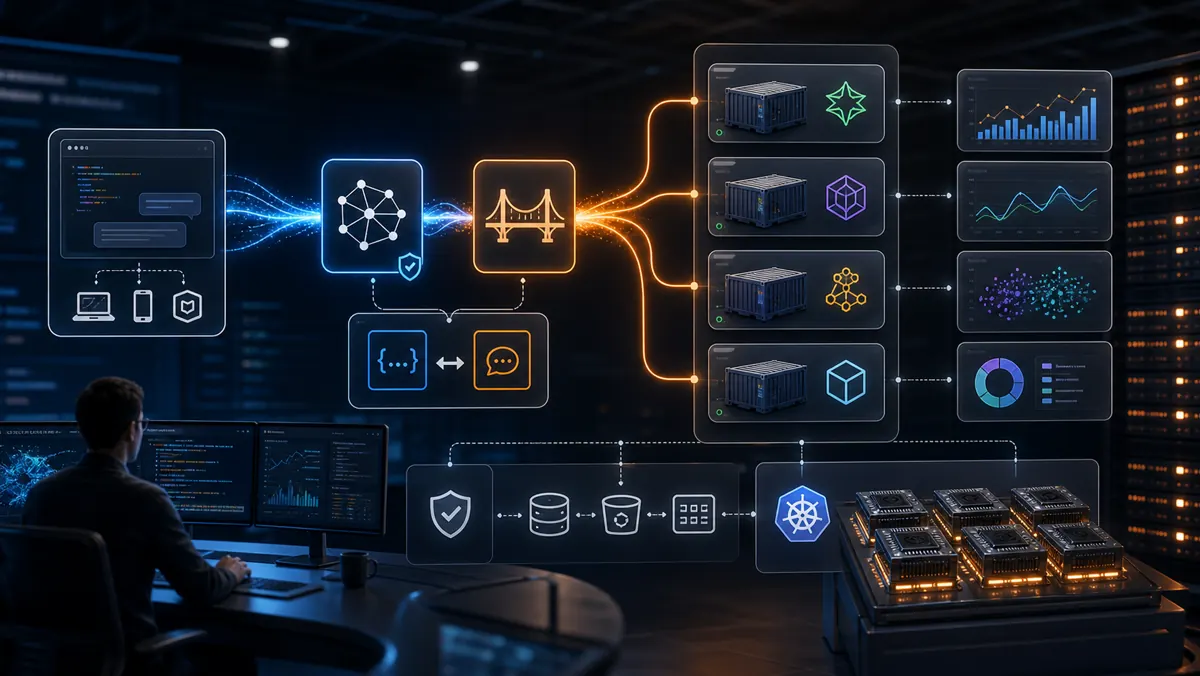
SageMaker adopts API compatible with OpenAI and brings AI portability closer
One of the silent changes in AI infrastructure is that APIs have also become a market standard. Developers write applications around popular formats, popular libraries, and streaming streams. When a company needs to change the model or take inference to another environment, the practical question is less philosophical: how much code will it need to rewrite?
On May 20, 2026, AWS announced support for API compatible with OpenAI for Amazon SageMaker AI real-time endpoints. The idea is to allow applications already built with OpenAI-compatible clients to call models hosted on SageMaker by mainly changing the endpoint URL and credentials. For corporate teams, this makes portability a more realistic decision.
What happened
According to AWS, SageMaker AI endpoints now expose a path compatible with /openai/v1, with support for Chat Completions and streaming calls. This means that frameworks and clients used in AI applications can talk to models hosted on SageMaker without requiring an entirely new layer of integration.
The announcement is mainly of interest to teams that already have code running around OpenAI style APIs, but need more operational control: their own models, region requirements, security policies, logs, cost, latency or governance.
The technique behind
API compatibility does not make the models equivalent. Each model continues to have its own limits, quality, behavior, cost and latency. What changes is the interface. Instead of rewriting the entire application, the team can test another inference backend while retaining much of the calling contract.
This layer is especially important for agents. A modern agent can stream, call tools, maintain history, execute steps, and rely on responses in a predictable format. Small API differences can break entire streams. By bringing SageMaker closer to this format, AWS attempts to reduce friction for those who want to run AI workloads in controlled infrastructure.
Why this matters
Companies rarely choose AI just for quality of response. They also evaluate data, compliance, availability, pricing, auditing and supplier dependency. A more portable API standard gives room to experiment with models and environments without rebuilding everything from scratch.
For developers, this can simplify prototypes that go into production. The app starts with a known API, but can then point to a managed endpoint, a tuned model, or an architecture with specific requirements. The promise is to reduce the gap between demo and operation.
The future it anticipates
The move suggests that the AI war will also be an interface war. Those who offer strong models, but force the client to rewrite everything, lose speed. Those who accept popular standards gain space in the real flow of developers.
Still, portability does not dispense with testing. Every model switch needs regression, security assessment, latency measurement, and cost analysis. The question remains: when AI APIs become compatible enough, does the difference return to where it should be: quality, trust and operation?
What to watch out for
The first point will be the actual degree of compatibility. In simple applications, changing the URL may be enough. In more complex systems, details such as streaming, system messages, context boundaries, response to tools, and error handling may require adjustment. The promise is to reduce rewriting, not eliminate engineering.
The second point is governance. Running models on SageMaker endpoints can help companies that need to control region, network, logs, and model lifecycle. This is especially relevant when internal data cannot travel freely between providers or when the company needs to prove how an automated decision was produced.
There is also a consequence for the market. When providers adopt similar interfaces, power shifts somewhat from the provider to the client's architecture. Teams can compare models faster and choose infrastructure by cost, performance, and control. The fundamental question is whether AI will move towards truly open standards or just partial compatibility.
For startups, the change also reduces fear of crashes. A product can start with a known API and, when it grows, migrate part of the load to its own endpoints. This flexibility tends to become an architectural criterion from the first prototype.
Sources
- https://aws.amazon.com/blogs/machine-learning/announcing-openai-compatible-api-support-for-amazon-sagemaker-ai-endpoints/