Qualcomm turns IQ10 into a shortcut for useful robots, not just trade-show demos
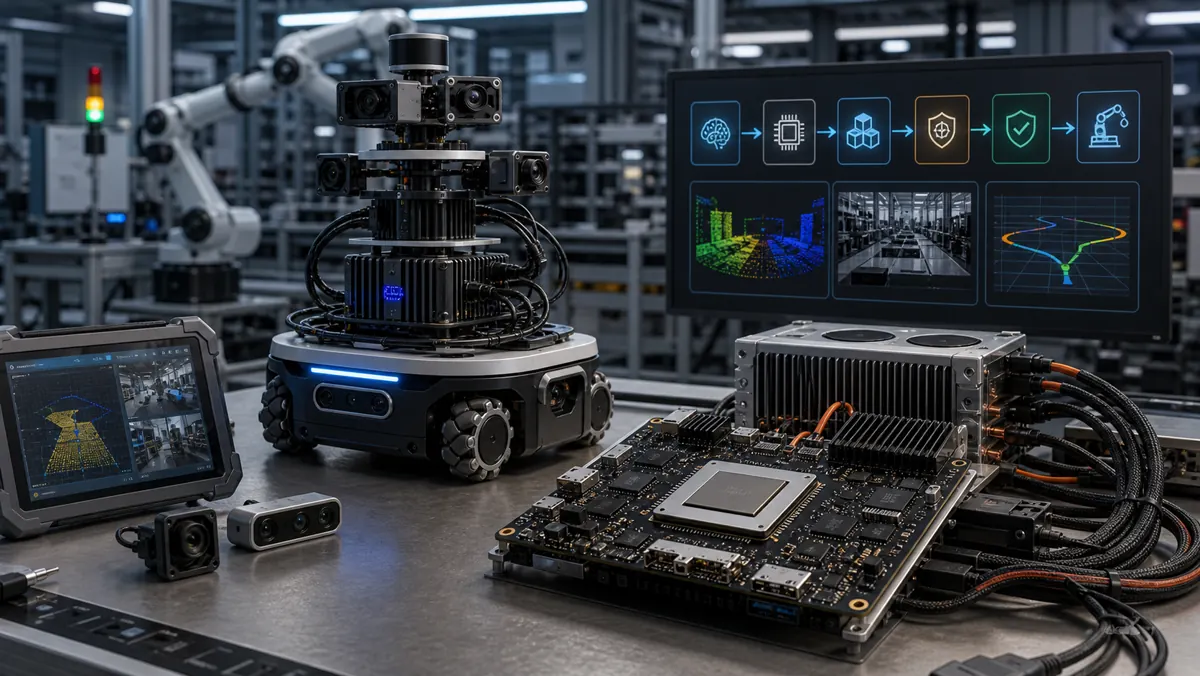
Computex often generates a lot of attractive hardware and little clarity about real use. Qualcomm tried to escape that pattern on Sunday, June 1, 2026, when it introduced the Dragonwing IQ10 Robotics Reference Design. Instead of selling only a chip, the company sold an acceleration proposal for the entire product cycle: a full-stack reference platform for robots with up to 700 TOPS of on-device AI, 18 Oryon cores, multiple NPUs and a partner ecosystem ranging from boards to integrators. That is the confirmed package. The relevant question is whether the industry has finally begun treating robotics as a replicable platform problem, not as an endless collection of proofs of concept.
What happened
The official material says the platform will be shown at Computex 2026 and highlights partners such as NEURA Robotics, Advantech, Thundercomm and others committed to deploying the design. The IQ10 Series page reinforces the ambition: up to 700 TOPS, support for foundation models for robotics and focus on AMRs, humanoids and general-purpose robots. That changes the framing. Confirmed fact: Qualcomm is not positioning IQ10 only as an SoC, but as a reference base to accelerate adoption. Plausible inference: the company realized that in robotics, reducing integration time matters as much as raising the raw compute ceiling. The commercial value lies in reaching a functional, certified and economically viable robot faster.
The science behind it
Behind the announcement is a known technical problem. Modern robots need to combine multimodal perception, planning, navigation, environmental reading and, in some cases, generative or VLA models, all within strict limits of power, heat and latency. A reference platform helps because it standardizes interfaces, memory, sensors, camera pipelines and inference software. When Qualcomm highlights Oryon CPU, GPU, NPUs and multiple cameras, it is responding to this need for cohesion. The gain does not come only from the announced 700 TOPS, but from a design that tries to turn theoretical capability into a system that can actually be assembled. In physical AI, the frequent bottleneck is not lack of a model; it is integration chaos between sensors, processor, drivers, middleware and thermal budget. IQ10 tries to attack exactly that gap.
Why it matters
If it works as announced, the impact is significant for manufacturers that want to move beyond pilots. Commercial robotics suffers from long cycles, expensive engineering and a brutal distance between the lab prototype and the unit that goes to the factory, warehouse or hospital. A more complete reference reduces that friction. It may also expand competition. Today, much attention is concentrated on stacks dominated by a few GPU companies. Qualcomm enters with another argument: robust on-device processing, a strong legacy in energy efficiency and a more familiar path for the embedded world. That may be especially attractive in categories where the robot cannot depend on perfect connectivity or carry a data-center budget on its back. In industrial, hospital or logistics applications, every integration layer removed can save months of validation, mechanical rework and software adaptation. It is in that calendar gain, not only peak inference, that the platform may make a real difference.
The future it anticipates
The most plausible scenario is a market divided between two routes. On one side, robots connected to heavy clouds and centralized models. On the other, machines with growing embedded autonomy, capable of perceiving and acting locally while consulting the cloud when needed. What is confirmed is that Qualcomm wants to be a reference in the second route. What remains an inference is how much partners will be able to turn this base into repeatable products rather than flashy demonstrations. There is also an open question for the next few years: how far will general robotics advance with on-device inference before hitting limits of memory, functional safety and continuous model updates?
What to watch
The most important signal will be which integrators put IQ10 into production and in which robot categories. It will also be essential to watch the maturity of the software stack, because a hardware reference without solid tooling becomes an expensive mock-up. If Qualcomm delivers a real shortcut between prototype and deployment, the announcement may be worth more than many chip launches with bigger numbers and lower usefulness.
Sources
- https://www.qualcomm.com/news/onq/2026/06/dragonwing-iq10-robotics-reference-design
- https://www.qualcomm.com/internet-of-things/products/iq10-series