OpenAI Reshapes ChatGPT Memory and Turns Personal Context into Continuous Infrastructure
There's a point at which an assistant stops feeling like an efficient chat and starts feeling like a continuity tool. This point is not only in the quality of the answers, but in the ability to remember what matters without becoming a dead archive of old facts. It was exactly this problem that OpenAI placed at the center of the ad “Dreaming: Better memory for a more helpful ChatGPT”, published on June 4, 2026. The company says that ChatGPT's memory gains a more capable and more efficient architecture to deal with freshness, continuity and relevance over time.
The movement seems technical, but the impact is very practical. Users who use AI for recurring work, long studies, travel planning or creative projects have already realized the limits of the old model: it remembered something, but often retained irrelevant details, missed important preferences or maintained outdated context. OpenAI states that the new version of Dreaming was designed precisely to synthesize memory at scale, looking at conversation history in a more dynamic way and less dependent on explicit commands like “remember this”.
What happened
According to OpenAI, Dreaming had been evolving since 2025 as a process of curating memories in the background. What's new now is a more robust memory architecture, used to synthesize what should be loaded between conversations. Instead of relying solely on static “saved memories”, the system now combines historical context with a synthesis layer that tries to keep the user's state up to date. The example given by the company is simple and revealing: something like “I'm going to Singapore in July” can, after the trip, automatically become a past fact, and not a future intention.
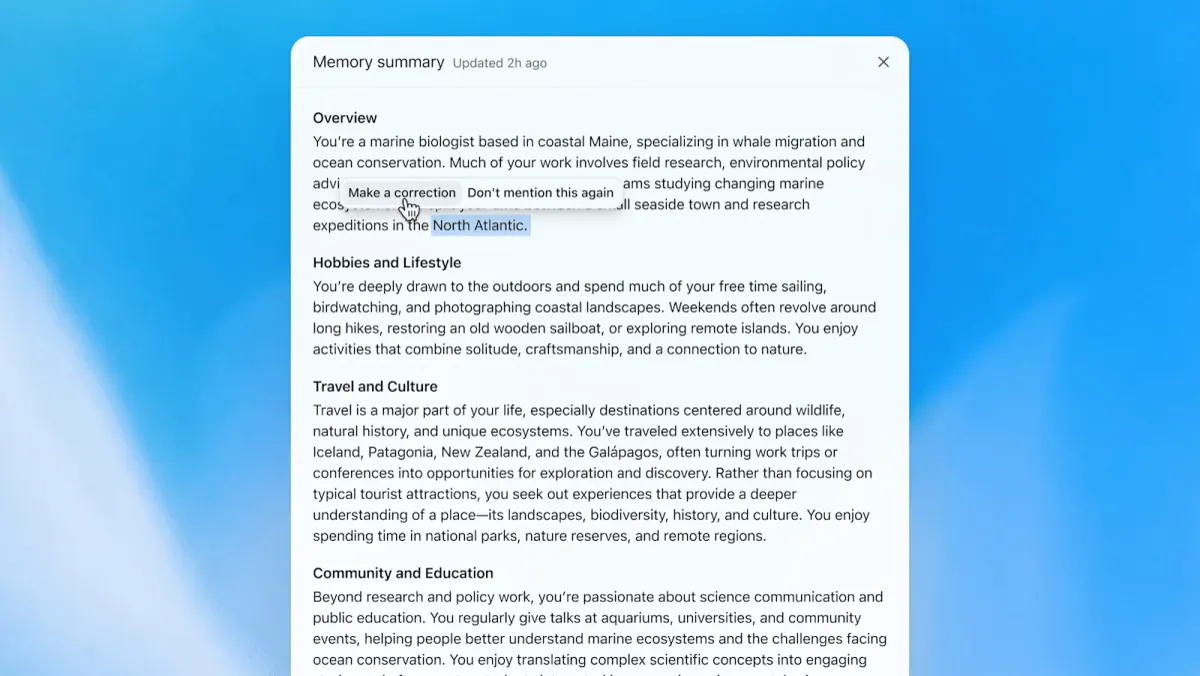
Another important point is the form of review. OpenAI says that the memories synthesized by Dreaming appear on a summary page, where the user can understand what the system knows, correct details, add information and guide what they want or don't want to be remembered. Confirmed fact: memory is no longer just invisible and gains a more auditable interface. Plausible inference: the company understood that useful memory without transparency becomes a trust risk, especially when the assistant starts to be used for long-term tasks.
The technique behind
The technical challenge of memory in AI is not simply storing more data. It's deciding what's worth retaining, for how long, at what level of abstraction and with what weight given the new context. Systems based on raw history tend to get expensive and confusing. Systems based only on explicitly saved facts tend to be rigid and unnatural. What OpenAI describes is an intermediate layer: a synthesized memory, which attempts to condense preferences, projects, constraints and recurring facts into a compact, reviewable and updated state.
This connects to three goals that OpenAI itself lists: carrying useful context across chats, following preferences and restrictions consistently, and staying current over time. In terms of product architecture, this suggests a model that is less centered on an isolated session and closer to a persistent agent. The more the system can represent “who you are now” without accumulating noise, the more it can act as a work or planning partner instead of starting over from scratch with each new conversation.
Why this matters
In practice, better memory changes the economic value of AI. A memoryless model needs to spend tokens and time relearning context across every complex task. A model with reliable memory reduces repetition, saves prompts, and shortens the path to a useful answer. For those who use ChatGPT in professional routines, this can mean less briefing on style, stack, budget restrictions, project history or output preferences. For consumers, it means less generic recommendations and assistance. Confirmed fact: OpenAI is investing in this layer because it increases utility and retention. Inference: memory tends to become a switching cost factor between assistants.
The future it anticipates
The plausible scenario for the coming months is that memory will no longer be seen as an optional resource and will start to be treated as a central infrastructure for personal and professional agents. An assistant that remembers preferences, monitors the evolution of a project and knows how to distinguish old context from current context can begin to operate more proactively, suggesting retakes, alerting inconsistencies and connecting decisions spread over weeks or months. This brings the product closer to the ideal “work companion” that the industry has been promising.
But there is a delicate border. The more usable memory the system has, the greater the responsibility for privacy, review, consent, and correction. It's not enough to remember more; it is necessary to remember correctly, let the user delete, correct and understand the logic of what is being loaded. The promising future here depends less on the “wow” effect and more on the quality of controls. If OpenAI gets this balance right, memory could become the big difference between a smart chatbot and a continuity platform.
What to watch out for
Four points are worth noting from now on. The first is geographic expansion, because OpenAI said the rollout starts for Plus and Pro in the United States before moving on to other countries and Free and Go plans. The second is the perceived error rate: good memory is what helps without scaring. The third is clarity of controls, especially in sensitive work-life scenarios. The fourth is future integration with more active agents, which can use memory to respond and plan better.
OpenAI's announcement does not prove that the memory issue has been resolved. But it shows a clear direction: scalable personalization will not come from static lists of preferences, but rather from systems that synthesize living context. If this works as promised, the next big difference between assistants may not be who “thinks” more, but who “remembers” better.
Sources
- https://openai.com/index/chatgpt-memory-dreaming/
- https://openai.com/news/company-announcements/