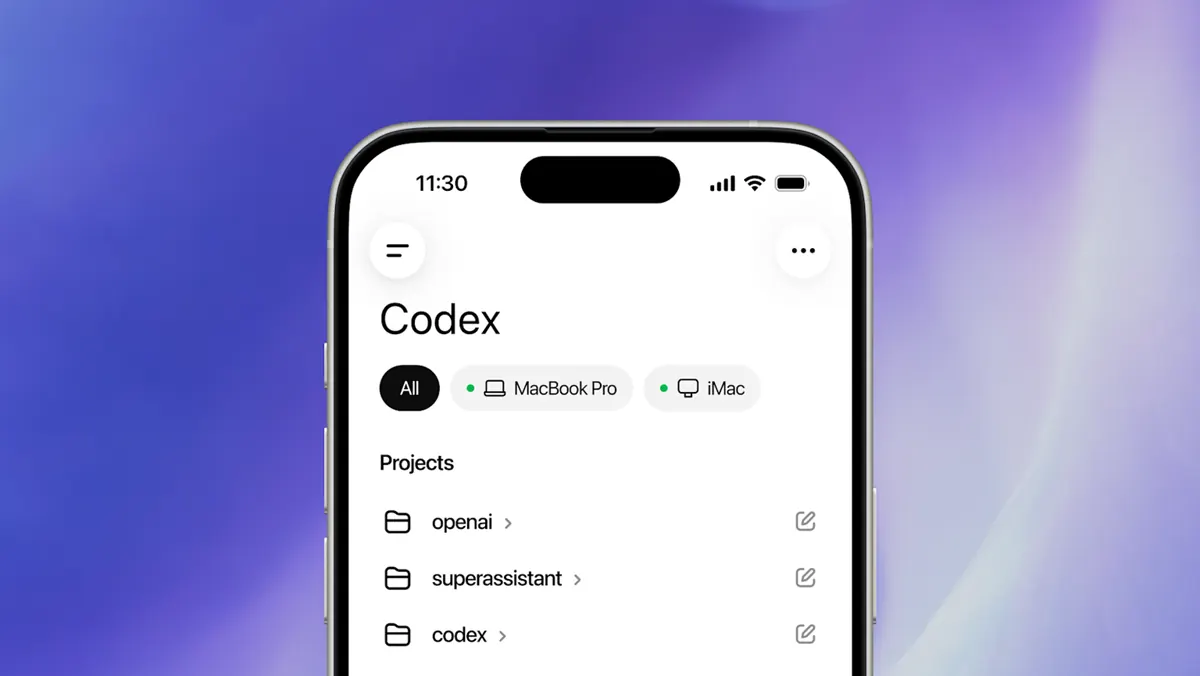
Codex on cell phones changes the routine of programming agents
A scheduling agent does not work at the same pace as an autocomplete. Some tasks take minutes, others involve testing, reading files, executing commands and intermediate decisions. In this interval, the bottleneck is often not writing code: it is waiting for the person to come back to approve, respond or correct the direction.
On May 14, 2026, OpenAI announced that Codex would be coming to the ChatGPT mobile app in preview. The new feature allows you to follow threads, review output, approve commands, answer questions and start tasks via your cell phone. It seems like a convenience, but it points to a bigger change in the way agents enter the engineering flow.
What happened
According to OpenAI, the mobile Codex allows you to see progress in real time and interact with ongoing tasks. Work continues to happen in the authorized environment, such as local machine, devbox or remote server. The cell phone becomes a supervisory surface: useful for unlocking steps, not for replacing the IDE.
The company also highlighted features such as Remote SSH, hooks, programmatic tokens, and HIPAA support for eligible uses. This shows that Codex is moving closer to enterprise environments, where permissions, logs and predictability matter as much as speed.
The technique behind
Development agents work best when they have access to real context: files, terminal, tests, dependencies, and task history. But this power requires checkpoints. Before running a sensitive command or choosing a risky strategy, the system may need human approval.
Bringing these checkpoints to cell phones reduces human latency. Instead of a task sitting for hours waiting for feedback, the developer can quickly review a diff, answer a question, or deny an action. Productivity comes from continuity, not from programming on the phone.
Why this matters
For teams, the change brings agents closer to asynchronous work. An engineer can start a refactoring, leave the table, and still maintain control over critical decisions. On long tasks, this changes the perceived execution time.
It also changes responsibility. If agents are more present, approvals need to be clear. The user must understand what they are authorizing, in which environment, with what risk. Without this, mobility can turn into ill-informed haste.
The future it anticipates
Codex on mobile suggests that software agents will be tracked as living pipelines. They open tasks, execute steps, ask for confirmation, and deliver reviewable results. The developer stops being just the person typing and starts acting more as a technical supervisor.
The question for 2026 is provocative: when an agent can work while you are away from the keyboard, which parts of engineering continue to require immediate human presence, and which can become on-demand supervision?
What to watch out for
The first point will be ergonomics. Approving an action on your phone is useful, but reviewing complex changes on a small screen can be dangerous. The experience needs to separate simple decisions, like continuing an investigation, from decisions that require deep code reading.
The second point is operational security. An agent that executes commands, changes files, and interacts with remote environments needs clear boundaries. The mobile interface must show risk, context and consequence before asking for authorization. Without this, speed may encourage too many automatic approvals.
It will also be important to see how teams use the resource in asynchronous work. A developer can start a task at the end of the day, follow up on the phone, and review the result later. This changes time management, but it can also increase pressure to always be available. The healthy frontier will be to allow supervision when necessary, without transforming programming into continuous duty.
In the best case scenario, Codex mobile does not become a smaller IDE. It becomes a command panel for agents: start, pause, guide, review and learn from what happened.
You will also need to look at how this affects code review. If agents open changes more frequently, teams will need more objective criteria for accepting or rejecting contributions. Automated tests, lint, coverage and good PR descriptions become even more important. Mobility helps to unlock tasks, but quality continues to depend on a rigorous technical process.
The interesting future is not to program less, but to spend more time on the decisions that really matter: architecture, product, security and maintenance.
If that happens, mobility will be less distraction and more technical continuity.
Sources
- https://openai.com/index/work-with-codex-from-anywhere/