OpenAI Brings AI to Biodefense and Opens a Tough Security Debate Ahead of the Next Biological Leap
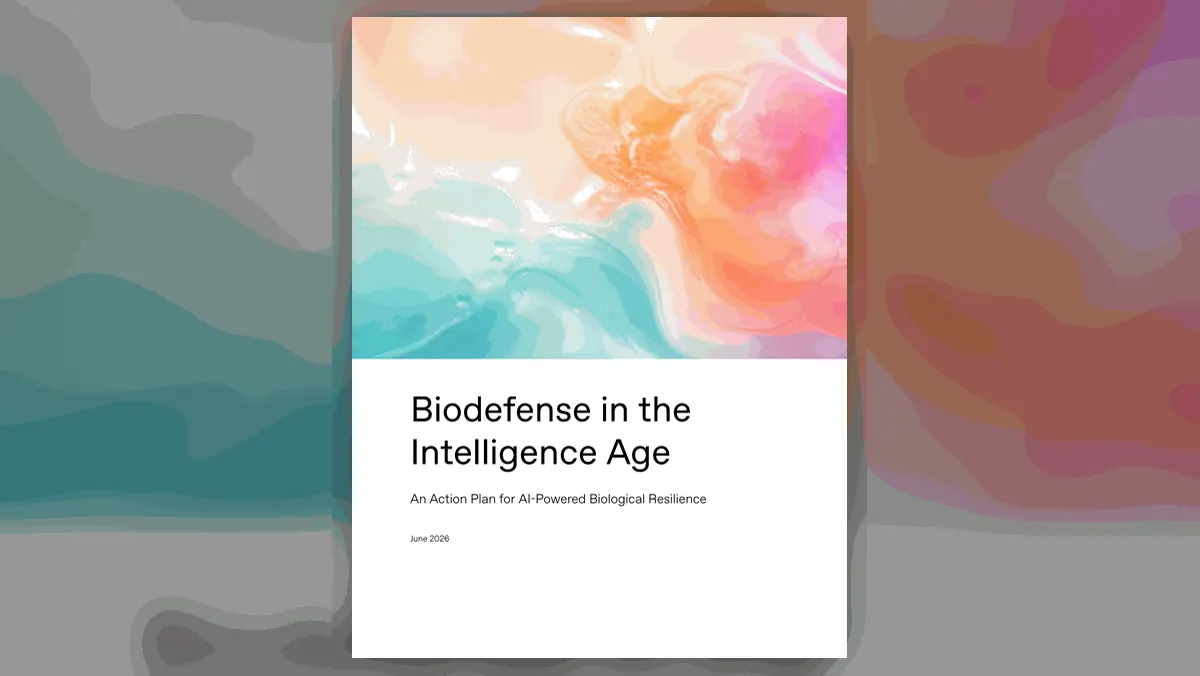
Few areas show the dual use of artificial intelligence as clearly as biology. The same capacity that accelerates the discovery of therapies and understanding of diseases can, in theory, shorten paths to abuse. On June 4, 2026, OpenAI published “Biodefense in the Intelligence Age,” an action plan that attempts to address this tension before it explodes into a concrete crisis. The central message is simple: advanced models for biology are becoming more capable and more available, so defense cannot wait for risk to mature before reacting.
The text connects directly to two recent announcements from the company itself. In April, OpenAI presented GPT-Rosalind, described as a reasoning model aimed at research in biology, drug discovery and translational medicine. In May, the company announced Rosalind Biodefense, targeting trusted developers to build preparedness capabilities against biothreats and pandemics. Now, the new document functions as a political and operational framework: if AI already helps scientists work faster, it also needs to strengthen those who monitor, detect and respond to biological risks.
What happened
The plan released by OpenAI states that the goal is to build a more resilient biological future, capable of detecting threats earlier, developing countermeasures faster and responding to crises with more coordination. Fact confirmed: the company is positioning its AI capabilities in biology not only as a driver of medical innovation, but as potential public safety infrastructure. The ad does not describe a new API or a new mass product; it outlines an action agenda for the biodefense ecosystem.
This is relevant because it shows phase change. Until recently, the debate on AI and biosafety revolved around abstract scenarios. Now, OpenAI itself is saying that advanced capabilities are already evolving quickly enough to justify institutional planning. Plausible inference: the company wants to anticipate an inevitable public charge. If frontier models begin to have a relevant impact on applied biology, the market and regulators will demand not only promises of caution, but concrete mechanisms of access, evaluation and governance.
The technique behind
AI-assisted biology is not just asking for a summary on proteins. Useful models in this area help interpret scientific literature, suggest hypotheses, connect biological pathways, prioritize experiments, and navigate large volumes of multimodal data. In drug discovery and translational medicine environments, the gain comes less from an isolated response and more from compressing cycles between hypothesis, analysis, and validation. It is this kind of acceleration that makes the technology powerful for legitimate science and at the same time sensitive from a security perspective.
When OpenAI talks about equipping responsible defenders, the technical implication is that models like Rosalind can be used to screen signals, prepare scenarios, analyze risk literature, support countermeasure design, and improve coordination between experts. But this only makes sense with filters, hazard assessment, access boundaries and usage monitoring. The problem is not just that the model knows more about biology; it is the entire system to decide in which contexts this knowledge can be operationalized.
Why this matters
From a practical point of view, the announcement matters because it moves biological AI from the imaginary of a futuristic laboratory to an institutional infrastructure agenda. If responding to outbreaks, laboratory threats or unusual events increasingly depends on analytical speed, those with better tools gain valuable time. In public health, time is not a detail. It also matters because the biological defense chain is fragmented: government, academia, hospitals, research, laboratories and technology providers rarely work at the same pace or with the same stack.
There is also a geopolitical reading. Frontier AI companies have begun to realize that in critical areas, it is not enough to say “our technology is neutral.” Society will demand that those with advanced capabilities play a role in protecting against misuse. Confirmed fact: OpenAI wants to participate in this definition. Inference: the plan also serves to shape the regulatory narrative, showing the company as a resilience partner, and not just as a supplier of a new risk.
The future it anticipates
The plausible future here is the emergence of a specialized layer of AI for biosafety, separate from generalist assistants and tightly linked to access, auditing and oversight criteria. Instead of making everything available in the same way to everyone, the sector can move towards a model in which more sensitive capabilities are contained in controlled programs, with integration into research, health and defense institutions. This already appears in the way OpenAI describes Rosalind Biodefense.
But there are still big questions. How to measure defensive utility without increasing offensive risk? How to audit outputs in an area where errors can be costly? How can we prevent legitimate research discussions from being excessively blocked, hindering biomedical innovation? The announcement points in a direction, but does not resolve these dilemmas. The most responsible vision of the future may not be to “release less” or “release more”, but rather to build different trails for different uses, with friction proportional to the risk.
What to watch out for
It is worth observing three fronts. The first is who, in practice, enters biodefense programs and with what trust criteria. The second is whether benchmarks and public assessments capable of measuring utility and risk in biology in a more concrete way will emerge. The third is alignment with government policies and health institutions, because a corporate plan only gains real weight when it becomes a multisectoral operation.
The OpenAI document is not a ready-made solution. Still, it marks an important change: AI companies no longer talk about biology just as a promising product frontier, but as an area of strategic responsibility. The uncomfortable debate began, and it probably started at the right time.
Sources
- https://openai.com/index/biodefense-in-the-intelligence-age/
- https://openai.com/index/frontier-safety-blueprint/