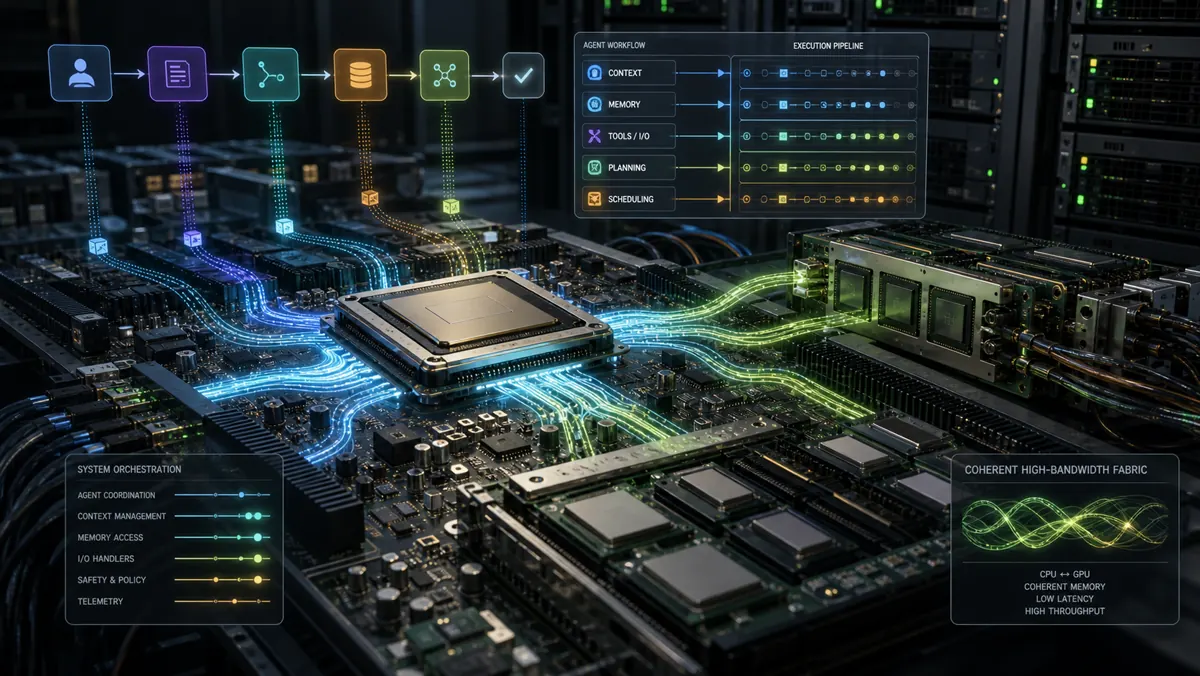
Vera, NVIDIA's CPU for agents, wants to shift the center of gravity of AI at scale
For years, the AI conversation became a conversation about GPUs. The CPU seemed like support infrastructure: important, but secondary in the public narrative. NVIDIA wants to invert part of that perception with Vera, announced on May 31, 2026, as its first CPU built specifically for AI agents. The confirmed fact is the official positioning: Vera will serve both in CPU-only servers and as the host for Vera Rubin systems. The most interesting point, however, is in the subtext. When a company that became synonymous with GPUs decides to draw attention to the CPU, it is admitting something many outsiders still underestimate: useful agents do not live only from massive inference. They live from coordination, context, I/O, orchestration and persistence.
What happened
The Taipei release says technology leaders already plan to adopt Vera and highlights its role as host processor for Rubin systems and BlueField-based storage platforms. A second NVIDIA text says OCI intends to deploy hundreds of thousands of Vera CPUs starting in 2026. That combination gives commercial weight to the announcement. This is not an architecture paper or a promise for 2028. The company presented a component with a defined function inside the stack and anticipated demand from hyperscalers. Confirmed fact: Vera enters NVIDIA's official design for agentic infrastructure. Plausible inference: the company realized that controlling the CPU-GPU boundary is as strategic as dominating the GPU itself, especially when workloads stop being only training batches and become persistent flows of production agents.
The science behind it
The technical reason is strong. Agents spend more time alternating between reasoning, external calls, state reading, task coordination and intermediate decisions. Part of that work is poorly served by a stack that treats the CPU only as a launch point for dispatching kernels. NVIDIA emphasizes the coherent high-bandwidth connection between Vera and Rubin through NVLink-C2C precisely to reduce friction between general and accelerated computing. That matters because context, queues, tools, memory and data rarely arrive at the GPU in a perfect linear format. There is always process coordination, serialization, scheduling policy and system control. The closer CPU and GPU operate, the less time is lost in copies, synchronization and host bottlenecks. The "CPU for agents" makes sense not because agents run only on CPU, but because their behavior requires a more symmetrical computing fabric than conventional inference.
Why it matters
The practical effect is a repositioning of the AI stack. For clouds, Vera offers the promise of better use of the complete system, not just the accelerator. For platform developers, it opens room for architectures where the host stops being a detail and becomes part of the performance differentiator. For competitors, the announcement restores an uncomfortable question: who controls the economic operating system of AI, the fastest GPU or the most efficient combination of CPU, GPU, networking and memory? At the same time, NVIDIA's strategy complicates life for traditional partners. If the company grows as a CPU supplier in the same data center where it previously depended on others, the competitive balance shifts. The center of gravity of infrastructure moves away from a collection of replaceable parts and closer to a highly optimized appliance.
The future it anticipates
The most plausible scenario is that Vera's success will be measured less by synthetic benchmarks and more by operational metrics: how many simultaneous agents fit in production, how much it costs to keep long workflows running, how much latency variance exists and what the real end-to-end throughput gain is. What is confirmed is NVIDIA's intention to make the CPU an explicit part of the conversation about agents. What still needs proof is whether customers will accept that movement as genuine technical progress or as deeper vendor dependence. There is also a long-term question: if agent work is hybrid by nature, will the classic split between CPU for coordination and GPU for inference continue to make sense, or will we see even more fused architectures in the next cycles?
What to watch
The main signal to watch is concrete adoption by clouds and OEMs beyond the initial promotional circle. It will also be useful to follow independent comparisons between agent workloads on Vera and traditional x86 CPU combinations with external accelerators. If NVIDIA proves consistent gains in long tasks with less systemic waste, Vera could become one of the most strategic announcements of the semester. If not, it will remain a good reminder that AI at scale depends as much on the invisible part of the system as on the GPU stamped on the slide.
Sources
- https://investor.nvidia.com/news/press-release-details/2026/NVIDIA-Unveils-Vera-the-CPU-for-Agents/default.aspx
- https://blogs.nvidia.com/blog/vera-cpu-delivery/