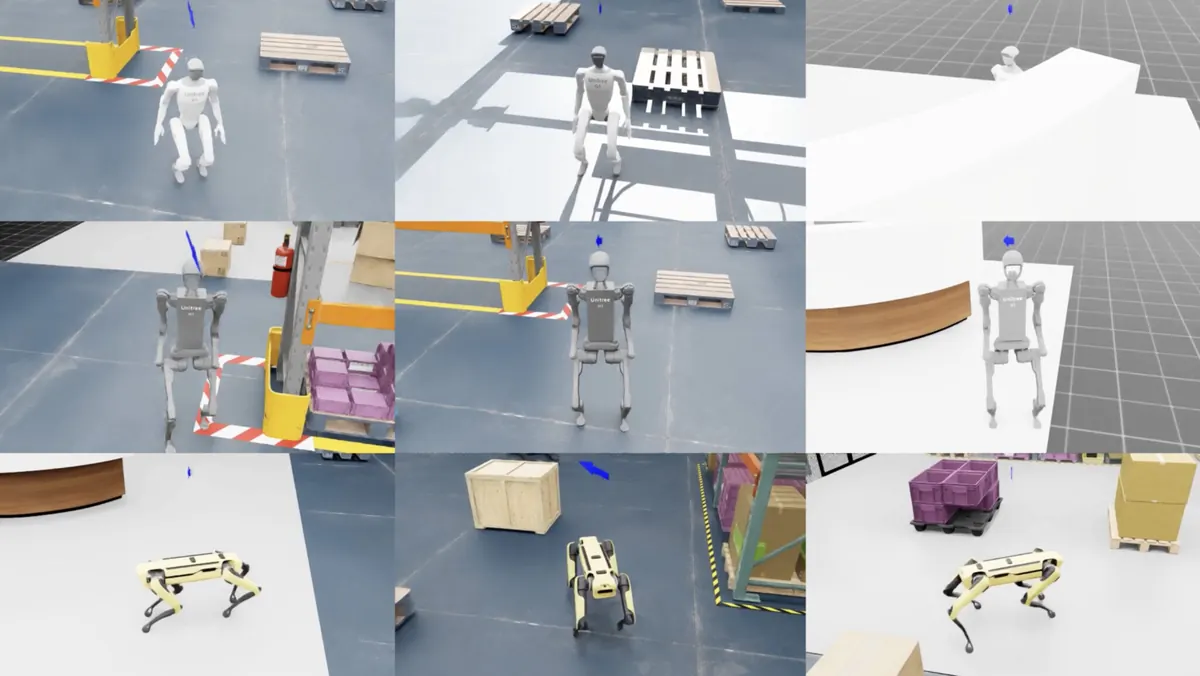
NVIDIA shows how robots begin to cross the bridge between simulation and the real world
A robot that only learns in the real laboratory is expensive, slow and dangerous. Each mistake can break a part, drop an object or put someone at risk. Therefore, the question that drives much of modern robotics is simple: how much learning can happen first in simulation, before the robot touches the physical world?
This was the axis of the summary published by NVIDIA Research on May 28, 2026, during ICRA. The company highlighted work that attempts to reduce the distance between simulated environments and real robots, a challenge known as sim-to-real. The promise is not magic. Simulations also simplify friction, lighting, deformation, sensors and accidents. But, when used well, they allow us to train thousands of scenarios before taking a control policy to the hardware.
What happened
According to NVIDIA, its researchers had 28 works accepted at ICRA, with eight studies focused especially on simulation, manipulation, assembly, planning and transfer to the real world. Examples cited include ScheduleStream, for parallel planning of multiple robotic arms; COMPASS, for policies that generalize across different bodies; Grasp-MPC, for adaptive grasping; and SPARR, aimed at precise assembly with corrections on the real robot.
The common point between these works is to treat robotics as a problem of perception, decision and physics. It is not enough to recognize an object. The system needs to understand how to act on it, how to correct errors and how to survive small differences between the simulator and reality.
The science behind
Yes-to-real exists because physical data is expensive. Training a robot to pick up objects, assemble parts, or navigate a space takes many tries. In simulation, it is possible to vary mass, texture, position, lighting, sensor noise and execution errors. This variation helps the model not just memorize a perfect scenario.
Even so, the simulator is never the world. The actual friction changes. One piece bends. A sensor fails. An object appears at an unexpected angle. Therefore, the most important scientific part is robustness: policies that can adapt movement, correct plans and accept uncertainty. When a method works on real hardware after simulated training, it shows that it has learned something more general than a pretty scene on the computer.
Why this matters
Robotics is entering a phase similar to that of large AI models: scale of data, simulation and infrastructure begin to define who can advance. For manufacturing, logistics, agriculture, healthcare and maintenance, the difference between a demonstration and a useful system is reliability. A factory robot cannot work only when the lighting is perfect or when the object appears exactly where it was trained.
If these techniques mature, companies will be able to test new tasks in digital environments before shutting down real lines. This reduces cost, speeds up experimentation and improves security. It also creates a new technical profession: teams capable of designing good simulated worlds, validating policies and measuring when the model is ready to leave the laboratory.
The future it anticipates
The future of robotics is unlikely to be a sudden leap to universal humanoids. It will be a sequence of more specific capabilities becoming reliable: pick up, assemble, inspect, open, fit, transport and correct. The simulation will be the training ground, but the real world will remain the judge.
The question that remains is decisive: when robots can learn thousands of mistakes before making a single one in the physical world, which tasks will no longer seem too difficult to automate?
What to watch out for
The next test for this line of research will be less visual and more statistical. It's not enough to show a working robot once. It will be necessary to measure how many times he repeats the task, in how many environments, with how many variations and at what cost of human correction. Useful robotics is born when the system stops depending on a perfect configuration.
It is also worth following how simulation and generative models will meet. If synthetic environments can create objects, glitches and rare situations more realistically, robots will have a richer training ground. But this raises the burden of validation: a convincing simulation can still teach shortcuts that don't survive in the physical world.
For companies, the practical question is when the investment starts to make sense. The promise is not to replace all workers with robots, but to automate dangerous, repetitive or difficult-to-scale tasks. The real frontier will be measured in availability, maintainability and security, not just stunning videos.
Sources
- https://blogs.nvidia.com/blog/icra-research-robotics-simulation-to-real-world/