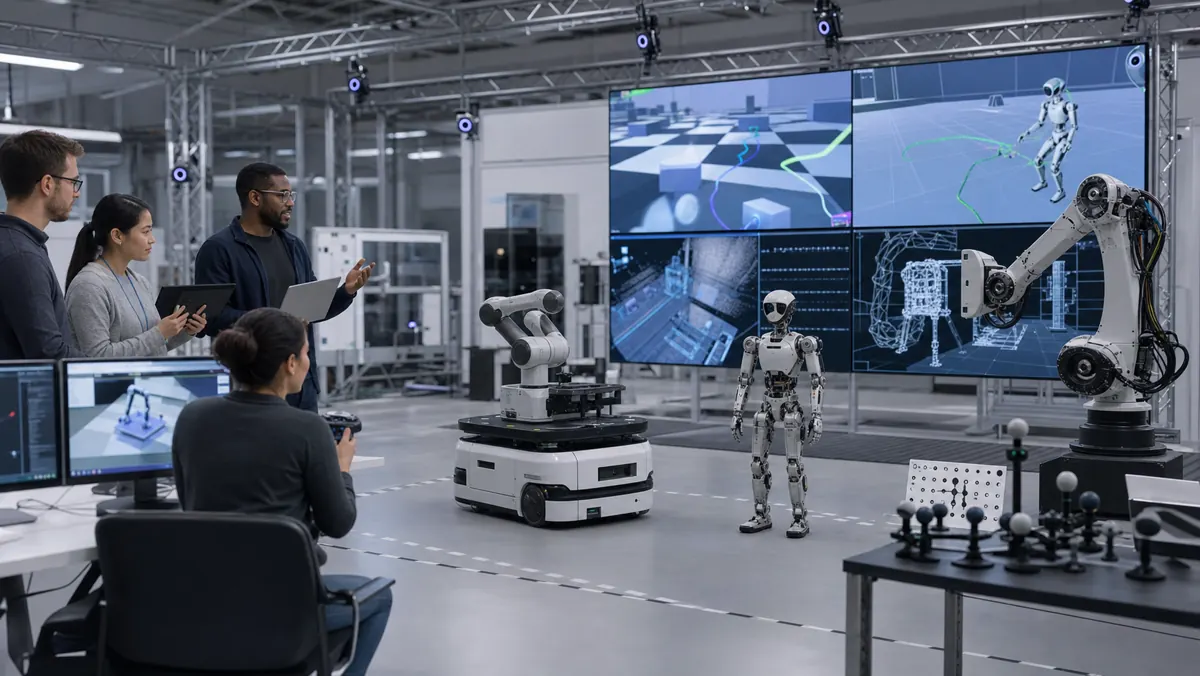
NVIDIA uses National Robotics Week to show that the robotics war has become a fight for data, simulation and world models
National Robotics Week became, for NVIDIA, an opportunity to combine research, benchmarking, startups and field cases into the same thesis: competitive robotics increasingly depends on world models, high-fidelity simulation and useful synthetic data.
The main reference for the article was published on April 9, 2026, in the official text National Robotics Week — Latest Physical AI Research, Breakthroughs and Resources. This helps to better separate what is a confirmed announcement from what is still a market projection.
What was announced
The summary highlights RoboLab as a benchmark for generalist robotic policies, applications of Cosmos Reason in palletizing, customizations of world models by teams such as the Toyota Research Institute, the mimic-video project, the new fellowship class with MassRobotics and the case of Maximo in utility-scale solar installation.
Why this matters now
The value of the package is in the maturity of the stack. Instead of selling magical robots, NVIDIA insists on a training and evaluation infrastructure that reduces dependence on expensive and slow real collection. This makes sense at a time when companies want to move away from proofs of concept and towards adaptable systems in less controlled environments.
In a market that has already left the curiosity phase and entered the budget, operations and governance phase, announcements like this are important because they change the way companies, technical teams and creators choose platforms, integrate tools and define acceptable risk.
What this can change in practice
- Makes robotics benchmarks more important to compare real progress between labs.
- Gives more value to synthetic data when it reduces the cost of training in physical tasks.
- Brings startups, universities and large manufacturers closer to the same validation infrastructure.
What to watch out for in the coming weeks
What defines the next phase is transfer to the real world. Benchmarks, simulation and synthetic data only become a competitive advantage when they translate into fewer failures, less reprogramming and more autonomy in the field. National Robotics Week shows that NVIDIA knows exactly where it wants to play this game.
The technique behind
Modern robotics relies on three layers that need to talk together well. The first is perception: cameras, sensors and models that understand the environment. The second is planning: deciding what action to take without violating security, physical or objective. The third is control: transforming a decision into precise movement. When either fails, the demonstration breaks.
NVIDIA tries to position itself precisely at the point where these layers join. GPUs, simulation, AI libraries and tools for robots form an ecosystem in which researchers can train in the virtual and bring some of the behavior to real machines. This doesn't eliminate mechanical engineering, but it reduces the cost of testing possibilities.
The future it anticipates
The robotics race will be less about a single universal robot and more about common infrastructure for many machines. Industrial arms, mobile robots, humanoids and drones can share models, simulations and validation pipelines. If this happens, robotics stops being an artisanal project and starts to look like a platform.
The question for the coming years is simple: when creating behavior for robots becomes more like developing software, which sectors will automate first?
The decisive signal
The detail that deserves attention is the change of narrative. Robotics used to be presented as a spectacle: a robot walking, picking up objects or opening doors. Now, the more mature conversation is about method. How to validate behavior? How to create enough data? How to reduce the distance between simulation and the real world? How do you prevent a lab-trained policy from failing when it encounters dust, sun, wind, or a misplaced part?
This change is good for the market because it reduces fantasy and increases engineering. The solar installation case cited by NVIDIA shows why this matters: outdoor environments are irregular, expensive and difficult to control. If world models and simulation can prepare robots for this type of scenario, automation can move beyond highly standardized factories and reach construction, energy, logistics and maintenance. The future of robotics will be interesting precisely when it becomes less cinematic and more reliable.
For those who create products, the lesson is clear: robotics does not advance just with prettier hardware. Progress when the entire stack learns to measure error, reuse experience, and transfer behavior between scenarios. This is the type of maturity that transforms research into market.
Sources
- https://blogs.nvidia.com/blog/national-robotics-week-2026/