NVIDIA brings AI-driven manufacturing to Hannover Messe and puts robotics and digital twins on the factory floor
At Hannover Messe 2026, NVIDIA used manufacturing as a showcase for a broader vision of physical AI. Instead of focusing just on chips or models, the company brought together sovereign cloud, simulation, computer vision, agents and robots as parts of the same industrial system.
The main reference for the article was published on April 20, 2026, in the official text NVIDIA and Partners Showcase the Future of AI-Driven Manufacturing at Hannover Messe 2026. This helps to better separate what is a confirmed announcement from what is still a market projection.
What was announced
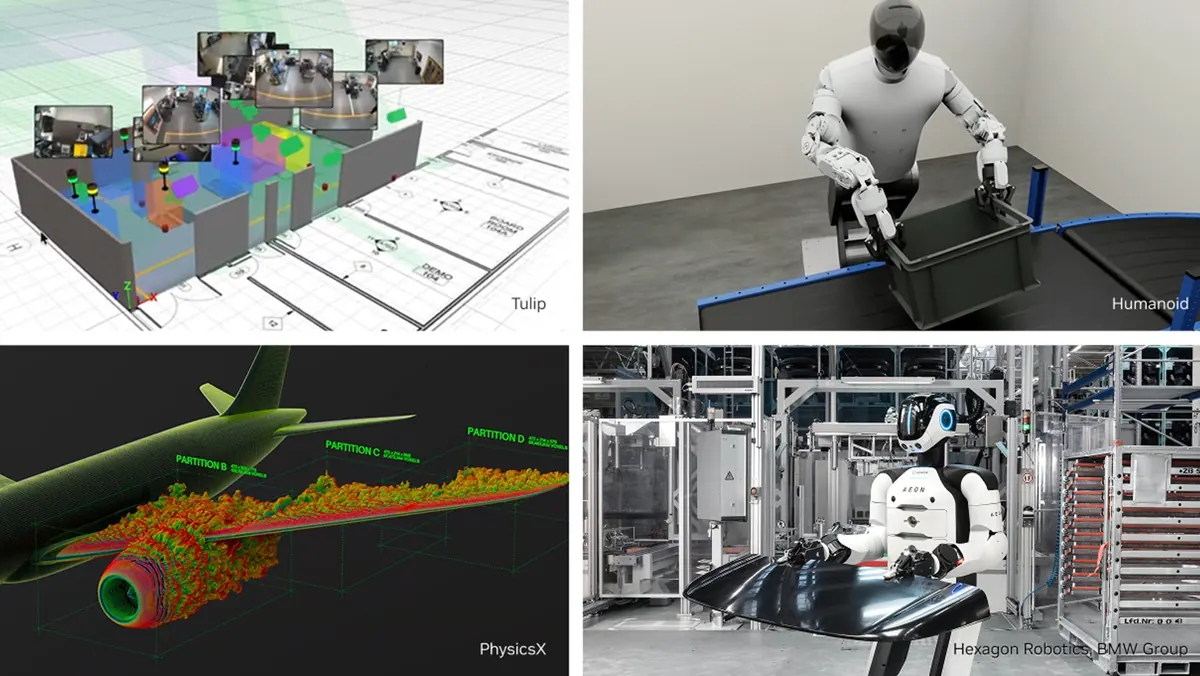
The post highlights the Industrial AI Cloud built in Germany, demonstrations with partners such as ABB, Microsoft and Siemens, digital twins with Omniverse, visual agents for quality and safety and humanoid and industrial robots operating in production scenarios. The narrative is that of a factory where AI is no longer a separate analytical layer, but part of the design, operation and automation.
Why this matters now
This type of integration is interesting because the industry has very specific needs: reliability, prior simulation, functional safety, spatial context and measurable return. By connecting physical AI with digital twins and familiar industrial platforms, NVIDIA attempts to shorten the transition between laboratory and deployment.
In a market that has already left the curiosity phase and entered the budget, operations and governance phase, announcements like this are important because they change the way companies, technical teams and creators choose platforms, integrate tools and define acceptable risk.
What this can change in practice
- Brings engineering, security and operations teams together around the same digital twin.
- Allows you to test layout changes, robots and visual inspection before moving the real line.
- Pressures industrial suppliers to integrate AI, simulation and automation into more complete packages.
What to watch out for in the coming weeks
It's worth monitoring how much of this becomes an actual rollout. Industrial demonstration is always impressive, but the difference is in maintenance, interoperability and economics. If the cases presented advance to continuous production, the argument for physical AI gains market density.
The technique behind
The centerpiece of this vision is the digital twin. Before moving to a real line, the factory can simulate layout, parts flow, robot behavior, safety zones and bottlenecks. This reduces risk because the team tests hypotheses in the virtual environment before stopping production. When the simulation connects to real sensors and data, it stops being just a model and becomes an operational tool.
Visual AI also weighs in. In manufacturing, models need to detect defects, track movement, understand spatial context and trigger alerts without producing too many false positives. A mistake on a social network is annoying; An error in the factory can interrupt production. Therefore, integration with known industrial platforms is as important as the model itself.
The future it anticipates
The future of the smart factory probably won't be a humanoid robot doing everything. It will be a layer of distributed intelligence: cameras, sensors, simulations, robotic arms, human operators and planning systems working in the same cycle. The decisive question is who can transform beautiful demonstrations into repeatable, safe and economically justifiable operations.
How to read the signal
The most provocative point of the NVIDIA showcase is that manufacturing begins to approach a software-like logic. Previously, changing a line meant long design, purchase, shutdown and validation cycles. With rich simulation and visual AI, part of this process can become a continuous experiment: testing, measuring, correcting and only then changing the real factory. This doesn't take the burden off the shop floor, but it changes where the risk is absorbed.
For executives, the signal is financial: less waste, less downtime and greater predictability. For technical workers, it's a role change: operating machines now includes interpreting data, reviewing recommendations and collaborating with autonomous systems. And for those who follow technology, the question is even bigger: if the factory becomes a programmable environment, which future products will be designed with robots, sensors and digital twins in mind from the first prototype?
The next milestone will be when these systems are no longer presented as a special project and become part of the maintenance, quality and planning routine. At this point, the advantage will not only be in having AI in the factory, but in knowing how to learn from each production shift.
Sources
- https://blogs.nvidia.com/blog/ai-manufacturing-hannover-messe/