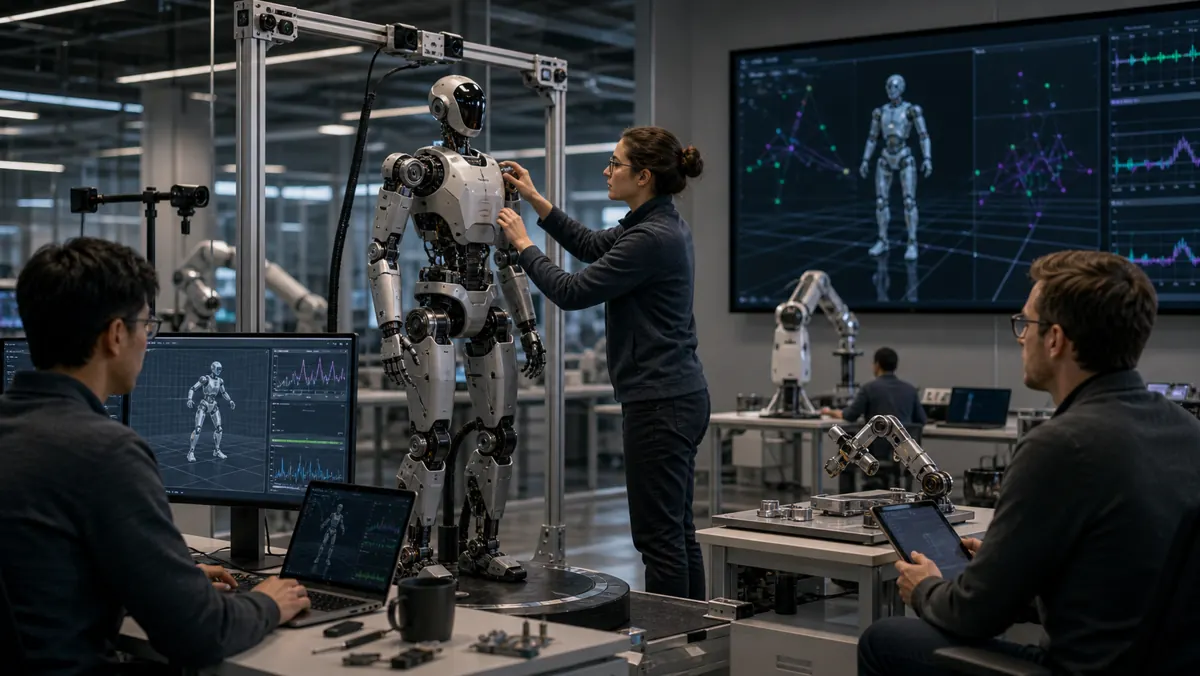
NVIDIA Isaac GR00T N1.5: humanoid robots enter the open model phase
Artificial intelligence spent years stuck to the screen. Text, image, code and video dominated the conversation. The advancement of NVIDIA Isaac GR00T N1.5 and open benchmarks for humanoid robots points to the next frontier: embodied AI, capable of perceiving, planning and acting in the physical world.
Humanoid robots have always seemed like a distant promise. What changed was not just the hardware. It was the foundation models, the simulators, the synthetic data and the training tools. NVIDIA wants to occupy exactly this space: the infrastructure that connects simulation, learning and real robots.
Why GR00T matters
GR00T is a family of models and tools aimed at generalist robots. The idea is to allow machines to learn skills from data, simulation and demonstrations, transferring behavior to different robotic bodies.
N1.5 reinforces the importance of foundation models for robotics. Instead of programming each movement manually, researchers and companies train systems capable of generalizing tasks. This may include manipulating objects, following instructions, adapting posture and operating in changing environments.
Open does not mean simple
The word “open” draws attention, but robotics remains difficult. An open model does not resolve actuators, sensors, security, battery, cost, maintenance and liability. The physical world punishes error more harshly than software. A bug in text generates a bad response. A bug in a robot can break an object, hurt someone or stop a production line.
Therefore, opening up in robotics needs to be accompanied by simulation, testing, limits and rigorous validation. The value is in enabling more labs and companies to experiment, compare and advance without starting from scratch.
Simulation to reality
The bridge between simulation and the real world is the heart of the problem. Training robots in the physical world is expensive and slow. Simulation allows you to multiply scenarios, generate data and test failures. But reality has friction, noise, lighting, deformable objects and unpredictable people.
Tools like Isaac help precisely in this cycle: simulate, train, validate and transfer. The better this bridge, the faster robotics advances.
Where humanoids make sense
Humanoids are attractive because the world was built for human bodies: doors, stairs, tools, shelves, benches. A human-shaped robot can theoretically operate in existing environments without rebuilding everything.
But that doesn't mean that humanoids will always be the best solution. In factories, specialized robots can be cheaper and safer. Humanoids make more sense in varied tasks, human environments and operations where flexibility is worth more than maximum efficiency.
The impact on work
If generalist robots mature, automation moves out of software and into warehouses, hospitals, homes, agriculture and light industry. This raises profound social questions: which tasks will be automated, who supervises, how to ensure security and how to redistribute gains?
The discussion should not remain in the fantasy of total replacement. The first impact will likely be tiring, dangerous or repetitive tasks. Even so, the transition needs to be planned.
The final reading
GR00T N1.5 shows that AI is taking shape. The next decade may be defined by systems that not only respond, but hold, move, assemble and assist in the real world.
This makes AI more useful and more serious. When intelligence leaves the screen, governance stops being abstract. The future of robots will depend on both models and prudence.
What companies should pay attention to
Before buying into the narrative of humanoids, companies need to map out real tasks. Does the robot solve a specific bottleneck? Is the environment safe? Is there supervision? Is the maintenance cost worth it? Is there a plan for failures? These questions are worth more than impressive videos.
It will also be important to keep up with open standards. The more interoperable models, simulators and robotic bodies are, the lower the risk of total dependence on one supplier. Openness can accelerate innovation, but it will only create a healthy market if it is accompanied by certification and good practices.
The ultimate curiosity
Humanoid robots stir the imagination because they seem close to us. But their success will depend on something much less dramatic: picking up objects safely, navigating without getting in people's way, and performing useful tasks every day. The future will be built on small, repeatable and safe movements.
Sources
- https://nvidianews.nvidia.com/news/nvidia-isaac-gr00t-n1-5-open-humanoid-robot-foundation-model
- https://developer.nvidia.com/isaac/gr00t
- https://developer.nvidia.com/isaac