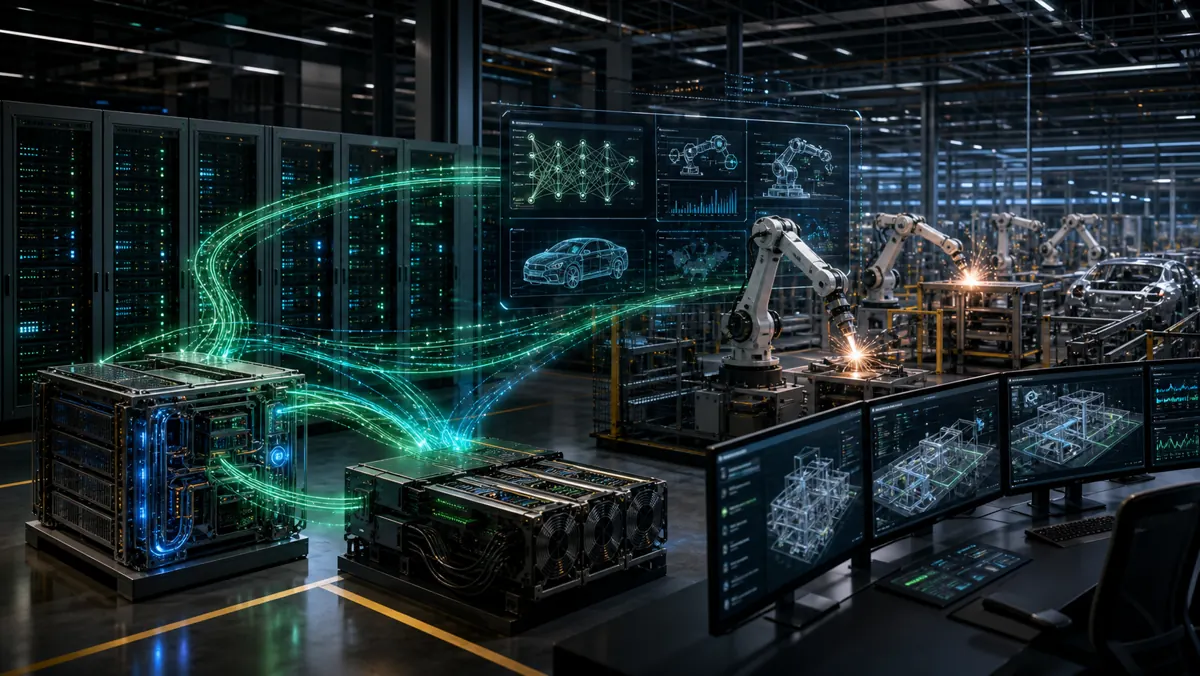
NVIDIA DSX wants to transform data centers into AI factories with cost per token at the center
Powerful chips are no longer enough. The bottleneck in the next phase of artificial intelligence is less about having an impressive accelerator and more about knowing how to transform electricity, cooling, networking, software and operations into useful tokens with predictability. It is exactly this shift in focus that NVIDIA is trying to capture with DSX, announced on May 31, 2026 during GTC Taipei.
The announcement appears, at first glance, to be just another layer of branding on top of the company's ecosystem. But the ambition is greater. DSX was born as a kind of operational manual for AI factories: an integrated set of accelerated platforms, modular software, APIs, reference designs and infrastructure partners for providers and large companies to build training and inference environments with lower cost per token and shorter time to production.
What happened
According to NVIDIA, DSX brings together, in a common architecture, components that previously used to be purchased, integrated and adjusted in separate steps. The platform combines the company's accelerated hardware, open and modular libraries, operational software, data center designs and partner technologies. The central pitch is that the company doesn't just want to sell silicon: it wants to standardize the way the entire AI factory is designed and operated.
Two points in the ad deserve special attention. The first is DSX MaxLPS, described as a software layer aimed at maximizing token performance per megawatt. The second is DSX OS, an open source and modular suite for lifecycle management, runtime consistency, platform health automation, resiliency, and multi-tenant operation. In other words, NVIDIA is trying to position itself not just as an engine supplier, but as an architect of the entire industrial system.
The science and technique behind
Talking about cost per token is recognizing a physical and economic reality. Generative models are, at heart, matrix multiplication machines. This means that actual performance depends on a technical chain: memory bandwidth, interconnection between nodes, accelerator occupancy, network latency, cooling capacity and operational stability. A shiny cluster on paper can produce terrible economic numbers if it becomes underutilized or if the software wastes energy on communication bottlenecks.
This is where the “AI factory” narrative makes sense. The industrial metaphor shifts the focus from peak performance to system performance. What matters is not just how many FLOPS a chip delivers, but how many useful tokens the entire set can generate per unit of energy and per square meter of infrastructure. DSX tries to encapsulate this reasoning by aligning computing, facilities and software under the same co-engineering logic.
The emphasis on modular software also matters. In large environments, maintaining consistency between versions of drivers, runtimes, libraries, monitoring, and allocation policies is often as critical as purchasing the hardware. Without this, scalability becomes fragility: a small configuration deviation can degrade throughput, availability and operational costs.
Why this matters in practice
For hyperscalers and cloud builders, DSX can reduce integration cost and accelerate timelines. Instead of assembling each layer almost from scratch, the promise is to start with a reference project already tuned for large-scale agentic workloads, training and inference. For companies that intend to build their own infrastructure, this can shorten the path between purchasing capacity and actual product generation.
There is also a political and market effect. By offering a complete “playbook”, NVIDIA expands your power over the design of the data centers of the future. The more the AI architecture is defined by its technical references, the more difficult it becomes for operators to replace parts of the stack without paying adaptation costs. Lock-in is no longer just a chip lock-in, but also an operation lock-in.
The future it anticipates
If NVIDIA's thesis is correct, the next AI winners will not just be the owners of the best models, but the owners of the most efficient factories. This pushes the sector towards a logic similar to that of energy and advanced manufacturing: whoever optimizes throughput, availability and consumption at a systemic level gains a structural advantage.
It is plausible to infer that DSX is a response to market maturation. After the race for GPUs comes the race for operational architecture. Video models, persistent agents, and long multimodal loads require more than raw capacity. They require environments that function as digital production lines, with observability, fault tolerance and economic predictability.
What to watch out for
The real test of DSX will be adoption outside of NVIDIA's inner circle. Partners like Dell, HPE, Lenovo and Supermicro can help legitimize the ecosystem, but the more important question is another: Will operators gain real measurable efficiency or just a new layer of vendor lock-in?
It is also worth following the practical opening of DSX OS. The open source discourse is relevant, but the market will observe how much of this openness allows real flexibility and how much remains strongly oriented towards the NVIDIA stack itself. Another critical point will be energy. Maximizing tokens per megawatt is an elegant formulation, but the physical world continues to impose limits on electrical supply, refrigeration and construction time.
Ultimately, DSX suggests that AI has entered a new phase. The problem is no longer just “how to train a powerful model?” and became “how to operate intelligence as continuous infrastructure?”. That's a much harder question, and perhaps a much more profitable one.
Sources
- https://nvidianews.nvidia.com/news/nvidia-dsx-gives-infrastructure-builders-the-playbook-for-ai-factories
- https://nvidianews.nvidia.com/news/dsx-infrastructure-ai-factory