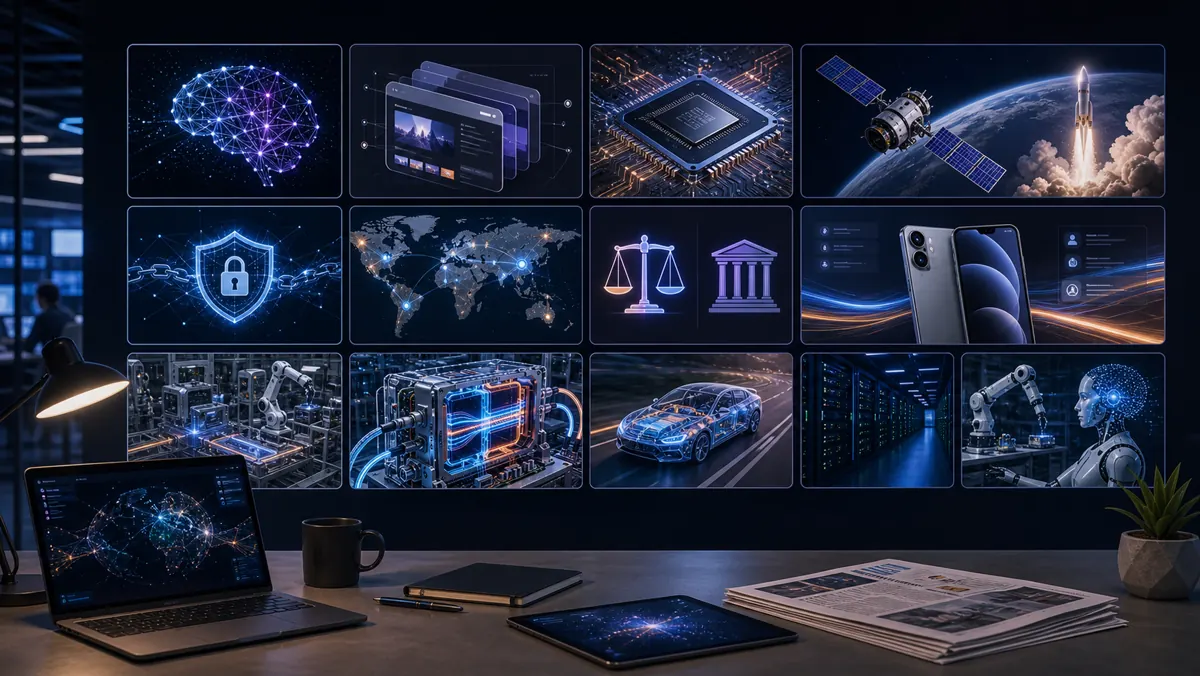
Updated AI Bulletin: What has changed from March to June 2026
March 2026 already seemed accelerated. June showed that that month was just the beginning of a more serious phase: AI stopped being a sequence of flashy launches and started to be organized into three practical axes. More capable models, agents that perform tasks and regulation that tries to monitor the impact.
This bulletin updates the March reading with what has already been consolidated by June 1, 2026.
Models: less charm, more work
The advancement of models has not stopped, but the conversation has changed. Anthropic, Google and OpenAI are talking less and less about "chat" and more and more about action. Claude Opus 4.8 arrived with a focus on agentive tasks, dynamic workflows, effort control and better judgment. Google introduced Gemini 3.5 Flash at I/O 2026 as a model aimed at long workflows, development and agents. OpenAI has positioned its business strategy around agents governed by a layer called Frontier.
The signal is clear: the next fight is not just about answering questions better. It's being able to execute processes with tools, context and supervision.
Video by AI: the Sora case became an alert
Sora 2 has shown that generative video can simulate motion and sound in increasingly convincing ways. But the official OpenAI page also started to report that the Sora product has not been available since April 26, 2026. This makes the case more interesting, not less.
AI video is expensive, sensitive and socially powerful. A false text deceives; a fake video can convince. Therefore, any synthetic media platform needs to treat consent, tagging, moderation, copyright and image use as a core part of the product.
Regulation: Europe has become a mandatory reference
The European AI Act remains one of the most important pieces of regulation on the planet. The European Commission highlights a risk-based approach, with prohibitions, obligations for high-risk systems, transparency and governance rules for general-purpose models.
For technology companies, this changes planning. Launching AI now requires thinking about documentation, logs, explainability, training data, synthetic content markup, and human oversight. The market may complain about bureaucracy, but the alternative is worse: autonomous systems without clear responsibility.
Hardware: infrastructure returned to the center
All this intelligence needs to run somewhere. GPUs, data centers, power, memory and networking are back at the center of the strategy. The NVIDIA features the RTX 5090 with 32GB of GDDR7 and a strong focus on AI loads; the RTX 4090 is still a reference with 24 GB; and AMD boards with lots of VRAM continue to attract technical users who are willing to deal with the ROCm ecosystem.
To the average user, this appears as notebooks and desktops with local AI. In the corporate sector, it appears as a dispute over data centers and inference costs. The AI of 2026 is software, but it is also electricity, silicon, and refrigeration.
What to watch out for in the second semester
Three questions should guide the coming months. First: will agents really be productive or just another layer of fragile automation? Second: will AI video find a responsible distribution model? Third: Will rules from the AI Act and other regulators increase trust or push innovation into more permissive markets?
It is also worth noting cultural change. Professionals are not just “using AI”; they are learning to coordinate systems. This requires new skills: formulating objectives, reviewing outputs, creating limits, understanding risk and deciding when automation should stop.
The final reading
Technology in 2026 has become more powerful and less innocent. The era of demonstrations still exists, but it is no longer enough. The market wants systems that work. Regulators want traceability. Users want utility without losing control.
The near future will be defined by this tension: AI increasingly autonomous, humans increasingly responsible for the consequences. The curiosity is not whether the models will improve. They will. The curiosity is whether we will learn to build institutions, products and habits capable of living with them.
Sources
- https://www.anthropic.com/news/claude-opus-4-8
- https://blog.google/innovation-and-ai/technology/ai/google-io-2026-all-our-announcements/
- https://openai.com/index/sora-2/
- https://digital-strategy.ec.europa.eu/en/policies/regulatory-framework-ai
- https://www.nvidia.com/en-us/geforce/graphics-cards/50-series/rtx-5090/