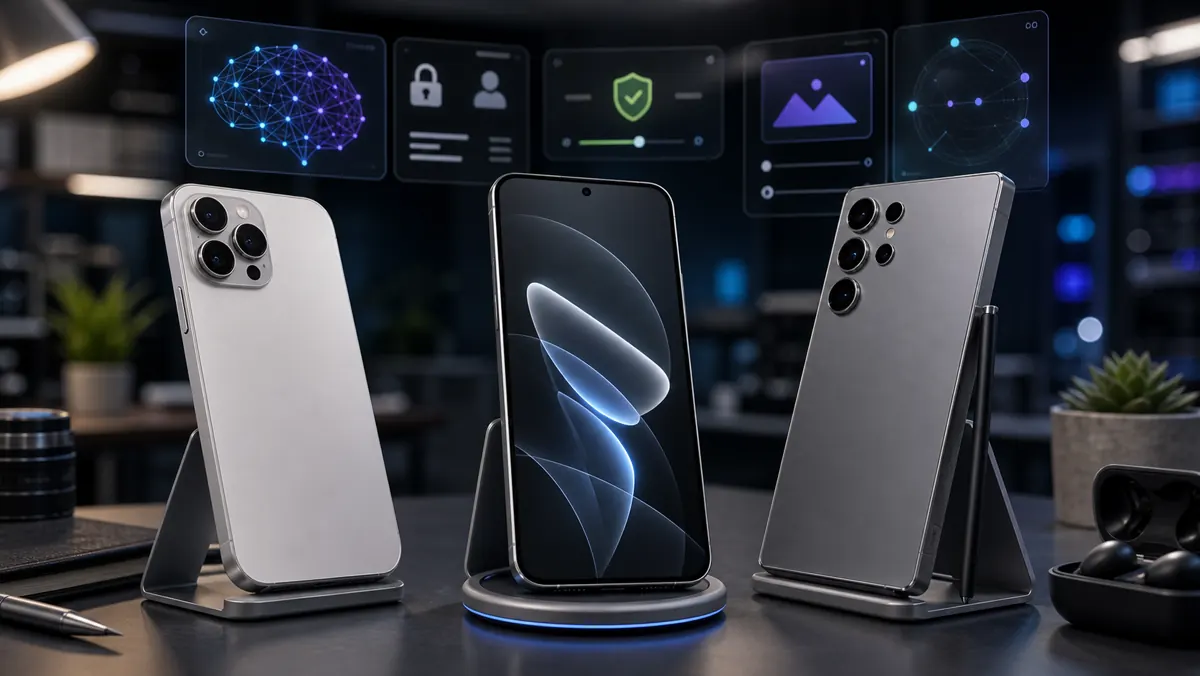
iPhone 17, Android 16 and Galaxy S25: the mobile dispute has become a race for useful AI
The mobile race in 2026 is less about megapixels and more about everyday intelligence. iPhone 17, Android 16 and the Galaxy S25 generation represent three paths to the same question: how to turn AI into something useful on the phone, without becoming just a bag of tricks?
Apple bets on vertical integration, privacy and Apple Intelligence. Google uses Android, Gemini and proprietary services to spread AI across search, voice, camera and productivity. Samsung combines strong hardware, Galaxy AI and partnership with the Android ecosystem. The result is a multi-layered competition.
What changed on Android
Android 16 has accelerated privacy, productivity, and AI integration features. Google also uses Gemini as a cross-layer, connecting assistant, search, camera and apps. This gives Android a distribution advantage: many manufacturers can bring smart features to different price points.
The risk is fragmentation. Not every device will have the same chip, memory, NPU or update policy. The AI experience on Android will largely depend on the manufacturer and price.
Apple's way
On the iPhone, Apple tends to prioritize control. The strong point is knowing exactly which models receive which features, with integration into the hardware and ecosystem. The Private Cloud Compute promise also attempts to address the privacy concern.
The challenge is speed. The market expects Apple to deliver AI capabilities that are as fast and visible as competitors. If it takes time, Android and Samsung may occupy the perception of innovation.
Samsung and the Galaxy AI effect
The Galaxy S25 cemented the idea that AI should be at the heart of the premium phone: image editing, visual search, translation, summarization, assistant and productivity features. Samsung's advantage is combining screens, cameras, chips and global scale.
But the consumer will judge by everyday life. Mobile AI needs to really save time: finding information, organizing content, improving photos without exaggeration, translating conversations and helping with accessibility.
The future it anticipates
The smartphone will be the main personal AI laboratory. It knows location, contacts, photos, voice, camera and habits. This can create powerful assistants, but it also requires clear boundaries. Whoever will win the race will not just be whoever has the strongest model, but whoever convinces the user that their phone understands without spying.
In 2026, buying a cell phone will mean choosing an AI philosophy. Privacy, update, integration, price and quality of features will be as important as camera and screen.
Practical impact
For consumers, the new dispute requires another type of comparison. It's not enough to ask which camera has more resolution. It is necessary to ask which AI edits without destroying naturalness, which assistant understands context without exposing data, which system receives updates for the longest time and which device maintains battery power even with intelligent features activated.
For developers, mobile AI opens up a huge surface. Applications can use local models for search, sorting, accessibility, and automation. But they will have to deal with hardware fragmentation, permissions and inference cost. The app that works perfectly on a premium device may be limited on an intermediate one.
The question for the future
The smartphone can become the main personal agent because it is always with us. It sees, listens, locates, authenticates and communicates. This intimacy requires greater trust than any other device. The company that treats mobile AI as a marketing gimmick will lose space to those who deliver discreet utility and clear protection.
What to watch now
The most real indicator will be recurring use. AI features that delight at launch and disappear from habit do not change the market. Translation, visual search, summarization, and editing only matter if the user returns to them weekly.
Closing
The mobile future will be less about operating system as tribal identity and more about trust in personal assistants. Apple, Google and Samsung have models, data and distribution. The difference will be in making all of this seem natural, safe and simple. The user does not want to know whether the task runs on the device or in the cloud. He wants a good, quick, private result without surprises. This will be the new ruler of smartphones.
It will also be important to observe subscription policies. Some AI resources can become paid services. If that happens, the comparison between devices will need to include not just initial price, but ongoing cost to maintain the truly smart functions.
Sources
- https://developer.android.com/about/versions/16
- https://www.samsung.com/global/galaxy/galaxy-s25-ultra/
- https://www.apple.com/apple-intelligence/