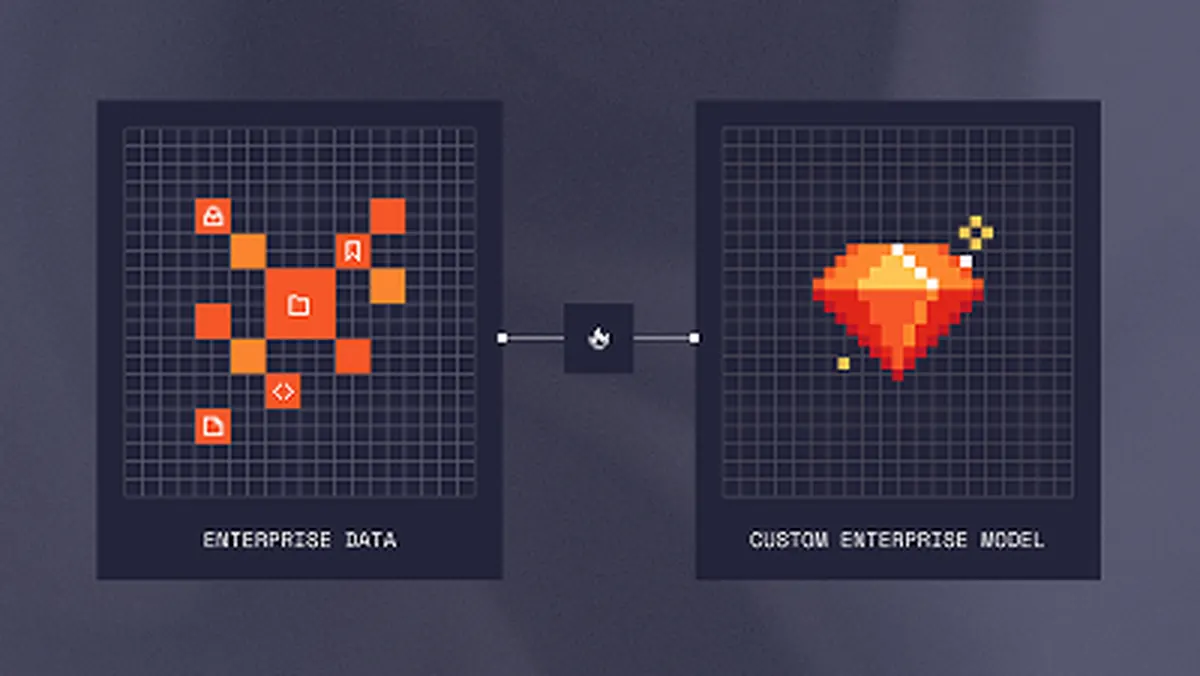
Mistral Forge wants to transform internal knowledge into its own company model
While many companies still try to adapt generic models with prompts and RAG, Mistral is pushing a more ambitious argument with Forge: in high-value environments, perhaps the way forward is to train models that truly internalize institutional knowledge.
The main reference for the matter was published in April 2026, in the official text Introducing Forge. This helps to better separate what is a confirmed announcement from what is still a market projection.
What was announced
Forge was introduced as a system for building frontier-level models supported by proprietary documentation, code, structured data, and internal policies. The proposal covers pre-training, post-training, reinforcement, evaluation, versioning and support for dense and MoE architectures. A symbolic detail of the positioning is the agent-first mode: Mistral claims that even agents can customize models using natural language.
Why this matters now
This matters because many corporate agents fail less because of a lack of general reasoning and more because of a lack of knowledge of the internal terrain. A model trained with terminology, processes, constraints and organization history tends to improve tool choice, consistency in multi-step flows and adherence to operational policies.
In a market that has already left the curiosity phase and entered the budget, operations and governance phase, announcements like this are important because they change the way companies, technical teams and creators choose platforms, integrate tools and define acceptable risk.
What this can change in practice
- Gives companies an alternative between simple prompt engineering and complete training from scratch.
- Places assessment, versioning, and post-training at the center of the enterprise AI conversation.
- Increases the importance of well-organized, secure, and useful internal data for models.
What to watch out for in the coming weeks
The challenge is cost, maturity and governance. Building your own model only makes sense when the company can prove that the gains in quality, autonomy and reliability outweigh the simplicity of using a ready-made frontier model. Forge tries to be the bridge between these two realities.
The technique behind
Customized business models live between two extremes. On one hand, general models are quick to use, but may not understand specific internal vocabulary, policies, and data. On the other hand, training everything from scratch is expensive and slow. Customization tries to occupy the middle: adapting behavior, knowledge and response format without losing efficiency.
To do this, the platform needs to deal with sensitive data, evaluation, versioning and deployment. A "company" model cannot just be a tweaked statement; it needs to have a life cycle, clear owners and quality metrics.
The future it anticipates
The market is moving towards more specialized models. Companies will want assistants who understand their products, contracts, processes and rules. This can increase accuracy, but it also creates dependence on well-maintained data pipelines.
The question is whether the Mistral Forge will be able to make customization a repeatable product. If it succeeds, corporate AI becomes less generic and closer to the real knowledge that differentiates each organization.
What separates promise from product
Customizing a model seems attractive, but the value only appears when the company knows what it wants to improve. A service may need responses that are more faithful to contracts. A legal team may need accurate internal citations. An industrial area may want agents who understand machine codes, procedures, and exceptions. Without a clear metric, the customized model becomes just a more expensive version of a generic tool.
Forge will be interesting if it helps companies close this loop: choose data, train with purpose, evaluate against real tasks and deploy with control. You will also need to deal with a delicate question: who updates knowledge when the organization changes? Processes, products and rules age. An enterprise model needs maintenance, auditing and discarding bad versions. The future that Mistral suggests is powerful, but it requires discipline. The most useful AI may be less universal and more like each company's living technical memory.
This path also changes the relationship between technology and strategy. Internal data is no longer just a file or history and becomes raw material for operational intelligence. Companies that took good care of their own knowledge will have an advantage; Those who have accumulated disorganized information will discover that training a model is, first and foremost, facing their own home.
Sources
- https://mistral.ai/news/forge