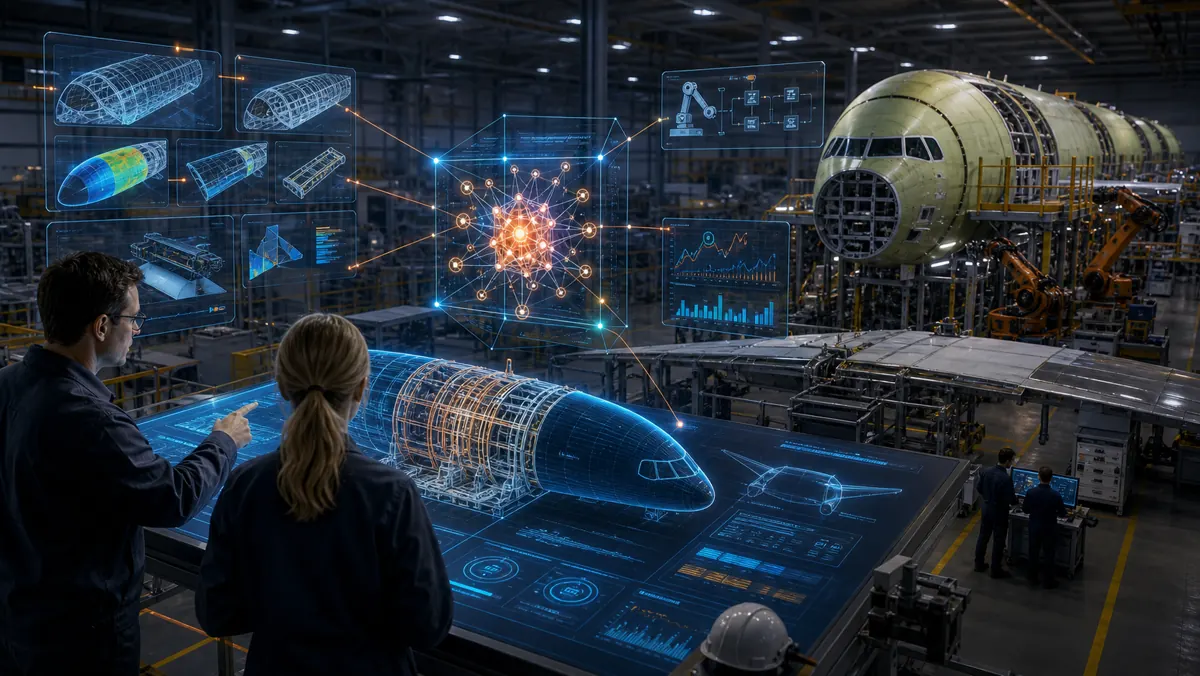
Mistral targets the factory: industrial AI starts to leave the chat
Much of the conversation around AI still revolves around chatbots, writing, and office productivity. But the next frontier may be less visible and much more demanding: industrial engineering. In this territory, making mistakes does not just mean generating bad text. It means compromising design, simulation, safety, deadlines and intellectual property.
On May 28, 2026, Mistral AI published an AI Now Summit summary highlighting Mistral for Industrial Engineering and the partnership with Airbus. The proposal is to bring models and agents to engineering flows where proprietary data, technical knowledge and physical validation need to go together.
What happened
Mistral describes Mistral for Industrial Engineering as an integrated stack to accelerate design, simulation and optimization in industrial environments. The partnership with Airbus was presented as a sign of adoption in highly demanding operations, including areas linked to commercial aircraft, helicopters, defense and space.
The central point is that AI does not just appear as a conversational assistant. It serves as a layer to explore design alternatives, organize specialized knowledge, connect simulation and support decisions in complex systems.
The technique behind
Industrial engineering requires more than language. A model needs to deal with physical constraints, standards, maintenance history, geometry, materials, costs, deadlines and safety. In sectors such as aerospace, there are also traceability requirements: a technical decision needs to be explainable and auditable.
Therefore, the idea of "stack" is important. General models can help, but they need to connect to simulation tools, internal databases, physical models and approval workflows. The useful agent is not the one who invents a solution, but the one who helps engineers explore possibilities without losing control.
Why this matters
If AI truly enters industrial engineering, the impact could be enormous. Complex projects involve thousands of small decisions. Reducing analysis time, finding bottlenecks and comparing alternatives can free up teams for more strategic tasks.
There is also a geopolitical reading. For Europe, models applied to industry combine technological sovereignty, competitiveness and data protection. Mistral and Airbus symbolize exactly this convergence: AI as a productive capability, not just a digital product.
The future it anticipates
Industrial AI will likely advance differently than consumer AI. Less spectacle, more validation. Less quick responses, more integration with systems that already exist. Value will not be measured by a pretty demo, but by fewer simulation cycles, less rework, and better documented decisions.
The risk is in relying too much on suggestions that seem technical but have not been verified. In engineering, the future of AI depends on a simple rule: agents can accelerate hypotheses, but validation continues to belong to the physical world.
What to watch out for
The first sign of maturity will be integration with existing tools. Engineers will not abandon CAD, PLM, simulation and documentation systems just because an agent talks well. AI needs to enter the current flow, respect permissions, and generate artifacts that can be reviewed.
The second point is confidentiality. Industrial projects carry sensitive intellectual property. An AI stack for engineering needs to operate with data governance, isolation, and traceability. Without this, the productivity gain may not be worth the risk.
It is also worth observing whether the approach reduces real bottlenecks. A good metric is not "how many ideas the AI generated", but how much time it saved in analysis, how many scenarios it helped compare, and how many decisions were better documented. In industry, creativity without verification is noise.
If Mistral and Airbus can show measurable results, the European AI debate will change tone. It stops being just digital sovereignty and becomes productive capacity. The question is whether specialized models will be able to transform accumulated industrial knowledge into operational advantage, without compromising security and control.
Another sign will be the participation of engineers in the cycle. Industrial AI should not function as an automatic order, but as a research bench: it proposes, compares, documents and awaits validation. This format preserves human responsibility and also reduces repetitive analysis work. If the tool manages to respect this balance, it can gain ground in sectors where trust weighs more than speed.
It is precisely in these sectors that AI will need to prove value without asking for blind faith.
Sources
- https://mistral.ai/news/ai-now-summit-2026