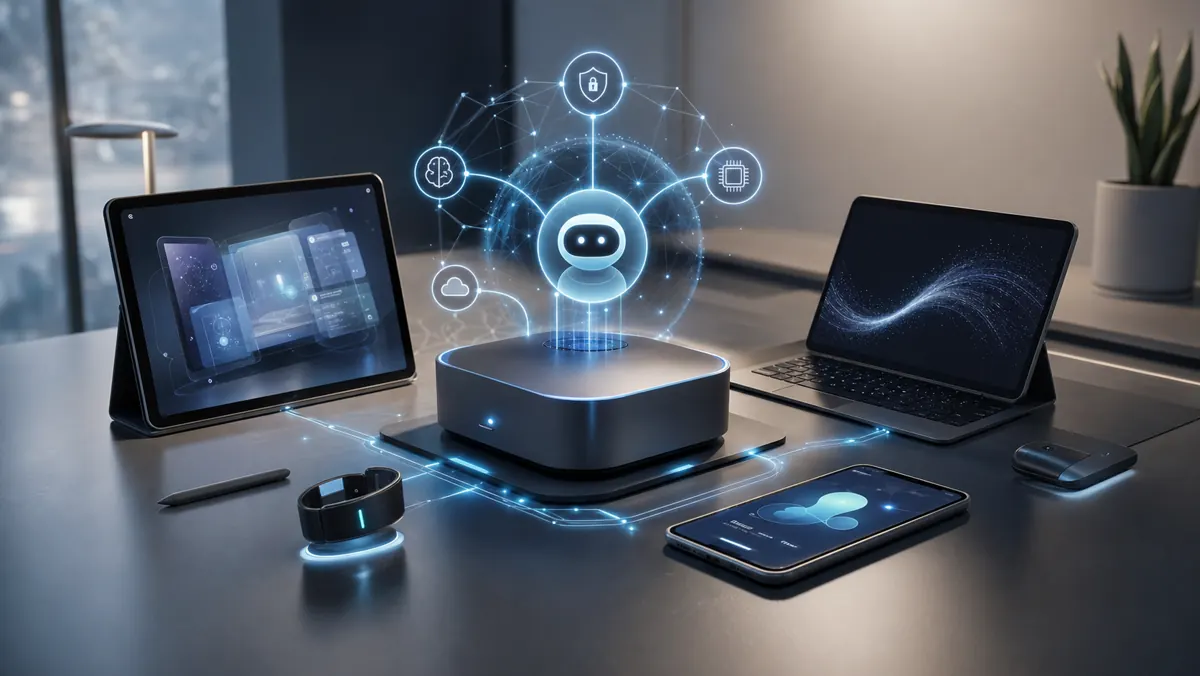
Project Solara suggests the next computer could be a device around agents
For years, the industry repeated that AI would come “inside” applications. Project Solara, shown by Microsoft in June 2026, points in another direction: agents operating "outside" the apps and reorganizing the format of the devices themselves. The announcement is still in its early stages, but it is one of those moves that are worth more for the proposed architecture than for the finished product. ## What happened At Command Line, Microsoft described Project Solara as a "chip-to-cloud" platform designed for agent-first experiences. The idea is to combine hardware, software and cloud so that agents become the main computing interface in new formats, not just on traditional PCs. The company presented two reference concepts for the corporate world and highlighted Qualcomm and MediaTek as the first silicon partners. The official text is explicit on one point: it's not just about putting intelligence on your PC or cell phone. The ambition is to create a layer in which the device becomes a window to distributed intelligence, with persistent state in the cloud, enterprise authentication, management by Intune and integration with agents such as WorkIQ. A symbolic example is the portable badge, designed for professionals who need quick, contextual and hands-free access to their agents. ## The technique behind The concept of "chip-to-cloud" usually sounds like a slogan, but here it points to a concrete architectural decision. Instead of assuming that all logic lives locally or that everything depends on the cloud, Microsoft proposes a liminal system: the interface and part of the contextual sensitivity are at the edge; durable state, orchestration and large-scale services are in the cloud. This matches the nature of agents, which need persistent context, authorization, memory, and the ability to act at very different times. The pillars presented by the company are clear: enterprise readiness, agent-centric interaction model and extensibility for multiple agents. On the device side, MDEP based on AOSP, Agent Shell capable of loading cloud-based agents, Intune, Entra ID and Hello for Business. In other words, Microsoft wants to prevent "AI device" from becoming synonymous with an experimental gadget without governance. There is a second important technical element: the recognition that there will not be a single dominant agent. This makes Solara feel less like a closed product and more like a layer of coordination. The company itself talks about agent dispatcher and task manager, which suggests a future in which different agents are activated depending on task, environment, data sensitivity and user profile. ## Why this matters If the thesis is right, the computing interface will change more in format than in screen. Instead of opening an application, navigating to a menu and then performing an action, the user now summons an intelligence that can choose tools, distribute work and return only the human decision point. This jump doesn't happen because models just got a little better; it depends on identity, policy, security, sensors, connectivity and viable energy consumption. This is why Solara is relevant. It shifts the debate from “which agent responds best?” to “which platform makes trustworthy agents in the physical world?” In companies, this detail is decisive. Without management, biometrics, audit trail and access control, an agent-first device becomes a walking risk. With these controls, it can become a new category of interface for healthcare, retail, hospitality, logistics and fieldwork. ## The future it anticipates The plausible future is not the end of the laptop. Just as PCs didn't kill mainframes and cell phones didn't eliminate PCs, the trend is toward specialization. Microsoft describes just that: computers shaped around context, task and environment. A smart badge for frontline professionals, a stationary device for operations, enterprise wearables and other formats not yet defined. The practical implication is strong. The more agents gain persistence and autonomy, the less sense it makes to force them to fit only into traditional windows. The interface can become episodic, appearing only when a decision, confirmation or human intervention really matters. It's a change in computational ergonomics as much as AI. ## What to watch out for The first risk is falling into the trap of conceptual demos. The history of technology is full of "future" devices that have not found sufficient cost, battery, utility, or acceptance. The second risk is privacy: a badge with a camera, microphones and agents that are always accessible needs transparent rules for the user and the people around them. It will also be necessary to maintain the balance between openness and control. Microsoft promises a multi-agent world, but the viability of that promise depends on interoperability standards, predictable policies, and incentives for third parties. If Solara becomes just another walled garden, it will lose part of the strength of its thesis itself. If you can coordinate diverse actors with real enterprise security, you could mark the beginning of a new computer category.
Sources
- https://commandline.microsoft.com/project-solara-build-2026/
- https://news.microsoft.com/build-2026/