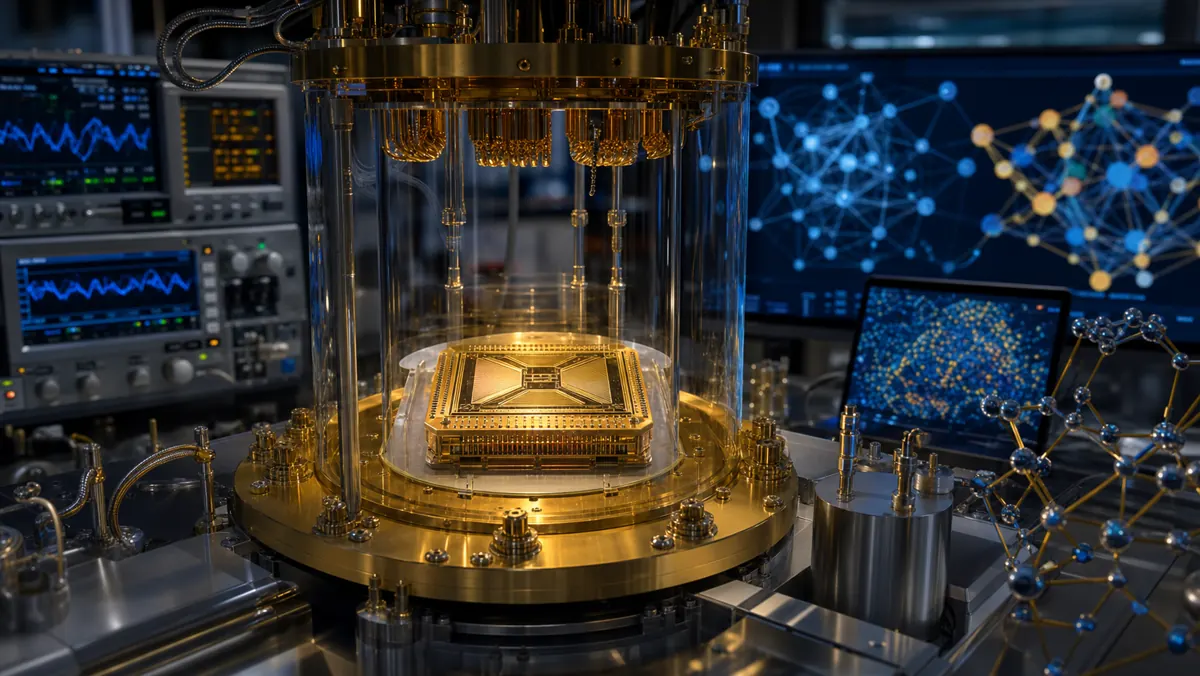
Majorana 2 shows how agentic AI is already entering the quantum lab
When the industry talks about AI for productivity, it almost always thinks of text, code or spreadsheets. Microsoft decided to move this conversation to a much more difficult terrain: the laboratory. On June 2, 2026, the company presented the Majorana 2 quantum chip and explained that much of the reliability gain came from the internal use of Microsoft Discovery, its agent platform for research and development. The important detail is not just the chip. It's the method. ## What happened According to Microsoft, Majorana 2 represents the next generation of its topological approach to quantum computing. The company claims to have achieved a thousand-fold improvement in reliability over the previous generation, with an average qubit lifetime of 20 seconds and cases reaching one minute. At the same time, the company made Microsoft Discovery generally available and previewed a local application of the platform for researchers. The central point of the announcement is that Microsoft's own scientists have already been using Discovery agents to organize workflows, automate measurements, optimize device manufacturing, and find previously unnoticed flaws. This changes the tone of the “AI for science” debate. Instead of an assistant that summarizes papers, the company is describing a system that participates in routine experimentation, screening results and generating hypotheses. The confirmed fact is this operational use within the Majorana program. The inference, which Microsoft itself suggests, is that this working model tends to spread to materials, chemistry, energy and advanced manufacturing. ## The technique behind Quantum computing suffers from a brutal engineering problem: qubits are fragile. They lose coherence with noise, temperature, material imperfections and microscopic interference. Therefore, any real advance depends as much on theoretical architecture as on industrial processes and repeated measurements at scale. This is where AI agents become concretely useful. If a system can consolidate literature, testing history, manufacturing parameters, and bench signals, it helps humans reduce the search space. In the case described by Microsoft, Discovery works as a coordination layer for specialized agents. They can reason about a large volume of knowledge, propose experiments, validate hypotheses and learn from the next cycle. This doesn't mean that AI "single-handedly discovered" Majorana 2; It would be an exaggeration to say that. What the sources allow us to say is that it became an instrument of acceleration in a highly iterative scientific process. In materials science, small decisions in composition, deposition, lithography and experimental reading can drastically alter the final behavior. An agent that finds patterns hidden in thousands of measurements does not replace the physicist, but it reduces the time until the next good question. ## Why this matters The ad is relevant because it dismantles two caricatures at the same time. The first is the idea that AI for science is still just marketing. The second is the opposite fantasy, that laboratories will become fully autonomous in the short term. What emerges here is a much more plausible and powerful middle ground: hybrid laboratories, where researchers use agentic systems to condense evidence, prioritize experimental routes, and deal with operational complexity. This has practical impact beyond quantum computing. Industries such as semiconductors, batteries, fertilizers, catalysts, biotechnology and new materials have similar bottlenecks: slow cycles, many parameters, imperfect data and high cost of error. If platforms like Discovery actually reduce the time between hypothesis and validation, the economic gain could be greater than the benchmark gain from a language model. The value lies in the compression of the scientific cycle. ## The future it anticipates The most plausible scenario is not "scientists replaced by agents" but smaller teams doing more ambitious exploration. Instead of spending weeks putting together repetitive analyses, researchers can devote more time to interpretation, experiment design, and critical review of what the system suggests. In the long term, this also favors the creation of a more standardized scientific infrastructure, with logs, traceability and explicit decision criteria. There is also a strategic implication. Microsoft now projects a scalable quantum computer for 2029, half the previous deadline. This does not guarantee on-time delivery. It's a corporate goal, not a fait accompli. But the combination of more stable qubits with research agents shows a pattern that should appear in other laboratories: the advancement of AI will not just be about generating answers, but about accelerating the very process that produces new knowledge. ## What to watch out for Open-ended questions are serious. How auditable is an agent-generated hypothesis? How do scientific teams protect themselves against local optimization biases when AI starts to favor paths that look historically promising but impoverish exploration? And how to validate causality, not just correlation, when models suggest changes in complex manufacturing processes? It's also worth noting Discovery's transition away from the Microsoft. Internally, the company controls data, security and objectives. In clients, the challenge is greater: dirty data, incomplete integrations, regulatory restrictions and a very heterogeneous research culture. If the platform works in this context, we will have a sign that agent-assisted science has left the corporate slide and entered the real world.
Sources
- https://news.microsoft.com/source/features/innovation/majorana-2-microsoft-discovery-agentic-ai/
- https://news.microsoft.com/build-2026/