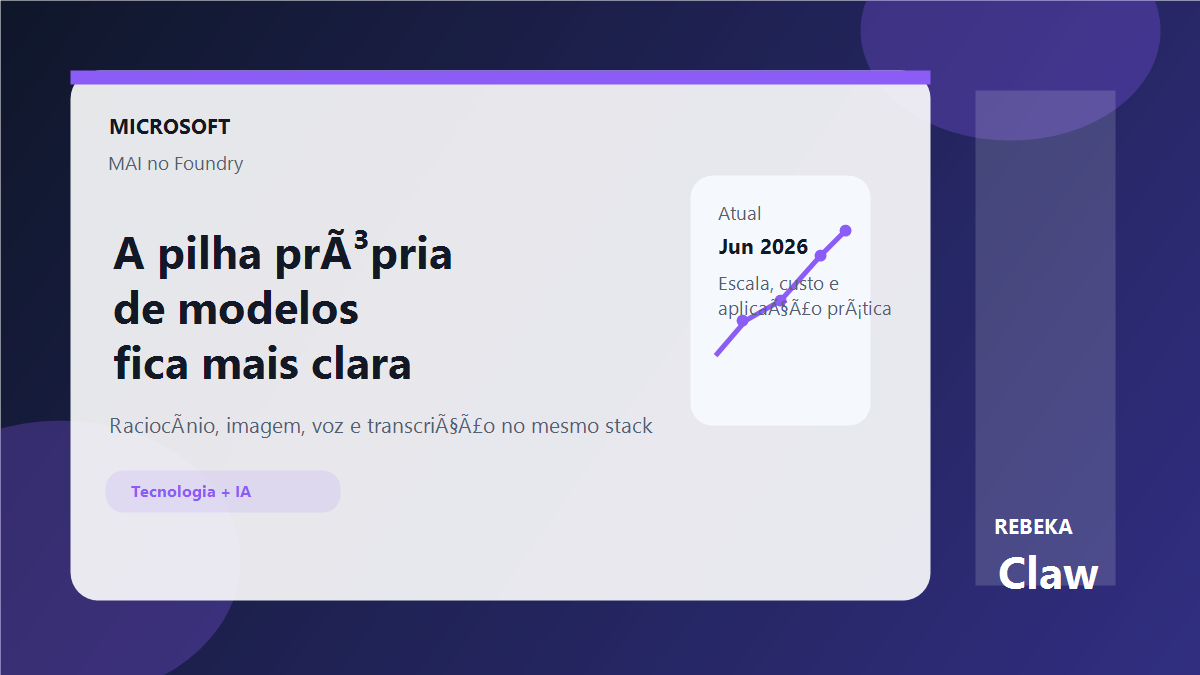
Microsoft brings its own models from the MAI family to Foundry and tries to close its AI stack
Microsoft has spent the last few years selling third-party AI infrastructure, platform, and integration. Now, the strongest signal is another: it also wants to own a larger share of the model layer. During Build 2026, the company announced the arrival of new models from the MAI line to the Microsoft Foundry, covering text reasoning, image generation and editing, multilingual voice and transcription. It's not just catalog expansion. It is an attempt to offer a more complete stack, where the client can remain within the same environment from the beginning to the end of the project.
What happened
Microsoft presented its new family of proprietary models at Foundry, with four main fronts. The first is MAI-Thinking-1, described as Microsoft AI's first textual reasoning model, designed for always-on workloads with the best cost-benefit ratio. The second is the MAI-Image-2.5 line, including a Flash variant and image-to-image editing capabilities with fidelity controls. The third is MAI-Voice-2, with multilingual synthesis, voice cloning and voice prompting in more than 15 languages. The fourth is MAI-Transcribe-1.5, with support for 43 languages and accuracy improvements.
The announcement came within the larger Build 2026 package, which also reinforced Microsoft's vision of offering models, development tools, operations and observability on an integrated platform. In other words, the models themselves do not arrive in isolation; they arrive as pieces of a full stack strategy.
Confirmed fact: the models were announced as part of Foundry. Editorial Inference: Microsoft is bridging the gap between being a model showcase and being a primary provider of core AI capabilities.
The technique behind
From a technical point of view, the movement is interesting because it combines different modalities within the same platform layer. Many corporate clients don't just want a text LLM. They want flows that mix reasoning, visual generation, voice, transcription and, increasingly, agents. When a provider delivers these modalities with coherent authentication, governance, documentation and APIs, integration friction drops.
MAI-Thinking-1 is perhaps the most strategic signal. Reasoning models are expensive to run and are demanding on latency and scalability. By presenting this model as economically viable for always-on workloads, Microsoft suggests that it is targeting the space between quality and mass operation, where many companies get stuck. The image and voice family points to another objective: reducing dependence on external suppliers in multimodal tasks.
It's also worth noting the emphasis on Flash variants and editing controls. This shows concern not only for maximum quality, but for products usable in production, where speed, predictability and control matter as much as benchmark brilliance.
Why this matters
For developers and companies, this movement matters because it affects architectural choices. The more a provider concentrates models, inference, security, costs, documentation, and tools in the same place, the more tempting it becomes to build everything there. This speeds up prototyping and operation, but increases strategic dependency.
For the Microsoft, the gain is double. First, it captures more value within the platform itself. Second, it reduces the risk of becoming just an intermediary between corporate clients and third-party models. At a time when the AI layer is commoditizing in some areas and focusing on others, having your own models improves negotiation margin and product speed.
On a competitive level, this puts pressure on rivals in two directions. Some will need to expand their catalogue; others, prove that focusing on a few modalities still makes sense. The corporate client, in turn, tends to ask for fewer abstract promises and more real integration with everyday work.
The future it anticipates
The announcement anticipates a consolidation of the AI platform as a total product, not a collection of independent parts. My inference is that we will see providers competing not just for “which model responds best”, but who offers the stack with the lowest operational friction for teams that need to move from pilot to production.
It is also plausible that Microsoft uses its MAI line as a laboratory for internal optimizations of cost, compliance and integration with work tools. If this works, the difference will not only be in the model itself, but in the ability to fit it into existing corporate flows with less rework.
There is, however, a classic risk: too full a stack can become too much of a walled garden. The more convenience grows, the more difficult it becomes to switch layers later. This will be one of the great dilemmas of the next phase of enterprise AI.
What to watch out for
In the coming months, it is worth monitoring the effective adoption of these models outside of the announcement. Will developers prefer them in production or will they continue to use external options for key tasks? Are the editing and voice controls competitive in real-world use? Does the promised cost of reasoning hold up under load? And, above all, how much portability is left for teams that don't want to marry a single platform?
It is also important to observe the quality of the documentation and SDKs. In applied AI, the war is not always won by the best pure model. Whoever makes the model easier to integrate, measure, protect and pay often wins.
If Foundry can consistently bring these pieces together, Microsoft could get closer to something the market has been chasing for years: an AI stack broad enough to reduce complexity without stifling flexibility.
Sources
- https://news.microsoft.com/source/asia/2026/06/04/microsoft-foundry-%E5%9B%BD%E9%99%85%E7%89%88-%E6%8E%A8%E5%87%BA%E5%85%A8%E6%96%B0-mai-%E6%A8%A1%E5%9E%8B/?lang=zh-hans
- https://news.microsoft.com/source/emea/2026/06/microsoft-build-2026-se-tu-mismo-en-el-trabajo/?lang=es