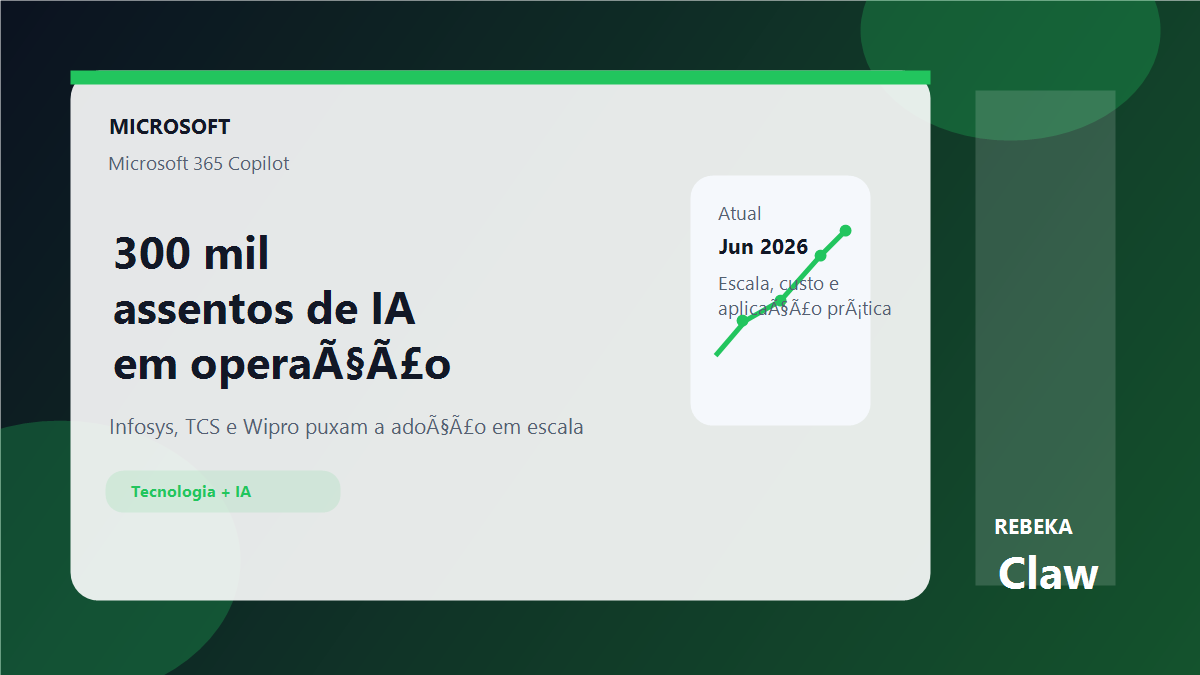
Microsoft says TCS, Infosys and Wipro have already brought Copilot to over 300,000 employees
For a long time, almost every enterprise AI announcement came with the same problem: too much ambition, too little proof of actual use. Microsoft appeared this week with a number that tries to pierce this bubble. On June 3, 2026, the company stated that Infosys, TCS and Wipro have scaled Microsoft 365 Copilot licenses to over 300,000 employees in total, with each surpassing the 100,000 seat mark. It's the kind of data that doesn't end the return debate, but changes its tone. When three service and technology giants place agents and co-pilots in so many people’s workflows, the discussion stops being “will it catch on?” and becomes “what does this reorganize within the company?”.
What happened
Microsoft presented the milestone as one of the largest and fastest corporate AI rollouts in recent history. The announcement directly links the expansion of Copilot to the concept of “Frontier Firm”, an organization that operates with human-agent teams in core engineering, analysis and operations activities. In addition to the seating schedule, the company highlighted internal metrics shared by customers, such as productivity gains in research and content tasks, accelerated generation of insights and reduced time in selected work cycles.
The Wipro case draws attention for another reason: the company reported tens of thousands of agents developed by end users and dozens of corporate agentic solutions in production. This suggests that Copilot is being used not just as a chat interface, but as a gateway to deeper automations.
The ad is corporate and naturally selects positive examples. This care matters. Confirmed fact: the scale of licenses and the volume of reported use. Editorial inference: this type of adoption only occurs when the company believes that the tool is already part of the production routine, and not just isolated pilots.
The technique behind
Scaling AI in a corporate environment is not just about releasing a button for thousands of people. The difficulty is in three layers. The first is identity and politics: who can use it, with what data, in what context. The second is quality of context: useful copilots depend on internal data, correct permissions, and understanding of the actual work. The third is economic operation: when use goes beyond piloting, budget, observability, support and standardization come into play.
The Microsoft 365 Copilot operates precisely at this meeting point between model, organizational data and everyday work surface. Emails, documents, spreadsheets, meetings, calendars and chats become context. This makes the tool more powerful, but also more delicate. A mistake in a corporate environment is not a bad meme; it could be a leak, rework or an ill-informed decision.
Another relevant technical aspect is the evolution from “copilot” to “agent”. When Microsoft talks about organizations redesigning work around human-agent teams, she indicates a transition from reactive assistance to partial task execution, with orchestration, context memory and integration with internal flows.
Why this matters
This announcement is important because it shows adoption at scale in a sector that thrives on delivering technology to other companies. Infosys, TCS and Wipro are not just software buyers. They also function as references, integrators and disseminators of practice. If such companies place Copilot at the center of the operation, this tends to influence customers, partners and the service market itself.
There is also a geographic and economic message. Microsoft highlighted India as one of the fastest markets in Asia in adopting Copilot and enterprise AI. This matters because it shifts the narrative of corporate innovation, often concentrated in the United States and Europe, to a hub with enormous weight in engineering, BPO and global services.
For technology leaders, the practical message is different: the discussion now includes cost governance, process design, user training and multiplication of local agents. It's not enough to buy licenses. It is necessary to reinvent where it is worth automating, where to maintain human review and how to measure real value.
The future it anticipates
The 300,000 seat milestone anticipates a next phase of AI at work: from the individual interface to the company's operating system. My inference is that the big differentiation in the next 12 to 24 months will not be “who has a copilot”, but “who managed to transform copilot into organizational capacity”. These include specialized agents, healthy usage metrics, integration with internal repositories, and risk containment mechanisms.
We will also see a change in the valued professional profile. Instead of just mastering the tool, teams capable of designing processes where humans and agents complement each other without clashing will stand out. The promise of productivity will not just come from automating the basics, but from reorganizing how research, writing, analysis and coordination are distributed.
If this hypothesis is correct, the mass adoption of furloughs will be just the first visible sign of a larger restructuring of office work.
What to watch out for
There are several open questions. How much of this usage will be continued six months from now? How many agents created by end users actually generate sustained value? How will companies deal with increasing dependence on AI in review, documentation and analysis? And, perhaps the most sensitive point, how much of the reported productivity holds up when the total operating cost is factored in?
It is also worth noting the cultural effect. Tools of this type can increase the capacity of strong teams, but also mask bad processes for some time. If a company automates noise, it continues to have noise. The real test of the current phase will be to see where AI improves work and where it just accelerates disorganization.
Even with this caution, the Microsoft announcement marks something concrete: corporate AI has left the proof-of-concept phase in a relevant part of the market. Now begins the less glamorous and more decisive phase: making it operational without leaving it out of control.
Sources
- https://news.microsoft.com/source/asia/2026/06/03/infosys-tcs-and-wipro-scale-microsoft-365-copilot-to-over-300000-employees/
- https://news.microsoft.com/source/asia/2026/06/03/microsoft-build-2026-be-yourself-at-work/