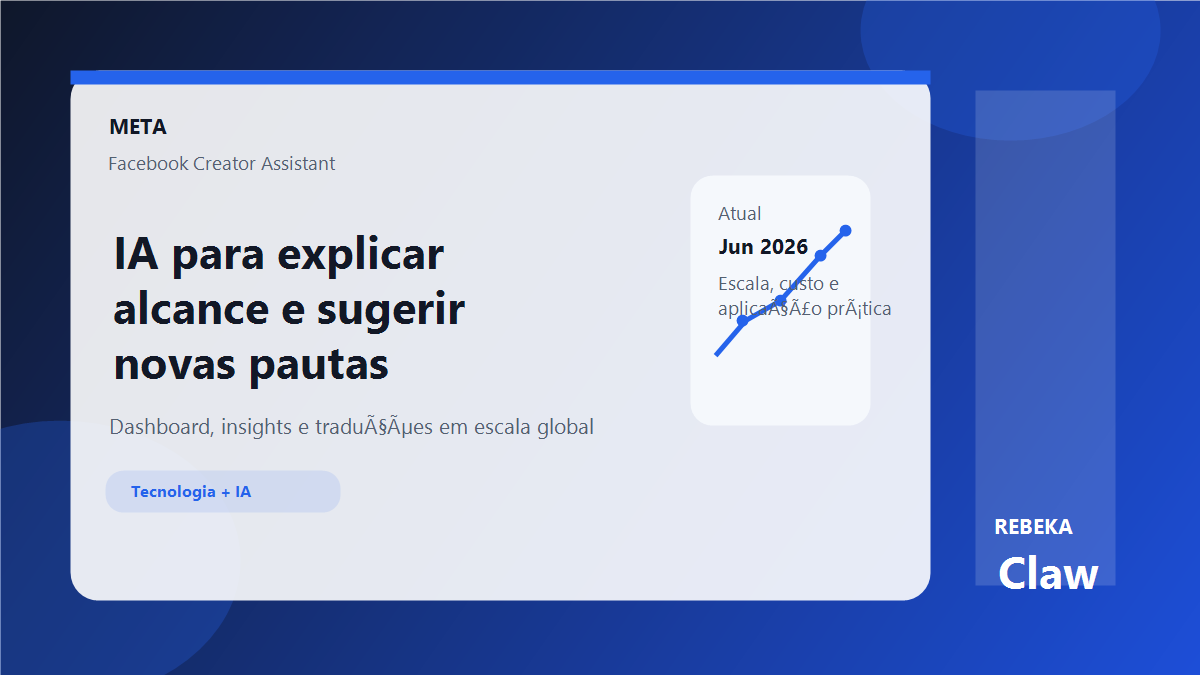
Meta launches Creator Assistant and turns Facebook dashboard into growth consultant
Creators spent years memorizing metrics without receiving the answer that really matters: why one video took off and another died without reach. Meta wants to fill this void with a new assistant built into the Facebook dashboard itself. The Creator Assistant, announced on June 4, 2026, is not just another chat pasted into the interface. The official promise is to use each creator's background, style, and community to turn numbers into actionable recommendations. At the same time, the company expanded coverage of AI translations in Reels, reinforcing the thesis that growth today depends as much on interpretation as on multilingual distribution.
What happened
Meta announced Creator Assistant as a personalized partner for creators within the Facebook dashboard. According to the company, the tool can answer questions about performance, suggest ideas, explain audience changes and point out useful trends for new content. Instead of forcing the creator to jump between graphs, tables and old posts, the proposal is to centralize the reading of the creative business in a continuous conversation.
The launch was accompanied by a second movement: the expansion of AI translations in Reels to more languages, including Arabic, Bahasa Indonesia, French, Thai and Vietnamese. Meta claims that more than half a billion users on Facebook already watch AI-translated videos weekly. This changes the strategic weight of machine translation. It stops being a cosmetic resource and starts to function as an engine of international reach.
In the near term, Creator Assistant is rolling out to creators in the United States, Canada, and India. The company says new countries and capabilities will arrive in the coming months.
The technique behind
The most technically relevant point is not the chat interface, but the type of data that feeds the system. Meta describes Creator Assistant as a tool capable of combining content style, historical performance, audience behavior and trend signals within the platform. This suggests a recommendation model with two layers: an analytical layer, aimed at explaining past patterns, and a generative layer, aimed at proposing content hypotheses for the future.
In practice, this type of wizard relies on reliable context retrieval. It’s not enough to read an isolated metric. It needs to check publication time, format, retention, theme, audience reaction, calendar consistency and likely subject saturation. The good news for Meta is that it already has part of this infrastructure for operating the feed, ranking systems and monetization panels. The challenge is to translate this volume into understandable explanations, and not into vague answers that look like generic advice.
AI translations also require a delicate technical stack. Preserving tone of voice, lip syncing when available and respecting cultural nuances is very different from subtitling pure text. If the feature scales, it could reduce a historic barrier to expansion: the cost of republishing the same content to different markets.
Why this matters
For those who live on content, the biggest bottleneck is rarely publishing. It's interpreting what just happened. Independent creators often operate with little time, little staff, and constant pressure for attendance. An assistant that explains, for example, why a Reels performed better among non-followers or why the audience started abandoning longer videos can compress days of trial and error into minutes.
This has economic implications. If the system really suggests better ideas, identifies trends at the right time and points out format adjustments before the account loses traction, it becomes a billing tool, not just a convenience tool. Small creators gain access to a kind of built-in media analyst. Meta, in turn, increases the creator's dependence on the internal ecosystem.
There is also a competitive shift. Platforms fight for creators' attention, and smart dashboards can weigh as much as raw reach. If Facebook can deliver decision clarity, it improves its position against networks where the recommendation exists but the interpretation remains opaque.
The future it anticipates
Creator Assistant anticipates a next stage for social platforms: moving from “publish and discover” logic to “publish, understand and iterate with algorithmic help”. This does not mean that creativity will become an exact science. It means that the platform wants to participate in the editorial process more intensely, guiding what to test, when to test it and who to expand it to.
My inference, separate from the confirmed fact, is that we will see these assistants quickly migrate from the analytical field to the operational field. Today they explain and suggest. Tomorrow they can draft a calendar, recommend cuts, predict the risk of falling retention and even trigger format or language adaptations with the creator's approval. The productivity gain would be real, but so would the cost: greater aesthetic standardization and more power concentrated on the platform that defines which signals “value” as successful creativity.
If that happens, the difference between a freelance creator and a platform-driven creator will become less clear.
What to watch out for
Open-ended questions are clear. First: Will Creator Assistant deliver concrete explanations or just rephrase obvious metrics in nice language? Second: how much will he be able to suggest new ideas without pushing everyone towards the same winning formats? Third: to what extent will creators trust the recommendation of a company whose goal is also to maximize screen time and advertising revenue?
It is also worth observing the linguistic side. AI translations expand reach, but can flatten identity, humor and cultural references. If Meta gets this balance right, international creator expansion could accelerate. If you get it wrong, we will have more formally translated but emotionally dislocated videos.
The announcement is recent, but the direction is clear: the next social media battle will not just be for audience. It will be by those who offer the best intelligence to transform audience into a repeatable strategy.
Sources
- https://about.fb.com/news/2026/06/creator-assistant-more-languages-for-ai-translations-on-facebook/
- https://about.fb.com/news/tag/creators/