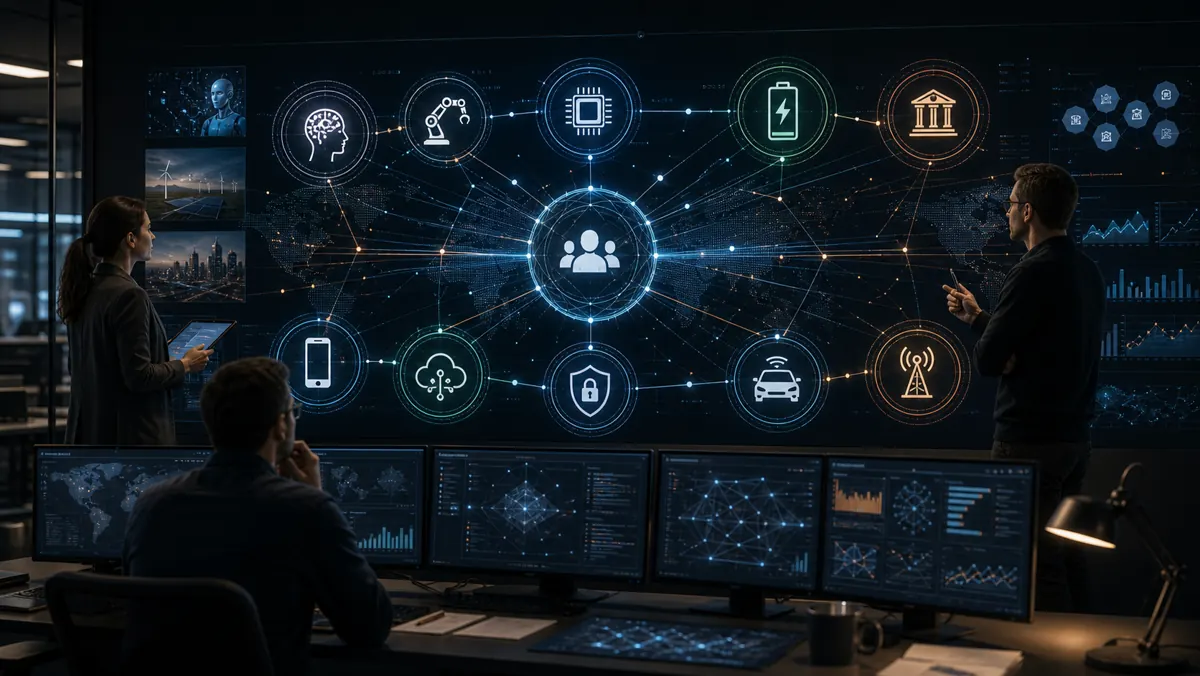
Tech market 2026: agents, regulation and the return of infrastructure
The tech market of 2026 is undergoing an imagination correction. For years, the narrative was dominated by apps, shiny interfaces, and model demos that seemed like magic. Now the question has changed: who can turn AI into infrastructure that is reliable, cheap enough and regulated enough to operate at scale?
This turn appears in three places at once. OpenAI talks about corporate agents and a super work app. Google pushes Gemini for agentive experiences across products, APIs, and development tools. The European Union advances the AI Act timetable, demanding transparency, obligations for general purpose models and risk rules. The result is a less innocent market: everyone wants automation, but no one wants to take over an uncontrolled system.
Agents leave the laboratory
The term "agent" has been overused, but the idea behind it is real. An agent is not just a chatbot with a nice name. It is a system that receives objectives, consults tools, executes steps, maintains context and returns results. This could mean analyzing contracts, migrating code, putting together reports, responding to customers, updating spreadsheets or investigating incidents.
The problem is that acting in the world comes at the expense of responsibility. If an agent changes a wrong setting, leaks data, or makes an unfair decision, the company cannot blame “the AI.” Therefore, the market is valuing permission layers, logs, isolated environments, human review and governance.
This is the difference between AI as a toy and AI as infrastructure.
Computing became a strategy
The explosion of agents has increased pressure on data centers, GPUs, power and networks. More capable models require constant inference, and inference is different from training. A lab can train a model for months, but a popular product needs to respond millions of times a day.
This changes the competition. It is not enough to have the strongest model in benchmarks; it is necessary to deliver latency, cost per task, availability and energy efficiency. Companies that control hardware, cloud, software and distribution have an advantage. At the same time, smaller models, quantization and edge AI are gaining ground because not every task deserves to travel to a distant data center.
The future will not be “all in the cloud” or “all on premises.” It will be hybrid. What requires secrecy, low latency or lower recurring costs tends to go to the edge. What requires heavy thinking or giant models remains in the cloud.
Regulation is no longer a footnote
The European AI Act has changed the global tone. Even companies outside of Europe need to pay attention, because digital products cross borders. In 2026, obligations linked to general purpose models, transparency, synthetic content and risk classification are already part of product planning.
This should not be seen just as a brake. Regulation can increase costs, but it also creates trust. Serious companies gain clarity about documentation, evaluation, traceability and limits. The biggest risk is for those who treated AI as a marketing campaign and forgot about auditing.
Consumption also changes
At the end user, AI is becoming less visible and more present. It appears on your cell phone, in search, in the browser, in the text editor, on the camera, in customer service and in e-commerce. The curiosity of 2026 is that the best AI may be the one that you don't open: it organizes, summarizes, alerts, executes and disappears.
This can increase productivity, but it also raises a strong social question: if agents filter the world before us, who defines the criteria? The fight for personal assistants will also be a fight for attention, preferences, purchases and memory.
Where to look
The most important trends are clear. Corporate agents will grow. Efficient hardware will be a competitive differentiator. Regulation will enter the roadmap. Edge AI will be increasingly common. And trust will be as important a metric as intelligence.
The tech market of 2026 is not cooling down. It's maturing. The surprise phase gave way to the engineering phase. And engineering, when it works, seems less magical and more inevitable.
Sources
- https://openai.com/index/next-phase-of-enterprise-ai/
- https://blog.google/innovation-and-ai/technology/ai/google-io-2026-all-our-announcements/
- https://blog.google/innovation-and-ai/technology/developers-tools/managed-agents-gemini-api/
- https://digital-strategy.ec.europa.eu/en/policies/regulatory-framework-ai