Intel uses Xeon 6+ and Crescent Island to put CPU and networking back at the center of agentic AI
Intel knows it is not winning the symbolic GPU war, so it chose another battlefield. On June 1, 2026, the company announced in Taipei new Xeon 6+ processors, expansion of the Ethernet 800 line and progress on the accelerator roadmap with Crescent Island. The important detail is the framing used in the official text: it "puts agentic AI to work." This is not only marketing. It is a clear attempt to redefine the debate, shifting attention away from the isolated GPU and placing CPU, networking and system integration back at the center of the problem. The confirmed fact is the announced package. The plausible inference is that Intel wants to convince the market that the next phase of AI will not be decided only by FLOPS, but by the ability to sustain agents, networking and data with economic predictability.
What happened
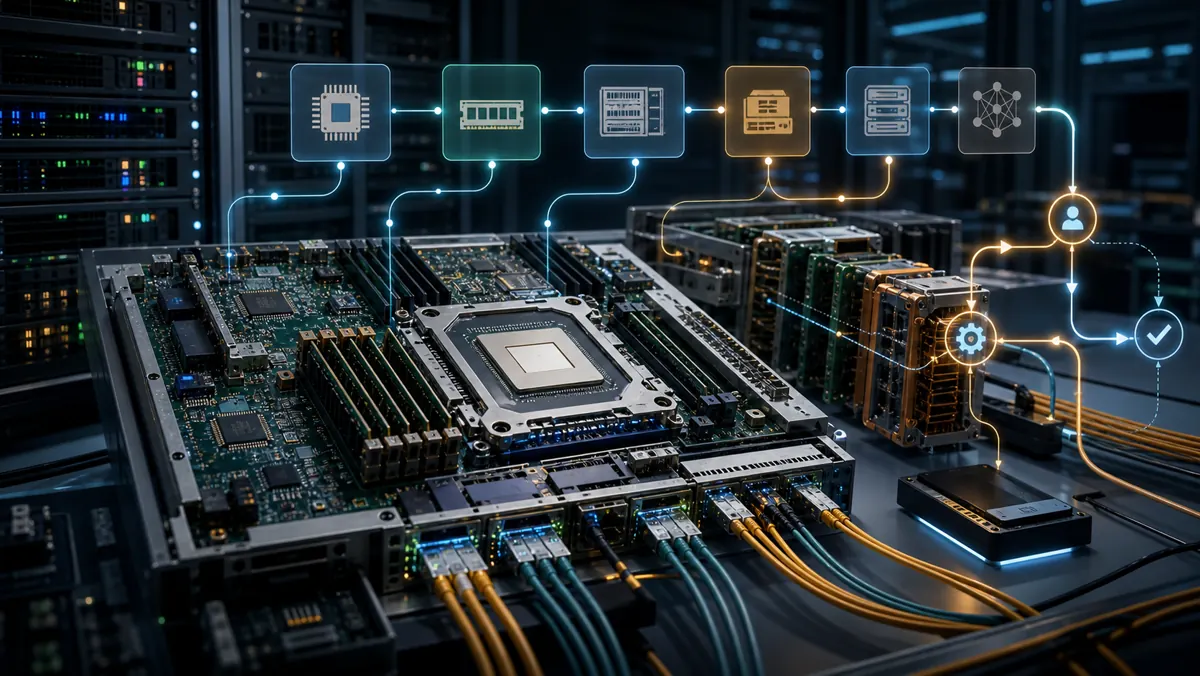
The release mentions a series of data center advances: new Xeon 6+ processors, expansion of the Ethernet E835 portfolio and updates on Crescent Island, while reinforcing the "AI systems" narrative. Even without pouring exhaustive specifications into the summarized text, Intel signals strategic direction. CPU, networking and accelerator stop appearing as independent product lines and are presented as a platform for agentic loads and edge-to-cloud workloads. Confirmed fact: the company is trying to sell infrastructure as a system solution. Inference: it understands that competing only in a direct comparison with the market's most desired GPU means losing the framing before discussing total cost, cluster utilization or network bottlenecks.
The science behind it
Technically, the thesis makes sense. Agents pressure systems differently from classic training. They generate more irregular traffic, more calls to services, more synchronization between steps, more movement between memory, networking and external tools. That means CPU, NIC and interconnect become decisive again. Xeon 6+ enters this story as the layer that manages threads, queuing, pre- and post-processing, security and observability. The Ethernet E835 line responds to another critical point: without adequate networking, coordination latency grows and part of the acceleration gain is lost. Crescent Island appears as a bridge toward a more complete proprietary acceleration offer. The central mechanism here is systemic: agent performance does not depend only on peak inference, but on the entire flow between decision, transport, memory, validation and action.
Why it matters
For enterprise buyers, the message is relevant because many organizations have already learned the hard way that owning expensive accelerators does not guarantee useful throughput. There are clusters with idle GPU capacity and pipelines blocked by data, networking, host systems or scheduling. By emphasizing platform, Intel is trying to speak to this market fatigue. It offers an engineering narrative closer to the customer's operational pain than to benchmark aesthetics. At the same time, there is a risk: without a clear acceleration leap, the company must convince through architecture and total efficiency. The positive side is that this is precisely an area where Intel still has historical legitimacy. If the message lands, Xeon 6+ can gain relevance not by being the star of AI, but by stabilizing real systems.
The future it anticipates
The plausible future is less glamorous and perhaps more important. If agentic AI consolidates in companies, the winning infrastructure will be the one that sustains thousands of heterogeneous tasks with predictable cost, good observability and fewer congestion spikes. What is confirmed is Intel's effort to stitch CPU, networking and accelerator into one narrative. What still needs proof is its ability to turn that into a repeatable commercial advantage against more integrated competing stacks. Another open question remains: will customers prioritize the technical elegance of a balanced system, or will they keep buying around the dominant accelerator even if the rest of the stack continues to be solved the hard way?
What to watch
Over the next few weeks, watch whether OEMs and cloud providers repeat Intel's message with deployment numbers rather than stage presence alone. End-to-end benchmarks will also matter, especially in agent, retrieval, security and distributed inference workloads. If the company shows that Xeon 6+, networking and Crescent Island reduce cost per completed task, the announcement becomes much more significant. If it remains stuck in a general thesis without measurable examples, the technical narrative will stay correct but commercially fragile.
Sources
- https://newsroom.intel.com/data-center/intel-puts-agentic-ai-xeon-6-networking-ai-systems