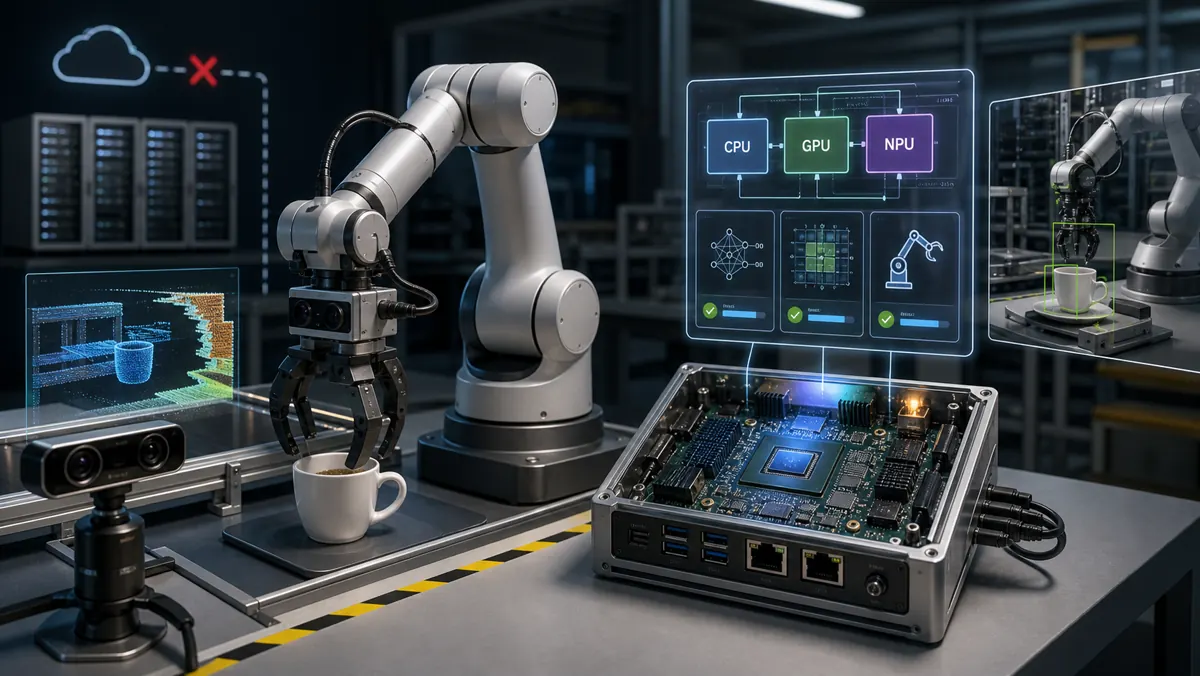
Intel pushes edge robotics with Core Ultra Series 3 and an argument against sending everything to the cloud
Not every useful form of intelligence needs a data center. That seems to be the premise behind Intel's most interesting move last week. On May 20, 2026, the company published that Core Ultra Series 3 is becoming its new standard for robotics computing and edge AI, highlighting cases such as the Ella robotic barista and workloads involving vision, language and action. The confirmed fact is simple: Intel is pushing a client chip family into commercial robotics territory. The question that makes the story relevant is different: will the next wave of physical AI depend less on the cloud than the market imagined?
What happened
In the official text, Intel emphasizes the integration of CPU, GPU and NPU on the same platform and connects that to real scenarios in hospitality, manufacturing, health and education. Another announcement, published on May 31, reinforces that more than 130 customers have already chosen Series 3 processors for edge devices and mentions OpenVINO Physical AI, partner kits and the Intel Robotics AI Suite. The company is trying to prove that the story does not end with silicon. Confirmed fact: there is an ecosystem effort, not just a chip launch. Plausible inference: Intel is betting that many commercially viable robots will need enough local inference to perceive, decide and act without continuously depending on external links, especially in environments sensitive to latency, cost or privacy.
The science behind it
From a technical point of view, the thesis is solid. Edge robotics combines multiple simultaneous streams: computer vision, language understanding, motor control, sensor fusion and, in some cases, VLA models. Placing CPU, GPU and NPU inside the same device reduces latency and simplifies thermal and energy engineering, especially when the goal is to operate outside cooled racks. Many control loops also cannot tolerate the latency or uncertainty of a round trip to the cloud. The robot's reasoning may be hybrid, but immediate perception and safe action require local processing. When Intel talks about gains in video analytics, LLMs and VLA, it is pointing to this convergence: the commercial robot needs enough AI to handle the physical world and, at the same time, a predictable platform to keep cost and power under control.
Why it matters
For integrators and manufacturers, this can shorten the path between an attractive prototype and a deployable product. A more standardized platform, with known tools and partner support, reduces engineering risk in sectors that traditionally suffer from endless proofs of concept. There is also an economic effect. If a significant part of intelligence is handled at the edge, operational cost per robot falls compared with architectures that are hyper-dependent on remote inference. The counterpoint is that edge does not eliminate the cloud; it redistributes the problem. Larger models, training, telemetry and updates still exist. The gain lies in not turning every physical movement into a remote request. That is where Intel is trying to position itself: as the provider of a balanced computing foundation for physical AI that must work in the real world, not only in controlled labs.
The future it anticipates
The plausible future is a clearer segmentation of robotics. Slow, highly connected and supervised tasks may continue to pull from the cloud. Local, repetitive or latency-sensitive interactions should migrate to platforms with more embedded autonomy. What is confirmed is Intel's intention to occupy this space with Core Ultra Series 3 and an associated software stack. What remains an inference is the size of the market willing to trade discrete GPUs or custom architectures for a more integrated and economically predictable solution. There is also an important conceptual question: if physical AI matures, which part of the robot's "brain" should remain local and which part should continue orbiting cloud services and central coordination?
What to watch
The best way to judge this announcement is to watch deployments. Which robots move beyond demos and enter operation with uptime, consumption and safety metrics? It is also worth monitoring whether OpenVINO Physical AI really simplifies life for integrators or becomes another technical layer to manage. If Intel gets this right, it may gain relevance in a field where the best answer is not always the most powerful GPU, but the most pragmatic platform.
Sources
- https://newsroom.intel.com/artificial-intelligence/intel-core-ultra-series-3-for-edge-ai-robotics
- https://newsroom.intel.com/client-computing/customers-choose-intel-for-edge-devices