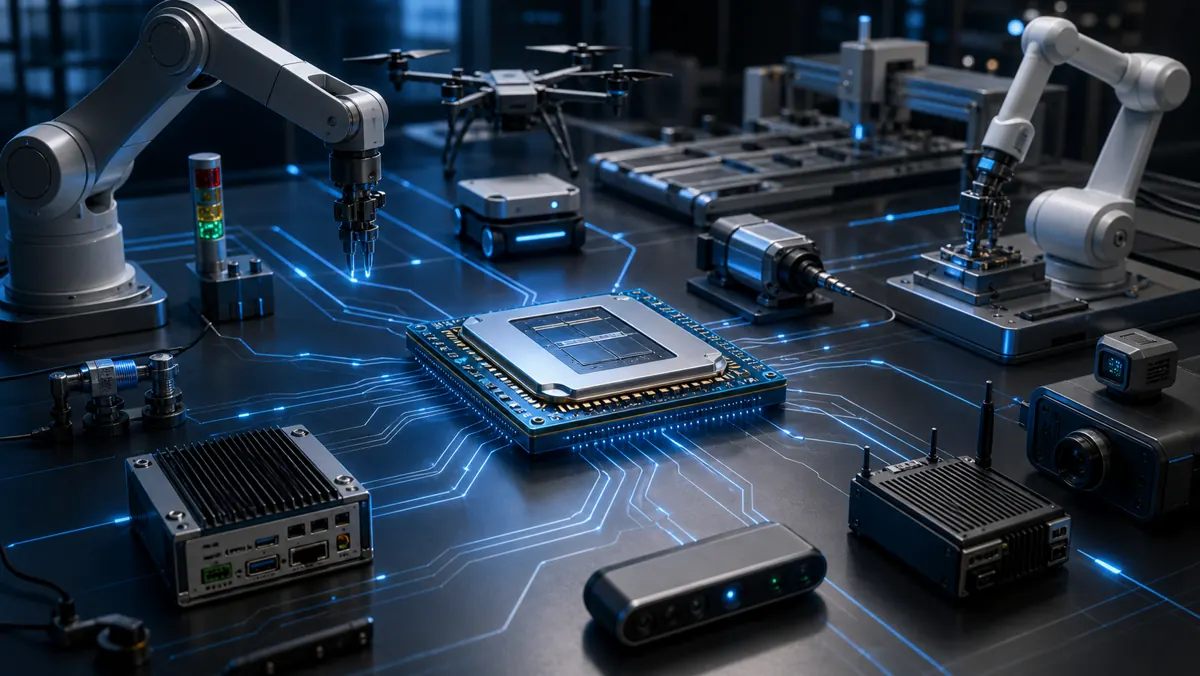
Intel uses Computex to say that the era of physical AI also needs a CPU
For some time now, the narrative of AI in hardware has been captured almost entirely by giant GPUs and data centers. Intel appeared at Computex 2026 trying to refocus the conversation: the next wave of physical AI, at the edge and in real devices, will still rely heavily on CPUs, integrated NPUs and hybrid computing. The speech may seem predictable coming from the company, but the announcement brings important signals about where the infrastructure is moving. ## What happened In the official Computex 2026 material, Intel highlighted the expansion of the ecosystem around the Core Ultra Series 3 and explicitly linked this platform to the growth of edge AI and physical AI. CEO Lip-Bu Tan and Alex Katouzian spoke of a portfolio that ranges from premium PCs to handhelds and, above all, robotics, autonomous machines and other physical AI devices. The company cited more than 130 edge designs already in 18A and an ecosystem with more than 4,000 partners and 100,000 deployments. The announcement is not a launch of a single magic chip. It is an attempt to frame Intel as a supplier of the control plane for agentic systems outside the data center. The message becomes stronger when combined with the company's recent moves into Xeon 6+, Ethernet 800 series, and physical AI deployment frameworks. The common thread is the same: useful AI in the real world doesn't just live in massive inference in the cloud. ## The technique behind Physical AI is crueler than chatbot. A robot, kiosk, industrial machine or autonomous device needs to react in real time, integrate sensors, respect thermal budget, maintain a viable cost and, often, operate with irregular connectivity. In these scenarios, intelligence cannot be thought of only as raw throughput. It depends on distributing work between CPU, GPU, NPU and cloud. It is at this point that Intel tries to regain relevance. An XPU package with a responsive CPU, high-throughput GPU, and low-power NPU makes sense for tasks where latency, privacy, and power matter as much as the model itself. When the company talks about hybrid AI computing optimized from the cloud to the edge, it is responding to a real problem: sending everything to the cloud is not always possible, cheap or acceptable from a regulatory point of view. On the scientific side, this connects to the notion of inference locality. Embedded multimodal models can filter signals, classify events, and execute immediate policies locally, while heavier or more open-ended tasks move up to the cloud. The value is not in “benchmark beating” in isolation, but in distributing intelligence across the stack. ## Why this matters If the industry truly moves toward persistent agents, collaborative robotics, and context-aware devices, demand for hybrid computing should grow quickly. This is of interest to factories, retail, healthcare, logistics and cities. And it creates space for a thesis in which CPU and platform return to the center of the conversation. Their role is not to compete with pure accelerators in everything, but to orchestrate systems, manage data, networks, sensors and model calls in heterogeneous environments. For Intel, this is probably the best thesis available today. Instead of promising to take down absolute leaders in giant model training, the company is trying to win at the layer where total cost, integration and deployment count most. If you can execute it, it could be relevant precisely where AI stops being a demo and becomes an operation. ## The future it anticipates The plausible future is a multiplication of specific AI devices: service robots, more autonomous industrial machines, smart points of sale, hospital devices with local capabilities and field equipment capable of making quick decisions. In this landscape, edge AI stops being a complement and becomes an architectural requirement. This also changes the way we think about software. Instead of applications made for a single target, teams will need to design pipelines that distribute models between device, gateway and cloud. The competitive advantage may lie less in the raw model and more in system engineering: compression, quantization, task routing, security and observability. ## What to watch out for There are two obvious risks. The first is promise without adoption: physical AI tends to advance more slowly than stage enthusiasm because real hardware, sensors and industrial integration are difficult. The second is fragmentation. A strong ecosystem depends on toolchains, drivers, frameworks and consistent support, not just chips. Therefore, the most useful signal to monitor is not the speech, but the concrete deployments. If Intel turns these partners and designs into cases that show measured operational gain, its narrative that physical AI needs a CPU makes sense again. If not, Computex 2026 will remain as another good presentation in a market that has already learned to distrust slides.
Sources
- https://newsroom.intel.com/artificial-intelligence/computex-2026-an-intelligent-world-built-on-silicon
- https://newsroom.intel.com/news