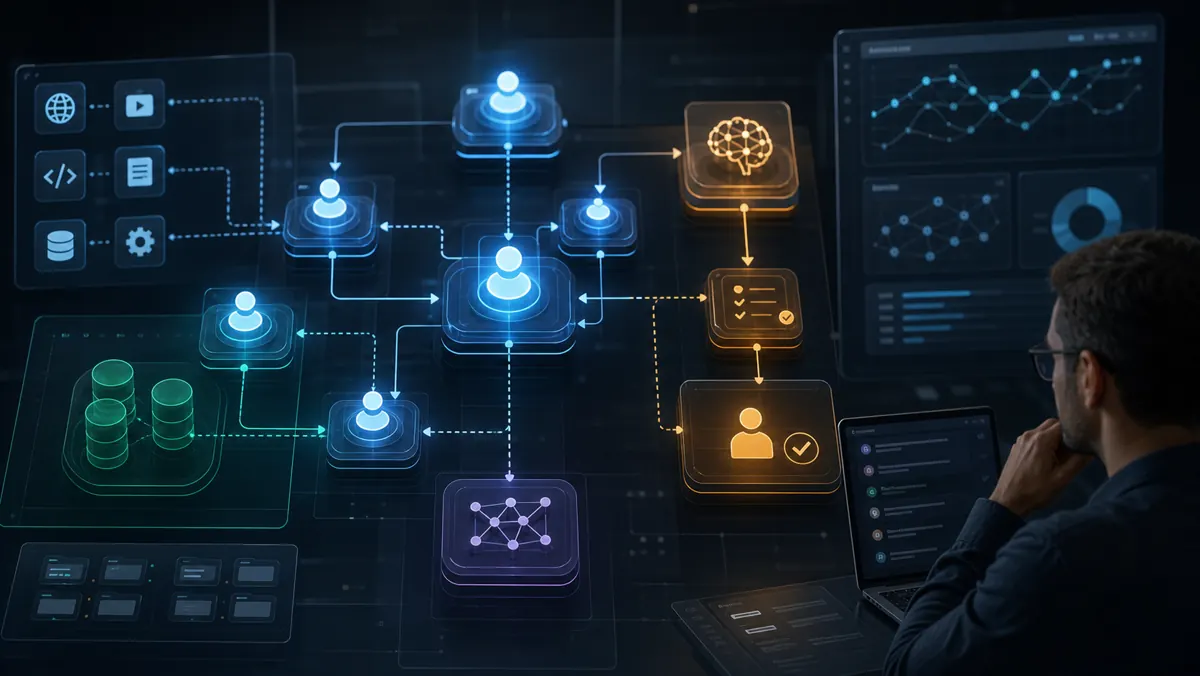
How to Create Autonomous Agents in 2026: Architecture, MCP, Memory, and Safe Limits
Autonomous agents are no longer just curious demonstrations. In 2026, companies use agents to review code, summarize incidents, trigger tools, search documents, and execute parts of internal processes. The promise is great, but the practice requires discipline. A good agent is not a chatbot with a prettier name. It is a system that thinks in cycles, uses tools, observes results and knows when to stop.
The most common mistake is to start with the model. The model matters, but the architecture matters more. An agent in production needs a clear objective, well-defined tools, useful memory, action limits, logs and human review at critical points.
What separates an agent from a chatbot
A chatbot responds. An agent acts. The classic pattern is the reason, act and observe cycle: the system receives a goal, breaks down the problem, chooses a tool, executes it, reads the result and decides the next step. This cycle can be simple, like querying a API, or complex, like opening a pull request after investigating test failures.
Four capabilities define a useful agent: tool use, persistent memory, planning, and self-healing. Without tools, it's stuck to the text. No memory, repeats context. Without planning, improvise. Without self-correction, it turns every error into human intervention.
MCP as integration layer
The Model Context Protocol has become an important piece because it standardizes the connection between agents and tools. Instead of each model speaking to each API differently, MCP servers expose resources, prompts, and actions in a common format. This reduces duplicate integration and makes it easier to switch clients, templates, or tools.
But MCP is not a brain. It connects. The framework or application decides the plan, controls state and validates outputs. In production, the combination is often: an orchestrator to manage the flow, MCP servers for tooling, and an authorization layer to limit what each agent can do.
Memory is not an infinite store
Memory needs to be drawn. Short memory maintains task context. Episodic memory stores a history of interactions. Semantic memory allows you to search documents by meaning. Procedural memory records operation rules. Mixing everything in a large vector database generates noise and cost.
The best way is to treat memory as a product: what should be remembered, for how long, with what permission and how will it be corrected? An agent who memorizes incorrect information may become worse over time. An agent who forgets everything never improves.
Architectures that work
For high-risk tasks, the safest pattern is single agent with human review. The system investigates, proposes and stops before acting irreversibly. For editorial, research, or analytics workflows, multi-agent teams can work well, as long as each role has a clear objective.
Frameworks like LangGraph help when the flow needs states, checkpoints, and granular control. Other tools are better for document retrieval, agent collaboration, or enterprise integration. The question is not which framework is trendy, but which makes the behavior verifiable.
The future it anticipates
The professional who creates good agents will be less of a “prompt engineer” and more of a systems designer. It defines tools, limits, metrics, and fallback. He also understands that autonomy is not binary. An agent can read freely, suggest changes with supervision, and perform only low-risk actions.
This gradation is what separates mature automation from dangerous gambling. Agents will take on more work, but the best ones will be those who leave trails, explain decisions and accept review. The future belongs not to the agent that looks smartest in a demo, but to the agent that remains reliable after a hundred runs.
Practical checklist
Before putting an agent into production, it’s worth answering five questions. What objective should he achieve? What tools can you call? What data can you access? At what point do you need to stop to ask for approval? How will the team know he failed? If these answers are not clear, the problem is not yet with the model; It's system design.
The best agent starts small. Automate an observable flow, measure success, record errors and increase autonomy in stages. This discipline prevents technical enthusiasm from turning into operational risk.
Sources
- https://modelcontextprotocol.io/
- https://langchain-ai.github.io/langgraph/
- https://openai.github.io/openai-agents-python/
- https://www.anthropic.com/news/model-context-protocol