Google Stacks AI Across Search, Productivity, and Devices in March 2026 Bundle
Google's monthly summary for March 2026 shows an increasingly aggressive strategy to spread AI across the surface of its products. Instead of a single isolated announcement, the company packaged updates to search, productivity, maps, devices and developer tools.
The main reference for the article was published on April 1, 2026, in the official text The latest AI news we announced in March 2026. This helps to better separate what is a confirmed announcement from what is still a market projection.
What was announced
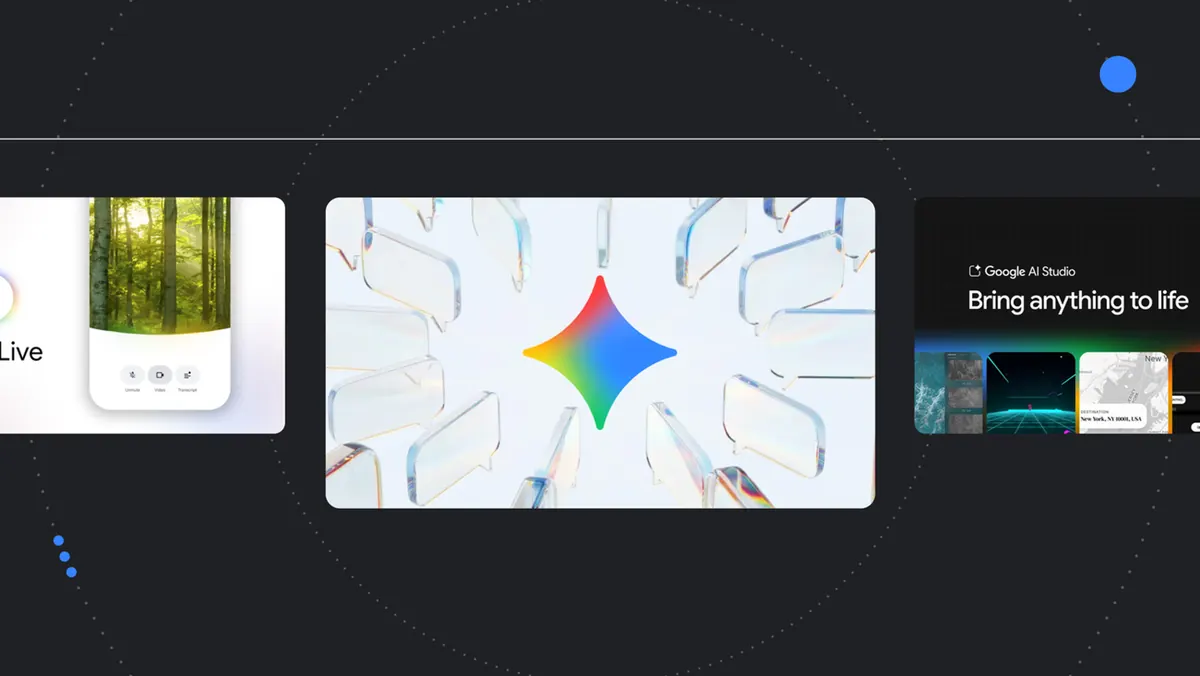
Among the highlights are the global expansion of Search Live where AI Mode is available, new Gemini features in Docs, Sheets, Slides and Drive, the arrival of Ask Maps, the expansion of Personal Intelligence, tools to migrate history from other assistants to Gemini, new features in Pixel Drop, live translation in more regions, as well as Lyria 3, Gemini 3.1 Flash-Lite, Gemini 3.1 Flash Live and an app building mode in Google AI Studio with the Antigravity agent.
Why this matters now
What matters here is the change of cadence. Google is no longer treating AI as a special feature in one product or another, but as a cross-layer. This reduces friction for end users, increases ecosystem dependency, and puts pressure on competitors to deliver connected experiences, not just strong models.
In a market that has already left the curiosity phase and entered the budget, operations and governance phase, announcements like this are important because they change the way companies, technical teams and creators choose platforms, integrate tools and define acceptable risk.
What this can change in practice
- Makes Gemini a seamless layer between search, documents, maps, devices and authoring tools.
- Increases user dependence on the Google ecosystem by reducing switching between applications.
- Pressures competitors to compete on integrated experience, not just model benchmarking.
What to watch out for in the coming weeks
The challenge now is consistency. The more AI Google rolls out, the more it needs to prove that personal context, privacy, accuracy, and inference cost can scale together. If this integration works well, Google's advantage becomes less the model itself and more the density of the ecosystem.
The technique behind
Google's strategy depends on context. Search Live, Workspace, Maps, Pixel, and AI Studio seem like different products, but they all benefit when the system understands intent, history, location, documents, and preferences. The difficulty is to use this context without scaring the user, violating privacy or mixing information inaccurately.
There is also an issue of cost. AI spread across popular products means inference on a massive scale. Every suggestion in Docs, every answer in Search, every interaction in Maps and every feature on Pixel consumes infrastructure. Google has an advantage in controlling models, chips, cloud, Android and distribution, but it needs to balance quality and cost so as not to turn each resource into an invisible bill.
The future it anticipates
The March package points to an internet based less on isolated applications and more on assistants that cross surfaces. You search, edit, browse, schedule, translate and build with an AI layer going along with the flow. This can be extremely useful, but it also makes the platform more central to everyday behavior.
The critical question is who controls the mediation. If AI summarizes a search, suggests a path on the map, organizes a document and recommends an action, it starts to influence small decisions all the time. Google's future with Gemini will be powerful if it increases clarity and autonomy. It will be worrying if you hide sources, choices and limits. The reader must observe not only what the AI does, but how it explains why it did it.
What to watch now
It is worth monitoring accuracy in Search Live, transparency of responses and user control over personal data. The more integrated AI becomes, the more important it is to have a clear button to review, correct and turn off context when necessary.
The big test will be daily confidence. Users can forgive failures in a new feature, but not in tools that guide search, routes, documents and communication. When AI becomes a permanent layer, small inaccuracies gain importance.
Sources
- https://blog.google/innovation-and-ai/technology/ai/google-ai-updates-march-2026/