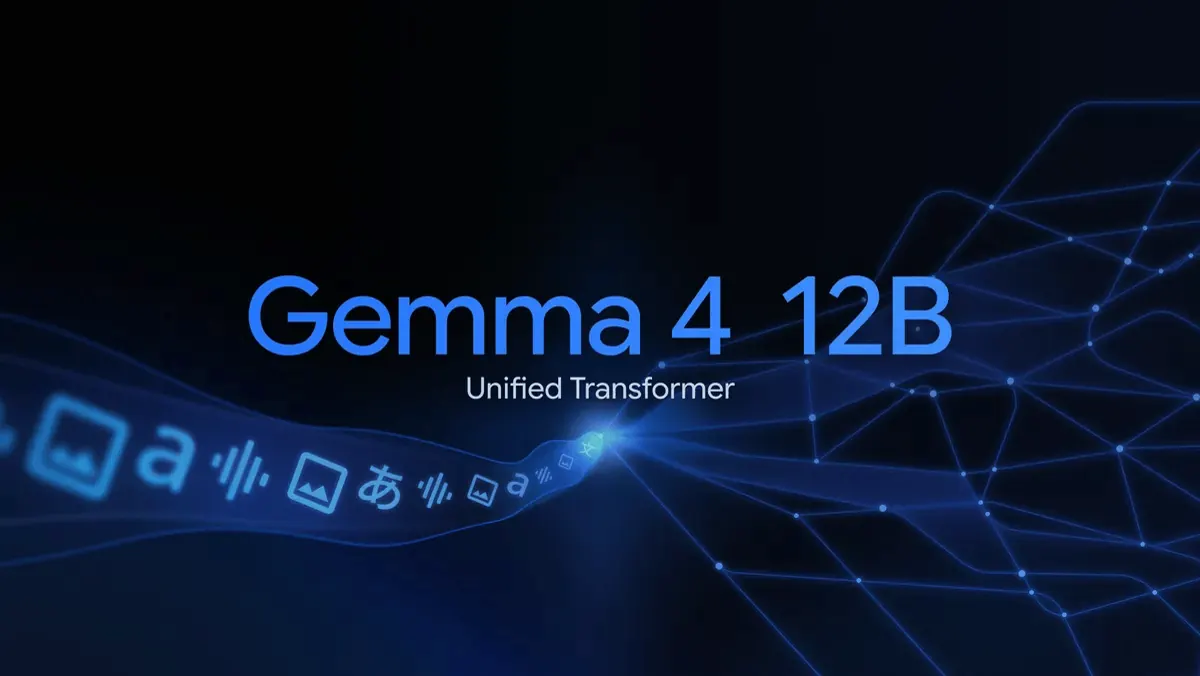
Google brings serious multimodality to the laptop with the Gemma 4 12B and bets on more useful local agents
For a long time, the local model market experienced an uncomfortable trade-off: either you ran something light enough to fit on a personal machine, or you used something actually more powerful, but dependent on heavy hardware and infrastructure far from most developers. The announcement of Gemma 4 12B, made by Google on June 3, 2026, tries to change exactly this point. The company presents the model as a unified, encoder-free multimodal system, designed to bring high-level intelligence directly to the laptop.
This “directly to the laptop” detail is the most important part of the ad. The Gemma 4 12B is not the biggest model in the Google ecosystem, nor does it intend to be. It is positioned between a smaller, more edge-oriented model and larger, heavier versions, offering a package that combines a reduced footprint, stronger reasoning and the first native audio input on an intermediate model in the family. In other words, Google wants to occupy the space where multimodal agents start to be useful without requiring a lab workstation.
What happened
In the official post, Google DeepMind says that the Gemma 4 12B was designed to bring agentic multimodal intelligence to laptops, serving as a bridge between the edge-focused E4B and the more advanced 26B Mixture of Experts. The company highlights that the model has a unified architecture, without a separate encoder, and includes native audio input. Confirmed fact: the explicit objective is to expand multimodal capacity while maintaining sufficient efficiency for execution closer to the user.
The announcement also speaks to the larger direction of the Gemma ecosystem. Google has been positioning the line as very capable “byte for byte” models for advanced reasoning and agentic flows. The new 12B reinforces this thesis with a practical message: useful multimodality cannot be restricted to the data center. Plausible inference: Google is trying to strengthen the space of open and semi-open models that serve as a rapid experimentation layer for developers, researchers, and companies that don't want to rely exclusively on external APIs.
The technique behind
The choice of an encoder-free architecture deserves attention because it simplifies the multimodal pipeline. In many approaches, text, image and audio go through different modules before reaching a joint representation. By more directly unifying these flows, the promise is to reduce complexity, facilitate orchestration, and improve inference efficiency for tasks where different modalities need to talk all the time. In a local agent, this makes a difference: each extra step weighs on memory, latency and energy consumption.
Another strong technical point is the native audio input. This opens up space for use cases where the model is not just “a local LLM with vision” but a system that can listen, describe, interpret and respond to sound signals without relying on an improvised external chain. On laptops, this could mean agents reviewing recorded meetings, helping with accessibility, interpreting spoken instructions, or cross-referencing audio, images, and text in creative and productivity flows.
Why this matters
In practice, the Gemma 4 12B matters because it helps fill a gap between models that are too light and models that are too good to run near the average user. Many teams want to explore on-premises AI for reasons of privacy, latency, cost, or operational resilience. But the value of this choice drops quickly when the quality of the model doesn't keep up. If Google really delivered a convincing multimodal 12B, it could breathe new life into an entire segment of personal and enterprise applications that require useful response without constantly going to the cloud.
There is also an ecosystem consequence. When a player like Google strengthens a lineup of models of this size, it puts pressure on other vendors to better justify their cloud tiers. The debate stops being “local versus cloud” in ideological terms and becomes architectural: what makes more sense to run close to the user, what needs a remote cluster and how to combine both worlds. Confirmed fact: Google wants models that serve real agents and workflows. Inference: It's laying the groundwork for a hybrid stack where local models do more of the front-line work.
The future it anticipates
The plausible scenario is a strong increase in personal and corporate agents running in hybrid mode, with an important part of the multimodal perception and immediate context being processed on the device. This can improve privacy, reduce cost, and make experiences more responsive. In particular, native audio combined with vision and text can give rise to a new class of more contextual local assistants, capable of monitoring learning, creation and organization tasks without depending on a perfect connection all the time.
But there are still open questions. How well does this model perform on varying hardware? What will the actual performance be on non-premium laptops? Which benchmarks matter most for everyday use, beyond demonstrating capability? And to what extent does the “agentic” promise hold up outside of controlled demos? The future looks interesting, but the litmus test will come from the technical community putting the Gemma 4 12B through real-world tasks and comparing cost, latency, and utility.
What to watch out for
Three things are worth noting in the coming weeks. The first is the tooling ecosystem, because good local models depend on both integration and weights. The second is adoption in desktop apps and practical multimodal flows. The third is the open market's response: if the Gemma 4 12B becomes a reference for the balance between capacity and efficiency, it could influence the design of a new generation of personal agents.
Google's announcement does not end the race for local models. But he leaves a strong hypothesis on the table: the laptop could once again become a central place for smart computing, as long as the right model fits there.
Sources
- https://blog.google/innovation-and-ai/technology/developers-tools/introducing-gemma-4-12B/
- https://deepmind.google/models/gemma/