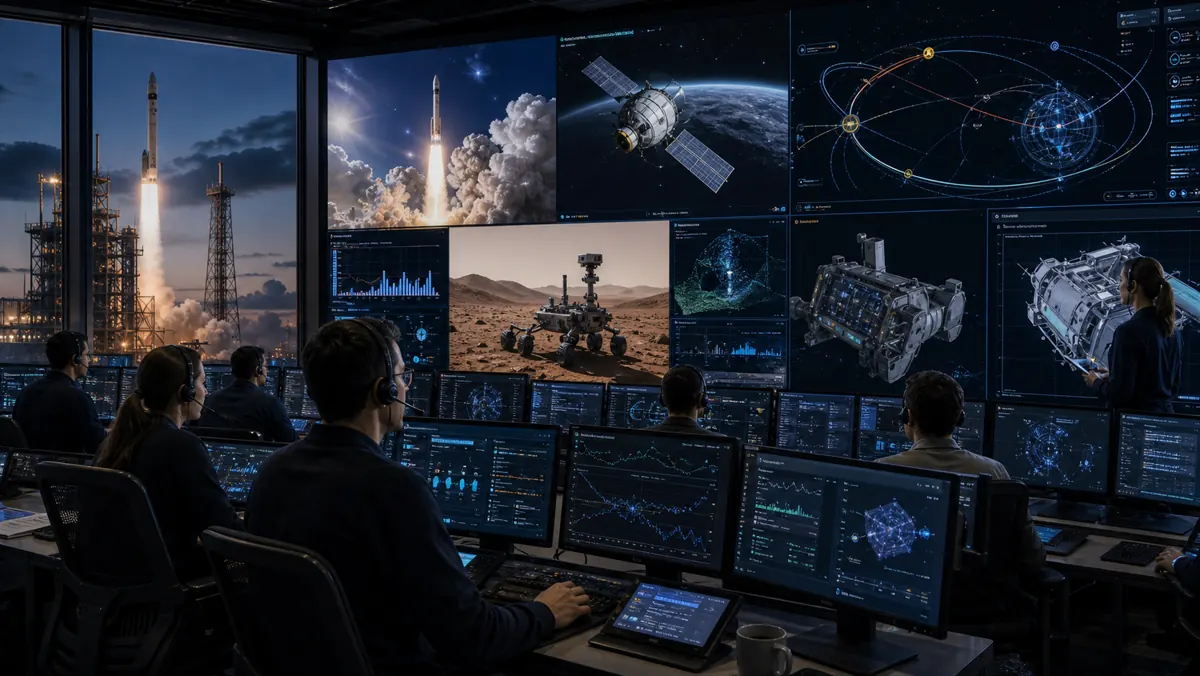
AI in Space Exploration: NASA, SpaceX and the Next Generation of Autonomous Missions
Space exploration has always depended on automation, but AI is changing the degree of autonomy. Missions to Mars, observation satellites, telescopes, probes and launch operations produce enormous volumes of data and require quick decisions. In many cases, waiting for command from Earth is too slow.
NASA, private companies and research centers have been using machine learning to plan routes, detect anomalies, prioritize scientific data, optimize operations and improve simulations. SpaceX, although less transparent in AI details, operates highly automated navigation, landing, telemetry and control systems.
Where AI already helps
Rovers need to decide paths, avoid obstacles and choose scientific targets. Satellites can filter images, detect events and reduce transmitted data. Manned missions can use assistants for maintenance, support and analysis. At launch, models help predict failures, monitor sensors and compare telemetry in real time.
The value is clear: autonomy saves time, energy and communication. On Mars, signal delays make it impossible to control everything manually. The further away the mission, the more the ship needs to decide on its own.
Why this matters now
The next space phase will be denser. There are constellations, a return to the Moon, plans for Mars, lunar robotics, commercial stations and satellites with increasingly powerful sensors. This creates operational complexity. AI helps turn data into decisions before humans are buried in telemetry.
There is also scientific impact. Models can identify patterns in planetary images, select samples and find rare events. AI does not replace scientists, but it expands their ability to look at giant data sets.
The risk of autonomy
In space, mistakes are costly. An agent who makes the wrong decision can lose a mission, damage equipment or compromise safety. Therefore, spatial AI needs to be verifiable, robust and limited. Autonomous systems must know when to act and when to ask for confirmation.
The challenge is to test first. Simulation, digital twins and validation in an extreme environment will be essential. An AI that works in a laboratory can fail due to dust, radiation, low gravity or degraded sensors.
The future it anticipates
Space exploration will move towards hybrid teams: humans on Earth, robots in the field and AI in the middle. The ideal mission will not be fully automatic, but intelligently distributed. Humans define scientific goals; autonomous systems execute, filter and replan.
This model could also return to Earth. Technologies created for rovers and satellites help mining, agriculture, weather, disasters and industrial robotics. The space is a laboratory of autonomy under maximum pressure.
Practical impact
For NASA, AI can increase scientific return without proportionally increasing human teams. An instrument that detects rare events, prioritizes images and adjusts observations can make better use of short windows. On long missions, this efficiency is the difference between losing and capturing a phenomenon.
For companies like SpaceX, autonomy reduces operational costs and increases cadence. Reusable rockets, orbital vehicles and complex missions depend on systems that react quickly to telemetry. Even when the word AI doesn't appear in marketing, advanced automation is at the heart of the operation.
The question for the future
The further we go, the more independent the machines will have to be. A lunar base, a mission to Mars or probes in the outer solar system will not be able to depend on constant manual control. IA will be co-pilot, assistant scientist and on-board mechanic.
What to watch now
The most important signal will be validation in a real environment. Simulations are essential, but dust, radiation, communication delay and aging hardware expose weaknesses. Space AI needs to be conservative when it must and autonomous when there is no time to wait for Earth.
Closing
For the reader, the most beautiful part of this story is that AI in space is not just for going further. It teaches how to operate in environments where mistakes are costly, communication takes time and resources are limited. These same lessons can improve robots, weather satellites, emergency systems, and exploration of hostile regions on Earth. Space continues to be the laboratory of the future, now with more intelligent agents.
There is also a cultural effect: the more missions depend on AI, the more we need to explain to the public how automatic decisions are validated. Space exploration inspires confidence when risk, autonomy, and oversight are transparent.
Sources
- https://www.nasa.gov/directorates/stmd/artificial-intelligence/
- https://science.nasa.gov/mission/mars-2020-perseverance/
- https://www.spacex.com/vehicles/starship/