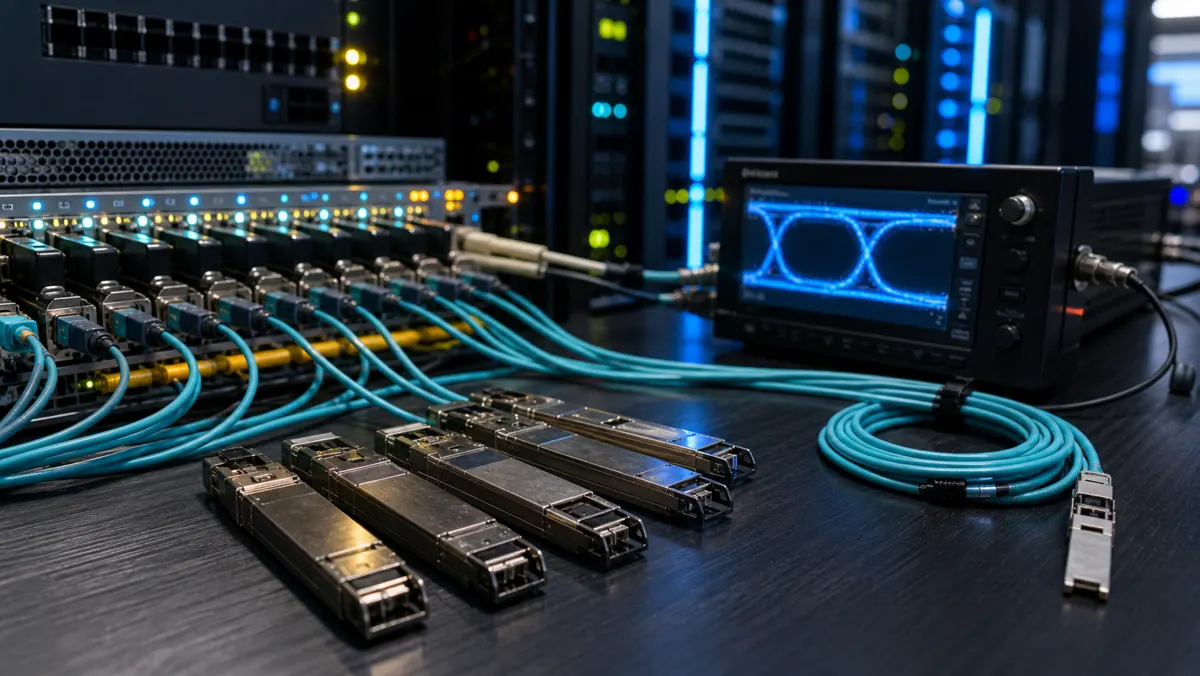
Credo ZeroFlap 800G: why cables and transceivers have become critical infrastructure for AI
Credo Technology launched its 800G ZeroFlap line with a message that seems small, but is huge for AI: the network within the data center has become a strategic boundary. Larger models, distributed clusters, and large-scale training don't just rely on accelerators. They rely on moving data between racks, GPUs, and compute nodes with low loss, low latency, and controlled consumption.
In March 2026, the company announced general availability of 800G 2xDR4 ZeroFlap optical transceivers for AI networks. It also presented related products for high-speed interconnection, reinforcing the thesis that connectivity is no longer an invisible part and has become part of the model's performance.
What is ZeroFlap
The concept aims for operational stability. In data center networks, small link problems can generate rework, loss of throughput, drop in efficiency and diagnostic difficulties. When thousands of accelerators work together, an intermittent failure can degrade training or delay expensive jobs.
Credo's proposal is to deliver transceivers and connectivity solutions capable of reducing interruptions and supporting intense traffic in AI environments. It's not a glamorous technology for the end user, but it's one of those layers that define whether the model trains on time or whether the cluster waits for data.
Why 800G Matters
Modern AI clusters need accelerators to talk continuously. Gradients, embeddings, checkpoints, training data, and distributed inference cross the network all the time. If bandwidth doesn't keep up, expensive GPUs become underutilized. This is financial and energy waste.
800G appears as a response to this pressure. Increasing speed per link reduces bottlenecks and helps operators design denser topologies. But speed alone is not enough. Power, reliability, range, heat, and serviceability determine whether the solution truly improves the data center.
The future it anticipates
The AI race is creating a new hierarchy of key suppliers. Anyone who only looks at models and chips misses half the story. Optics, active cables, switches, DSPs, cooling, and power define the true cost of intelligence.
For companies, this changes infrastructure purchasing. It's not enough to ask which accelerator to use. It is necessary to ask which network supports the cluster, what consumption per port, what failure rate and what diagnostic capacity. The difference between an AI lab and an AI factory lies in these operational layers.
Credo's announcement shows that the next competitive advantage can be born in physical detail. AI looks like software, but its limitations still obey the hard laws of signal, heat, energy, and distance.
What to watch now
The next indicator will be adoption by large cluster operators. If 800G transceivers with lower instability reduce failures, maintenance time and throughput loss, the value appears directly in the training cost. In AI, an hour of cluster downtime can represent a lot of wasted money.
It will also be important to monitor the transition to 1.6T. The interconnection market is moving fast because each generation of accelerators increases pressure on the network. Companies that solve consumption per bit, reliability and diagnostics will have an advantage, even if their products never appear to the end user.
The question for the reader
The AI that seems magical in the app relies on extremely concrete physical links. Before asking just which model is better, it's worth asking which infrastructure allows thousands of chips to think together without tripping over their own cables. This invisible layer will be one of the biggest disputes of the decade.
Practical impact
For data center operators, the network decision is no longer a peripheral purchase. It is included in the cluster ROI calculation. If the interconnect fails, the GPU waits. If the GPU waits, investment in accelerators loses efficiency. This makes for some hard math: every improvement in stability, consumption, and diagnostics can turn into millions saved on large projects.
The profile of strategic suppliers also changes. Companies like Credo start to occupy a more visible space because they solve the pain that appears after purchasing GPUs: making the entire cluster talk without wasting energy or time.
Sources
- https://www.nasdaq.com/press-release/credo-launches-800g-zeroflap-optical-transceivers-engineered-ai-networks-2026-03-17
- https://api.finexus.net/api/news/events/5bf9ddea-1bc3-464a-b41e-9412257af174/html