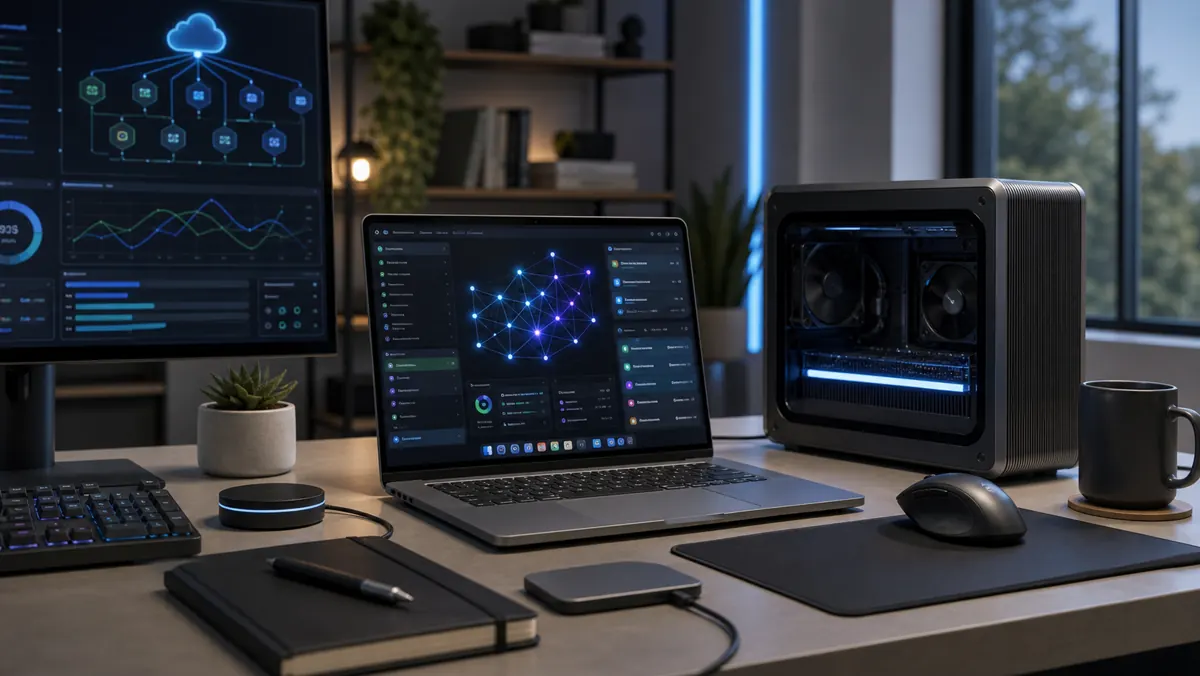
Windows, MacBook M5 and NVIDIA: the PC of 2026 became a competition for local AI
The PC of 2026 is being rebuilt around local AI. The conversation around "Windows 12", MacBook M5, and NVIDIA GPUs doesn't always involve confirmed products as they appear in rumors, but the direction is clear: personal computers need to run agents, small models, multimodal capabilities, and hybrid device-to-cloud flows.
Microsoft pushes Copilot+ and Windows PCs with NPUs. Apple explores Apple Intelligence on Apple Silicon. NVIDIA attempts to bring local GPUs and AI software to creators, developers and workstations. The result is a competition for the machine that will be between the user and the cloud.
Why local AI matters
Running local AI reduces latency, improves privacy and allows offline or semi-offline use. A notebook can summarize files, organize photos, transcribe meetings, suggest commands and review code without sending everything to external servers. This is of interest to companies and users who deal with sensitive data.
But local does not replace cloud. Larger models still require remote compute. The future will be hybrid: light, personal tasks on the device, complex tasks in the cloud, with clear data policies.
The architectural dispute
Windows AI PCs rely on diversity of manufacturers and dedicated NPUs. The advantage is scale. The downside is fragmentation. Apple controls chip, system and software, which favors integration but limits variety. NVIDIA remains strong when the task requires GPU, especially in authoring, development, and heavier local models.
The question is not which wins alone. It is which combination delivers the best experience for each profile: student, creator, programmer, company or gamer.
The role of agents
The PC stops being just a collection of applications and becomes an execution environment. Agents will be able to observe context, access files, use a browser, run commands and prepare tasks. This requires fast hardware, but also permissions, logs, and limits.
A local agent without governance is dangerous. A well-designed local agent can reduce repetitive work and protect data. This will be one of the great battles of trust.
The future it anticipates
Buying a computer will become less and less about just choosing CPU and storage. It will be choosing AI capability, software support and ecosystem. The user will ask: will this notebook be able to run local assistants for four years? Will it have enough memory? Will you receive model updates? Will it consume too much battery?
Personal computing is entering a more interesting phase. After years of incremental improvements, AI has created a real reason to rethink the PC. The challenge is to transform promise into everyday utility.
Practical impact
For businesses, this transition requires inventory. What machines have NPU? Which workloads can run locally? What data should never leave the device? Which users need a GPU? Without these answers, AI PC purchases become fleet swaps without a strategy.
For advanced users, the point will be memory and cooling. Local models require RAM, VRAM, and power. A beautiful but limited notebook can run simple features and get stuck on real tasks. The new fact sheet needs to include AI capability in an understandable way, not just slogans.
The question for the future
The PC is becoming interesting again because it has gained a new function: running personal agents. This can reduce dependence on isolated apps and bring tasks closer together. But it also increases risks. An agent with access to files, browser and commands needs much clearer limits than a chatbot.
What to watch now
The winner will be whoever simplifies this complexity. The user does not want to choose between NPU, GPU and cloud for each task. He wants the system to decide with privacy, speed and reasonable cost.
Closing
The best reading for 2026 is pragmatic: don't buy promise, buy verifiable capacity. An AI-ready PC needs enough memory, good battery life, updates, useful tools, and privacy controls. The fight between Windows, Mac and NVIDIA will be noisy, but the winner for each person will be the machine that turns agents into everyday help, not just another configuration layer.
This transition also changes technical support. When a local agent fails, the problem may be with the model, driver, permission, or application. The smart PC will need to be more explainable, not just more powerful.
Sources
- https://www.microsoft.com/en-us/windows/copilot-plus-pcs
- https://www.apple.com/apple-intelligence/
- https://www.nvidia.com/en-us/ai-on-rtx/