Cloudflare accelerates Browser Run and signals that the browser is becoming agent-native infrastructure
Much of the value promised by agents depends on a skill that is almost banal for humans and very difficult for software: opening a browser, reading a page, filling out a form, extracting content and reacting to what appears on the screen. This is why any serious improvement in browser automation deserves attention. When the browser stops being a side utility and becomes a platform, the web layer returns to the center of agent engineering.
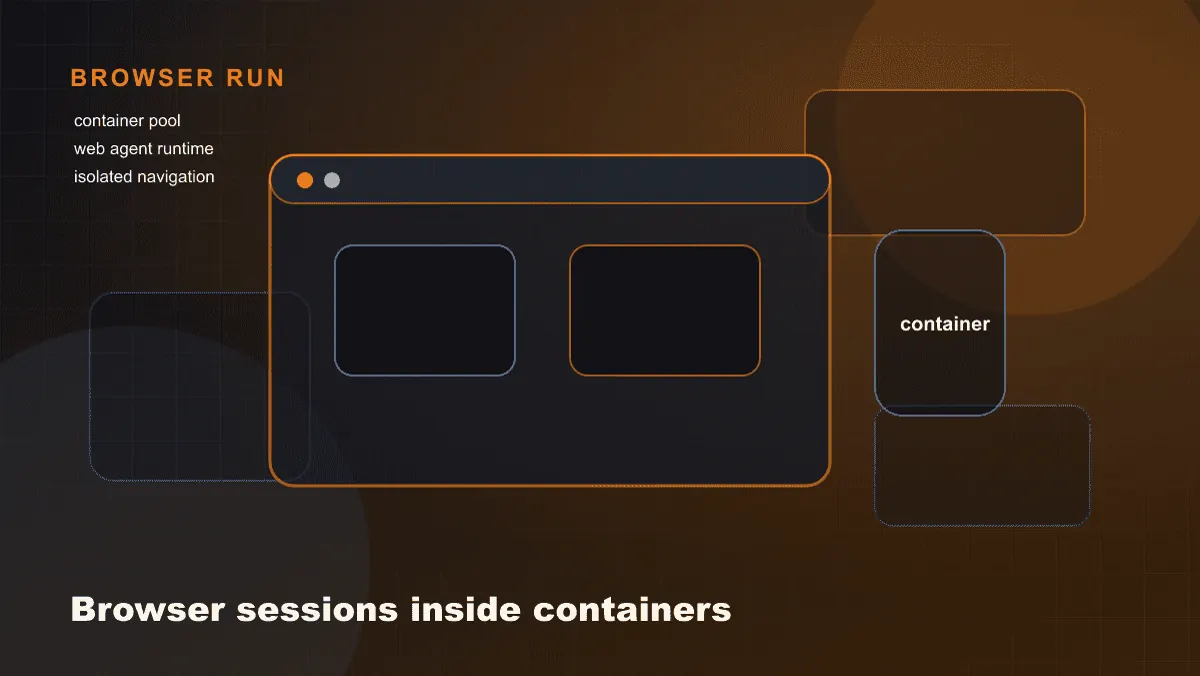
Cloudflare reinforced this in May 2026 with two complementary moves. First, it rebranded Browser Rendering as Browser Run and explicitly presented it as “the browser for agents.” Then, on May 13, it published that Browser Run was rebuilt on Cloudflare Containers, with more scale, better latency and more reliability. The ad is not just operational. It shows where the real demand from agents is already tightening: in the interface with the living web.
What happened
In the April announcement, the company said that Browser Run allows you to run full browser sessions on the Cloudflare global network, controlled by code or AI, with features such as Live View, Session Recordings, Human in the Loop, directly exposed CDP, Puppeteer support, Playwright, WebMCP and Quick Actions. In May, Cloudflare reported that the reconstruction in Containers raised the limits to 60 browsers per minute via Workers binding and up to 120 concurrent executions, four times the previous limit, in addition to reducing Quick Actions latency by more than 50%.
The May text is especially revealing because it admits the source of the pressure: agent builders began using Browser Run in sufficient volume to overwhelm its previous capacity. The company reports that demand for headless browsers grew so much that the architecture with Workers KV and shared infrastructure began to suffer from eventual consistency, concurrent allocation and difficulties in reacting quickly to spikes.
The technique behind
The solution described mixes Containers enabled by Durable Objects, pairing between DO and container close to the user and finer control of the global state of the browsers. In practice, this reduces the time between request and browser availability, improves geographic distribution and avoids some of the capacity races that would appear with a less immediate state layer. It's a classic example of how agents not only come up against models, but also highly specific execution infrastructure.
Another relevant technical detail is the autonomy of evolution. By no longer sharing the same container base with Browser Isolation, Browser Run gained the freedom to update Chrome faster and enable features like WebGL and WebMCP. This point matters a lot for agentic AI, because navigation, visual automation and debugging frameworks depend on the browser as a programmable machine, not just a renderer. If the infrastructure gets stuck in a slow update cycle, the entire product loses traction.
Why this matters
For developers, this means browser automation closer to a standard cloud service, not a handcrafted, team-maintained cluster. E2E tests, screenshot capture, crawling and web interaction by agents now fit better into real flows, including visibility and human intervention. In many cases, the browser is the bridge between the agent and proper tools, or between the agent and visual validation of something that has changed.
There is also a broader effect on agent design. Anyone who builds large-scale web automation knows that the browser is expensive, unstable and full of stateful details. By turning this into a managed product with higher limits and better telemetry, Cloudflare lowers the barrier for agents to actually interact with complex web applications. This helps from small teams to platforms that want to sell browsing agents as part of their stack.
The future it anticipates
The plausible future is to treat the browser as a basic component of agents, alongside memory, code execution and access to tools. It will not just be “a browser attached to the LLM”, but a continuous layer of perception, action and validation on the web. Cloudflare herself mentions Human in the Loop and session recording, signs that the agentic browser is evolving into something observable and auditable, not a blind bot that runs hidden.
The relevant inference here is that browsing the web will once again become a core infrastructure discipline. Companies that master browser runtime, observability and security will have an advantage over those who treat browsing as a peripheral plugin. If agents are to be truly useful in backoffice, support, QA, growth, and operations tasks, the browser will be as important as the language model.
What to watch out for
The risks remain real. Browser automation expands the surface of prompt injection, session leakage, credential abuse and execution of unwanted actions on malicious pages. It is also worth observing cost per volume, elasticity under peaks and quality of human control when the agent is lost. Larger scale does not, in itself, solve the governance problem of autonomous navigation.
Even so, Cloudflare made a move that goes beyond performance. She made it clear that the navigator is no longer an accessory to the agent. It is becoming part of the essential infrastructure for any system that needs to operate in the messiest and most important environment in modern computing: the web.
Sources
- https://blog.cloudflare.com/browser-run-containers/
- https://blog.cloudflare.com/browser-run-for-ai-agents/