Cloudflare wants agents to see cloud customers and buy domains without asking a human for help
Until now, many agents were already able to write code. The bottleneck came a few minutes later, in the part where the real world required an account created, payment method, API token and domain purchased. In other words: the boring stage that remains human. Cloudflare's new ad is interesting precisely because it attacks this point of friction. He tries to make the agent cross the last mile between building something and putting it on the air with its own identity.
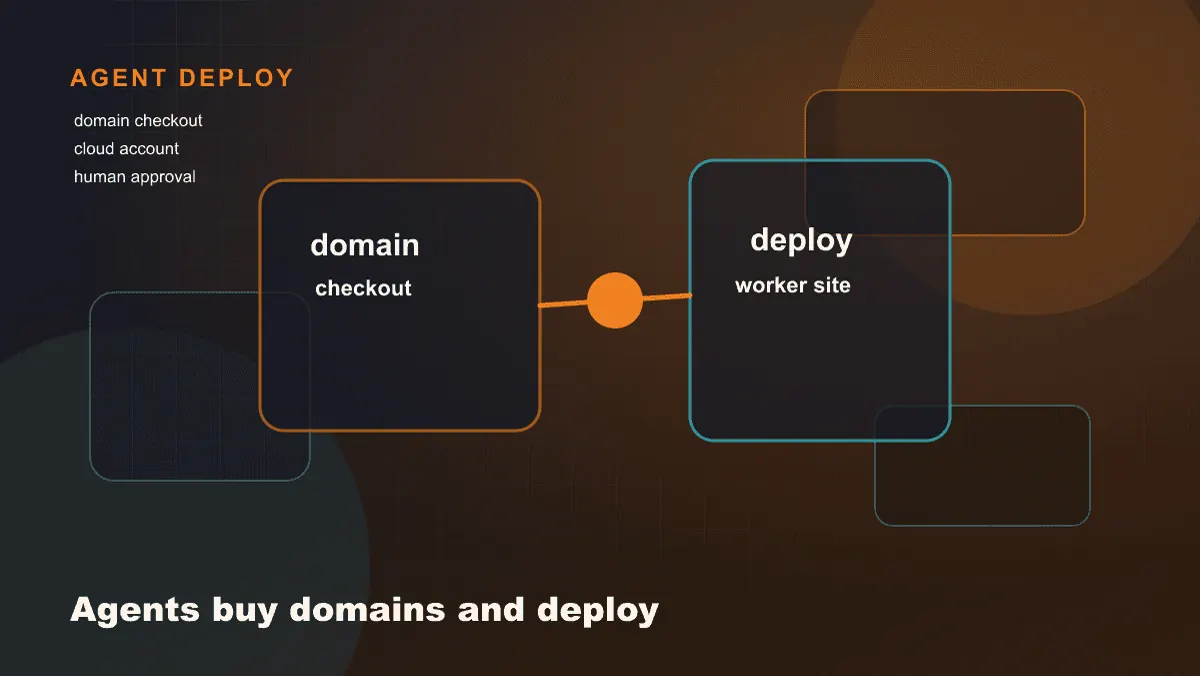
In the April 30, 2026 post, Cloudflare announced that agents can now create accounts, buy domains and deploy applications through an integration with Stripe Projects. The company states that, from this flow, the agent can provision a Cloudflare account, start a paid subscription, register a domain, receive a API token and publish it in production without needing the person to visit the dashboard, copy a secret or enter a card manually. The human being enters to consent when necessary, not to perform each step.
What happened
The announcement describes an almost entirely agent-mediated “zero to production” flow. Cloudflare explains that, if the user is already authenticated on Stripe, the agent can start a project, discover the services available through the catalog, choose Cloudflare as a provider, create or link an account, obtain authorization, use a tokenized payment method and register a domain before publishing the application. If there is already a Cloudflare account linked to the email, a standard OAuth flow enters. If it doesn't exist, the account can be automatically provisioned.
More than an isolated resource, the company presents a protocol composed of three blocks: discovery, authorization and payment. The text emphasizes that these pieces use familiar foundations such as OAuth, OIDC and payment tokenization, but combined to remove steps that previously disrupted agent autonomy. The implicit conclusion is simple and powerful: if software can create, it must also be able to hire, accredit, and publish.
The technique behind
Technically, what changes is the transformation of cloud services into a catalog that can be accessed by agents. Previously, many platforms exposed APIs for use after a human resolved registration, billing and credentials. Now, the resource acquisition itself comes within the scope of the agentic flow. The agent consults the catalog, selects a service, triggers delegated authorization and operates with credentials issued securely for the session. This is very different from simply storing a previously configured API key.
Cloudflare also associates this advancement with its ecosystem of Code Mode MCP server and Agent Skills, but makes it clear that the basic flow works even without extra preconfiguration. This point matters because it reduces the adoption threshold. The feature isn't just selling convenience to power users; is proposing that infrastructure platforms start treating agents as first-class customers. In terms of product architecture, this is almost a new layer of onboarding for software.
Why this matters
In practice, the impact is enormous for app generation, commercial prototyping and on-demand software. The hard part of “publish a website now” was never just generating files. It was dealing with account, domain, billing and token. If these steps can be followed by an agent with controlled consent, the time between idea and functional URL drops radically. This is of interest to both coding agents and platforms that want to offer complete experiences to end customers.
There is an even greater economic effect. When infrastructure, identity and payment begin to respond to agents, an embryonic form of machine-to-machine commerce with human supervision is born. Cloudflare and Stripe are testing precisely this bridge. If the model becomes widespread, digital services could be discovered, contracted and operated by software acting on the user's behalf, with built-in spending and authorization rules.
The future it anticipates
The plausible future is a market in which agents not only use APIs, but also choose suppliers, open services, renew subscriptions and change settings according to the user's goals. In a mature scenario, launching a digital project may feel less like “setting up five panels” and more like “giving budget, policy, and goal to an agent.” The Cloudflare announcement is a first concrete step in that direction.
The inferential, and decisive, part is governance. If agents can purchase resources and publish software, budget design, limits, reputation and legal responsibility become a central part of the product. The fascinating side of the news is the gain in autonomy. The serious side is that financial and operational autonomy requires containment mechanisms that are as strong as those for release.
What to watch out for
It is worth observing how Cloudflare and partners will deal with abuse, fraud, malicious provisioning and liability for improper agent actions. It will also be crucial to track the quality of experience for everyday users: how much consent is too little, and how much consent turns the promise of autonomy into annoying flux. Another point is the competitive effect. If infrastructure starts to be chosen by agents based on catalogs and policies, UX for machines could become as important as UX for humans.
In any case, the announcement already changes a market premise. Agents who only write code still depend on people to finish the work. An agent who creates an account, buys a domain and publishes an app starts to look less like an assistant and more like a digital operator with a temporary wallet and badge.
Sources
- https://blog.cloudflare.com/agents-stripe-projects/
- https://blog.cloudflare.com/en-us/tag/registrar/