Broadcom bets that the next AI battle will not just be in the data center, but in the edge network
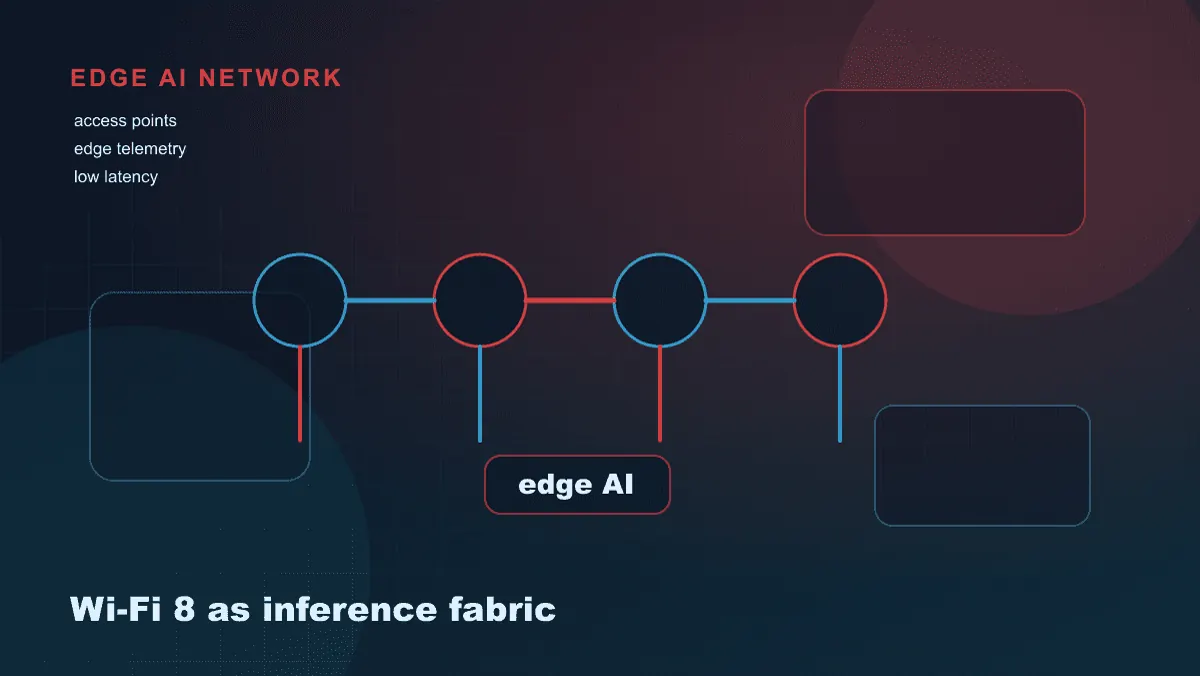
The conversation about AI infrastructure often stops at the data center, the rack, and the GPU. Broadcom wants to focus on a less glamorous but decisive bottleneck: the network that connects devices, homes, offices and gateways where AI applications truly touch the world. On June 1, 2026, the company introduced a broadband Edge AI portfolio with Wi‑Fi 8, 50G PON and platforms that embed local processing for residential and corporate applications. ## What happened In its investor statement, Broadcom described its new lineup as an AI-ready connectivity fabric at the edge. The package includes a gateway SoC for 50G PON, a complete Wi‑Fi 8 family, and a combined 5G and Wi‑Fi 8 solution for fixed wireless access. The company's argument is that instant conversational assistants and other intelligent workloads will require deterministic latency, localized processing, and greater privacy protections. Translation: Broadcom doesn't just want to sell more bandwidth. It wants to sell the idea that the connected edge will be a place for inference and preprocessing, not just transport. When the company emphasizes embedded NPUs in access equipment, it is suggesting that some of the intelligence should occur close to the user to reduce congestion, speed up response and limit the unnecessary sending of sensitive data. ## The technique behind This thesis makes sense for three technical reasons. The first is latency. Many conversational and multimodal AI flows lose value when the round-trip is unpredictable. The second is network cost. If everything goes raw to the cloud, the pressure on backhaul, congestion and energy consumption grows quickly. The third is privacy. Inferencing or filtering locally decreases raw content exposure. Wi‑Fi 8 comes in as a piece of stability and coordination, not just peak speed. In networks full of devices, the challenge is not just maximum throughput; is to maintain low jitter, consistent response, and efficient sharing of the medium. When Broadcom talks about multi-gig, sub-millisecond connectivity and localized intelligence, it is pushing the network closer to computing system logic. The use of APUs or NPUs in access nodes also points to a reconfiguration of the edge. Instead of modems and access points acting as passive boxes, they now participate in policy execution: classifying traffic, anticipating priorities, protecting sensitive sessions, and perhaps even hosting local agents or filters for simple tasks. It is a way of distributing intelligence throughout the network. ## Why this matters The announcement is relevant because it reminds us of a point that a lot of model hype forgets: useful AI needs a system. A multimodal home assistant, a corporate environment with smart cameras and sensors or a connected factory do not scale with a strong model alone. They scale with predictable networking, good orchestration, and partial processing close to the data source. For operators, this can redefine part of the value proposition. Instead of just selling access, they can sell ready-made infrastructure for more responsive and private smart experiences. For companies, it opens up space for edge AI in branches and campuses without depending on constantly going to the cloud for each micro-decision. For the hardware market, it reinforces the idea that the next phase of AI requires convergence between connectivity and computing. ## The future it anticipates The plausible future is a more hierarchical architecture. Sensors and devices do lightweight, contextual inference. Gateways and access points perform filtering, prioritization, and perhaps small agent tasks. The cloud gets training, global coordination, large memory and higher-cost reasoning. This reduces perceived latency and improves systemic efficiency. If this vision advances, the access point of the future will look less like a network peripheral and more like an intelligent micro computing node. This shift matters because the fight for value in AI can go down a layer. Whoever controls where network and inference meet controls a critical part of the experience. ## What to watch out for The thesis still needs to prove adoption and use case clarity. Not every workload deserves NPU at the gateway, and the risk of over-engineering is real. It will also be necessary to observe standards and compatibility: Wi‑Fi 8 needs to leave the promotional material and enter a consistent ecosystem of clients, routers and management software. Another point is security. The more intelligence embedded at the edge, the more the attack surface expands. The promise of local privacy is only valid if these devices have robust updating, isolation and governance. If Broadcom and its partners can deliver this, the connected edge could go from being mere plumbing to one of the most strategic fronts in applied AI.
Sources
- https://investors.broadcom.com/news-releases/news-release-details/broadcom-connects-ai-edge-comprehensive-multi-gig-broadband-and
- https://investors.broadcom.com/