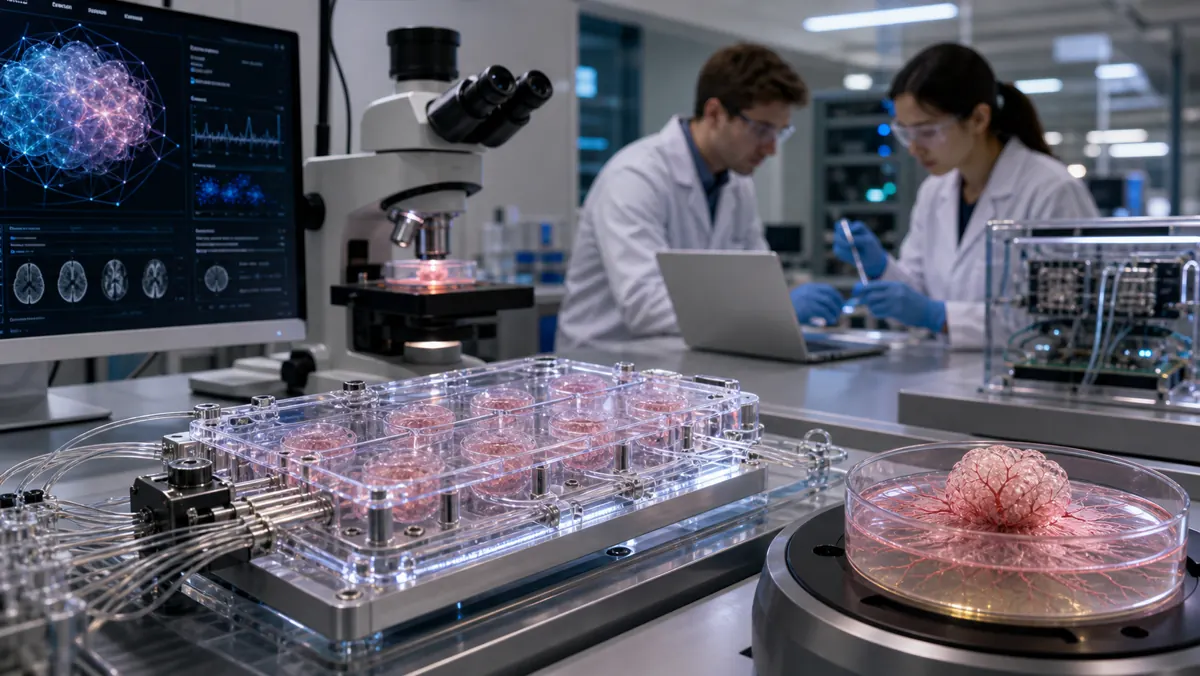
Commercial Biocomputers: Organoids, Living Chips, and the Ethical Frontier of Computing
Commercial biocomputers no longer belong solely to science fiction. Companies like FinalSpark and Cortical Labs offer platforms that connect neural cells, organoids or biological cultures to digital systems. The promise is to study learning, create new computing models and explore energy efficiency far beyond traditional silicon.
But it's important to use the word "commercial" carefully. These systems are not replacing GPUs or notebooks. They are research and development platforms, still experimental, with enormous potential and big ethical questions.
What's available
FinalSpark offers Neuroplatform, described as an online platform for neural organoid research. Cortical Labs introduced the CL1 as a biological computer in a box, aimed at researchers and developers interested in living cells integrated with electronics.
These platforms allow you to observe activity, apply stimuli and study responses. The goal is to understand how biological systems can learn, adapt and perhaps perform computational tasks differently than traditional machines.
Why this matters
The human brain consumes little energy compared to AI data centers. This comparison inspires biocomputing research. If living systems can perform certain types of processing efficiently, future computing could include biological components in specific tasks.
But there is a lot of distance between the laboratory and the general product. Living cells need nutrients, a controlled environment, stability and ethical protocols. There are also limits to reproducibility and interpretation. The fact that a neural culture responds to stimuli does not mean that we have a "computer brain" that is conscious or useful for any task.
The ethical frontier
Biocomputing asks questions that traditional computing did not ask. What type of fabric is being used? Is there a possibility of suffering? How to define experimentation limits? Who regulates? How to ensure transparency? Even though the current systems are far from conscious, the area needs to grow ethically from the beginning.
This is a crucial difference from the hype. Fascination cannot trample responsibility. Commercial platforms expand access and accelerate research, but they also require clear standards.
The future it anticipates
The most likely scenario isn't a home biocomputer in 2026. It's the emergence of labs using hybrid platforms to study learning, drugs, neuroscience, and new forms of processing. Biocomputing can help understand intelligence as much as it can help create new devices.
For the reader, the main curiosity is philosophical and technical: to what extent can we use living systems as part of computing? The response needs to be constructed with science, regulation and prudence.
Practical impact
For researchers, commercial platforms reduce barriers. Instead of setting up the entire laboratory from scratch, teams can access standardized environments to test hypotheses. This can accelerate neuroscience, pharmacology, bioelectronic interfaces and learning studies.
For traditional computing, the impact is still indirect. Biocomputers do not compete with AI data centers today. They help ask new questions: What kind of processing do living cells do well? How do they learn? How do they adapt? How to measure behavior without projecting consciousness where it does not exist?
The ethical question
The area will need rules before it grows too large. Researchers must define complexity limits, forms of monitoring, disposal, consent for biological material and transparency about objectives. Enthusiasm can't rely on vague language like "mini-brain" to gain attention.
What to watch now
The sign of maturity will be peer-reviewed publication, clear protocols, and honest comparison with traditional methods. If commercial platforms produce useful science, biocomputing will gain respect. If they promise too much, they will lose trust.
Closing
Biocomputing is one of the most fascinating fields precisely because it forces technology to stay humble. We're not just piling on more transistors; we are trying to talk to living systems. This can open up incredible avenues for science and efficiency, but it also requires precise language. Calling everything a "living computer" may sell headlines, but maturity will come when research, ethics and application go hand in hand.
The reader must follow the area with fascination and skepticism at the same time. Fascination because there is real science happening. Skepticism because the distance between biological demonstration and practical computers is still large.
When this distance decreases, computing could gain a new language, a hybrid between engineering, biology and applied ethics.
Sources
- https://finalspark.com/neuroplatform/
- https://www.corticallabs.com/cl1
- https://www.nature.com/articles/s41928-023-01069-w