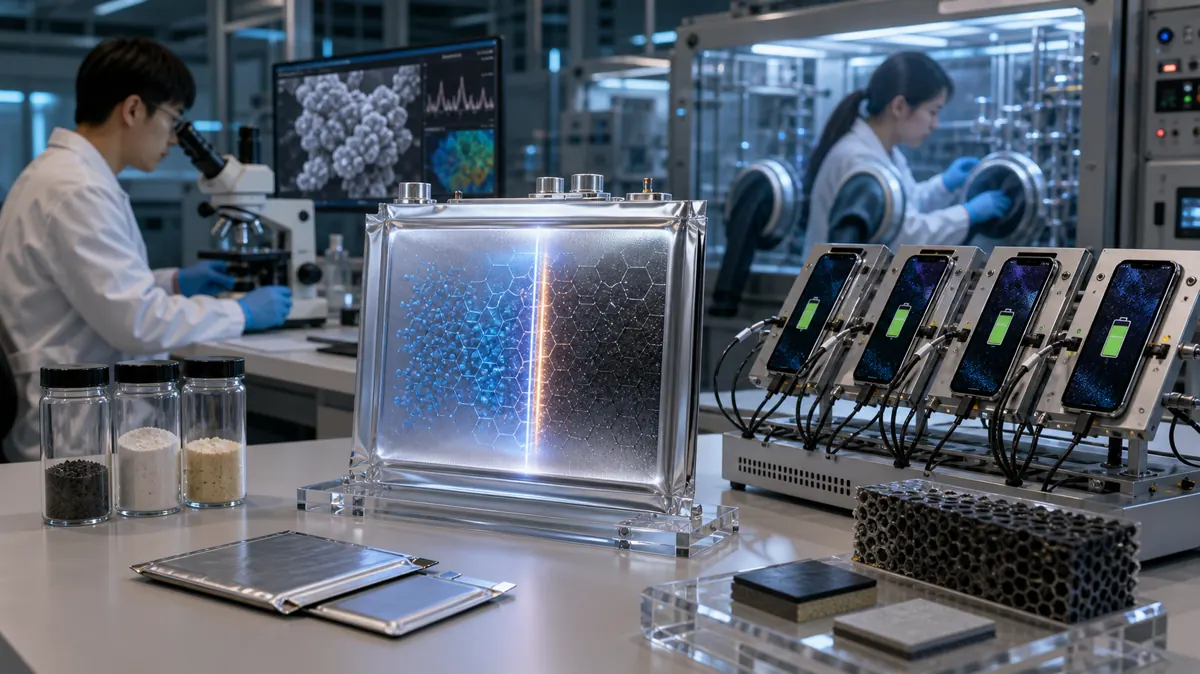
Solid-state batteries in cell phones: why weeks of autonomy are still a promise, not a reality
Solid-state batteries remain one of mobile technology's most alluring promises. The idea of a smartphone with autonomy of many days, fast charging and less thermal risk seems inevitable. But in 2026, the reality is even more cautious: advances exist, especially in silicone-carbon materials and batteries, but "weeks of autonomy" is not yet a commercial standard.
Solid state exchanges liquid electrolyte for solid material, which can improve safety and energy density. The problem is to transform this into a cheap, durable, thin and manufacturable product in millions of units.
What is already changing
Cell phone manufacturers have explored higher density batteries, including silicon anodes and silicon-carbon chemistries. This allows for more capacity in the same volume, something crucial in increasingly thinner smartphones. The evolution first appears as an incremental gain: a few extra hours, better durability and more efficient charging.
Full solid state still faces hurdles. Interfaces between materials, load cycles, mechanical expansion, cost and scale production are difficult challenges. A battery that works in the lab can fail when it has to survive heat, dropping, daily charging, and years of use.
Why this matters now
Mobile AI increases energy pressure. Camera resources, translation, image generation, local assistants and brighter screens consume more. If the smartphone becomes an AI platform, the battery will once again become a central limit.
There is also a security issue. Denser batteries need to be extremely reliable. An error in millions of units results in a recall, financial damage and risk to the user. Therefore, companies move slowly.
The future it anticipates
The leap in autonomy may not come from a single miraculous technology. It can come from a combination: denser batteries, more efficient chips, better screens, smart charging, AI that manages consumption and software that reduces background tasks.
The consumer should be wary of absolute promises. "Two weeks of battery life" may happen under specific conditions, but actual usage includes camera, network, gaming, video, AI, and high brightness. The important advance will be to achieve two or three days of intense use safely and with a decent useful life.
What to watch now
Look for signs of mass production, not just prototypes. Who manufactures? What energy density? How many cycles? What operating temperature? What cost? The battery of the future needs to leave the laboratory and survive in your pocket.
Practical impact
For manufacturers, the battery is the hardest part to promise. A new chip can be launched with controlled risk; a defective battery becomes a safety crisis. Therefore, adoption on smartphones tends to be conservative. Chemistry needs to prove stability in millions of units before it becomes mass marketing.
For users, the most likely short-term gain is less dramatic than "weeks." Devices with an autonomy of two real days, cooler charging and less degradation after two years would already be a huge advance. In countries where charger, energy and mobility matter, this changes everyday experience.
The question for the future
Mobile AI increases consumption, but can also help reduce spending. Systems can predict routine, shut down useless processes, optimize brightness, choose network and manage charge to preserve battery health. The next revolution could combine new chemistry and smart software.
What to watch now
Be wary of isolated numbers. Energy density, cycles, thermal safety, charging time and cost need to go together. The ideal battery is not just the one that lasts the longest, but the one that lasts the longest with safety, price and viable production.
Closing
The curiosity about batteries is fair because autonomy remains one of technology's most universal frustrations. But the real path is incremental. Before weeks without charging, we'll see better materials, smarter software, and less aggressive charging. This progress may seem modest, but it is exactly the type of innovation that improves the lives of millions of users without needing a revolution announced in giant letters.
For those who follow the sector, the most honest metric will be useful life. A battery that is impressive in the first month, but degrades quickly, will not solve the problem. The future needs to combine autonomy, security and healthy aging.
Sources
- https://www.samsungsdi.com/pr-center/news/2026.html
- https://www.imec-int.com/en/articles/solid-state-batteries
- https://www.nature.com/articles/s41560-024-01478-7