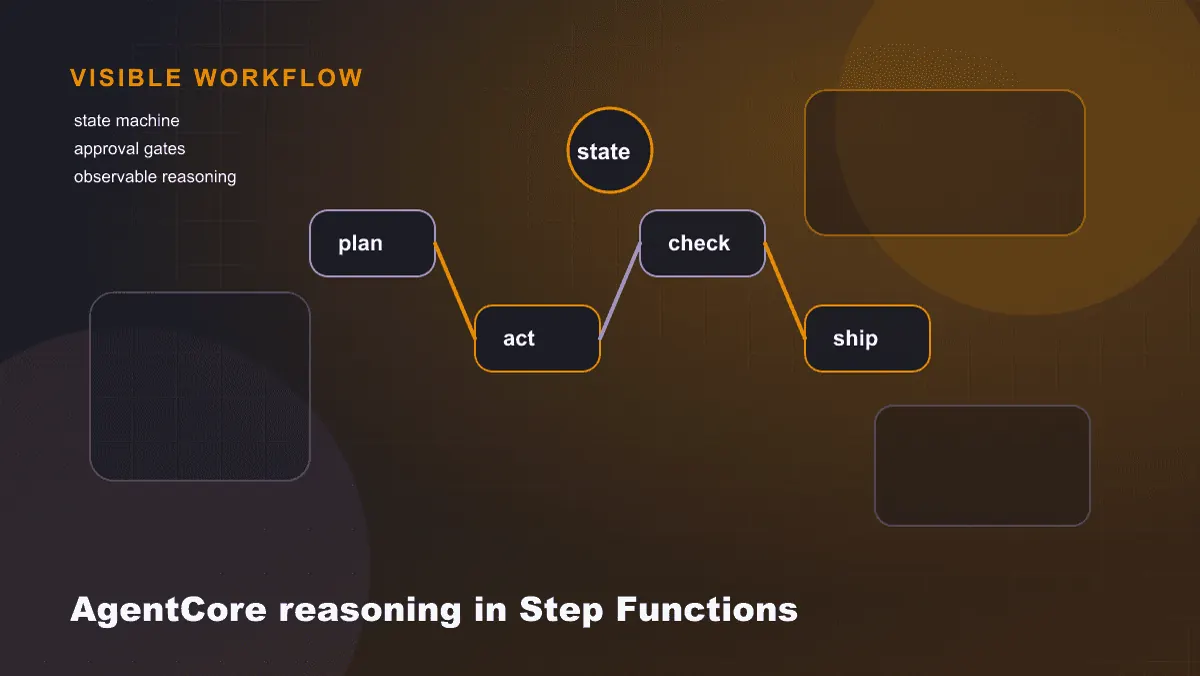
AWS puts agentic reasoning inside Step Functions and tries to tame the agent with visible workflow
One of the big problems for corporate agents is not just making the model think. It's making this thought fit into a system that has history, error handling, human approval and operational responsibility. Without this, the agent becomes an expensive black box. That's why AWS's latest Step Functions announcement may be more relevant than many model releases: it attempts to place agent reasoning within a framework that companies already understand.
On June 3, 2026, AWS announced that Step Functions gained an agentic reasoning step integrated into the Amazon Bedrock AgentCore Harness, still in preview. In practical terms, this means that visual orchestration flows can now call steps in which a deliberative agent comes into action, using a harness managed by AWS itself. The gain is not just adding AI to the workflow; is to make AI an auditable and parameterizable step in the workflow.
What happened
According to the official announcement, the integration allows you to automate tasks such as document classification and extraction of elements from unstructured forms. You can also run multiple agents in parallel or in sequence at different points in the same flow and insert human approval before critical actions. AWS also highlights that the execution history shows entry, exit, token usage and duration, with links to details of interactions in CloudWatch.
Another important point is operational flexibility. The company claims that it is possible to reuse an existing harness or create a new one directly in Workflow Studio. Furthermore, each invocation accepts model, system prompt and tool overrides, which allows the agent's behavior to be adapted to the specific context of that flow without duplicating configuration. Finally, the agent context can persist session ID within or between executions.
The technique behind
Technically, the proposal tries to separate two concerns that are normally mixed. Step Functions takes care of deterministic orchestration: order, parallelism, retries, errors, approvals and integration with other services. AgentCore Harness takes care of the agentic loop: model, tools, behavior and deliberation. By coupling the two layers with operational visibility, AWS turns the agent into a called and measured component, not a makeshift system outside the main flow.
The presence of invocation overrides is a powerful detail. It allows the same harness to be reused in different flows, changing tool, model or prompt without opening up an explosion of almost identical variants. This is important because the big nightmare of enterprise agentic automation is the duplication of difficult-to-govern configurations. Persistence by session ID also indicates that AWS is thinking about agents that need to carry context between decisions, but still be tied to traceable execution.
Why this matters
In practice, this matters because it brings agents closer to the type of infrastructure that real companies agree to operate. Visual workflow, execution history, observable costs, and human approval points are familiar elements for platform engineering and compliance teams. When AWS places the agent within this perimeter, it reduces the feeling that agentic AI is an unwieldy experiment.
There is also value for smaller teams. Instead of building their own orchestration, logging and error handling on top of an agent framework, many can reuse Step Functions as the backbone of the process. This doesn't eliminate prompt, tool, or data complexity, but it shifts some of the work to a mature workflow product. For AWS, it's a smart move: selling agents not as isolated magic, but as a natural extension of what customers already use.
The future it anticipates
The plausible future is a convergence between BPM, event-driven systems and agents. In this scenario, traditional steps remain deterministic, but certain decision points begin to trigger policy-controlled adaptive reasoning. It won’t be “everything becomes an agent”; it will be “the agent enters where the fixed rule is too expensive or too insufficient”. The AWS announcement fits well with this vision because it insists on context, auditing and parallel or sequential use within the flow.
The most interesting inference is that the dispute in the corporate market can migrate from the best raw agent to the best agent domestication environment. Companies tolerate a certain amount of semantic uncertainty; do not tolerate total opacity in critical processes. If Step Functions can offer a reliable path for agentic decisions, AWS gains an advantage in an area that is often underestimated: governing behavior, not just making the model available.
What to watch out for
The obvious precautions continue. Each agentic step adds variable cost, risk of prompt drift and the possibility of responses that are difficult to validate automatically. Observability of tokens and duration helps, but is not a substitute for quality testing. You will also need to look at how persistent session IDs affect privacy, retention, and large-scale debugging.
Even so, the announcement has rare merit: it does not sell the agent as a universal replacement for the workflow, but rather as an integral part of a serious workflow. For companies tired of pretty demos and nebulous operations, this may be worth more than any superlatives about intelligence.
Sources
- https://aws.amazon.com/about-aws/whats-new/2026/06/aws-step-functions-agentcore/
- https://aws.amazon.com/blogs/aws/category/artificial-intelligence/strands-agents/