AWS shows how to take agents to SRE and suggests that autonomous operations can go from slide to duty
Operations teams have long lived with an irritating paradox: monitoring generates too many signals, but useful understanding comes too late. The promise of “AIOps” tried to solve this with rules, dashboards and a little ML, but it rarely actually changed the on-call experience. The post published by AWS on June 3, 2026, “How to build self-driving AI operations on Amazon Bedrock at scale”, is interesting precisely because it tries to push this conversation to a more operational level. Instead of talking generically about AI for observability, the company shows a concrete architecture for detecting problems, adjusting alarms, classifying incidents and opening cases automatically.
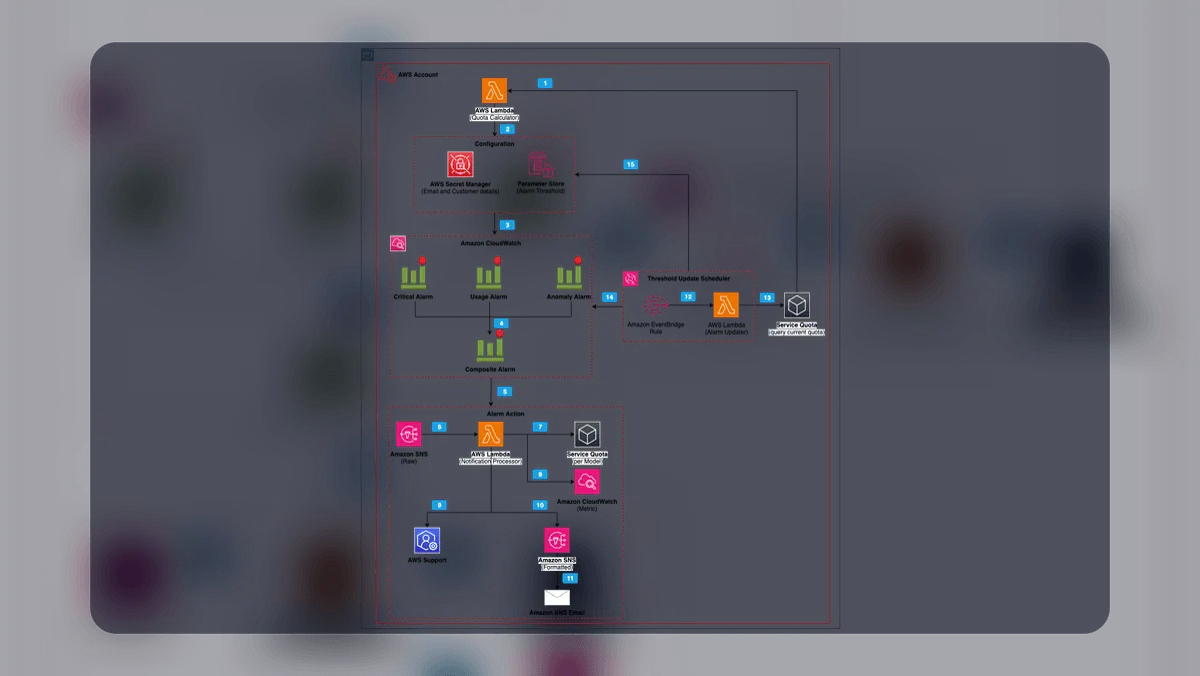
The name of the solution presented in the article is Bedrock Ops Alert. The proposal is to function as an automated monitoring layer at three levels, combining Amazon Bedrock, CloudWatch, Lambda and operational support logic. The main point is not to “replace SREs”, but to reduce the mechanical work of triage and referral that consumes a lot of time before the real human part of diagnosis and decision. In companies where incidents are repeated with loud noise, this can represent a relevant gain.
What happened
In the official post, AWS describes Bedrock Ops Alert as an automated three-tier monitoring solution. According to the company, it detects operational problems, dynamically adjusts alarm thresholds, classifies alarms by category, creates contextualized support cases, avoids ticket duplication when there is already an open case of the same type and notifies AI SRE teams with more context. Confirmed fact: it's not just a conceptual ad; there is an explicit architecture designed for implementation.
This type of publication has a different tone than classic press releases, but this does not reduce its importance. Plausible Inference: AWS is using technical posts to push its framing of the next phase of cloud operations. The idea of “self-driving AI operations” works as a narrative to say that observability, classification and operational response must migrate from predominantly human systems to flows in which agents do the first major part of the work.
The technique behind
The most important technical aspect is the notion of layered monitoring. Instead of treating each alarm as an isolated event, the architecture combines threshold adjustment, categorization, and actionable context generation. This reduces two classic problems: false positives due to poorly calibrated thresholds and wasted time with redundant or information-poor tickets. When the solution avoids opening a new case if there is already an unsolved one in the same category, it introduces operational memory into the automation, which is crucial to not transform AI into a noise factory.
It's also worth noting that the solution was designed around AWS's managed services, especially Bedrock, Lambda and CloudWatch. This suggests a path where operational agents are not isolated products, but compositions of cloud services with supporting LLMs, rules, and integrations. The potential gain is less in the “raw” model and more in the ability to weave together context, history and action with low friction.
Why this matters
In practice, this matters because operational shifts continue to suffer from an excess of poorly prioritized events. Even mature teams spend too much time understanding whether an alarm is a symptom, a cause, or repeated noise. If an automatic layer can group, classify and open the right case with the right context, the quality of human work rises. The team spends less energy on bureaucracy and more on actual remediation.
There is also an economic and organizational impact. Confirmed fact: AWS is showing a way to automate part of the SRE workflow with AI integrated into the cloud itself. Inference: This reinforces the bet that the next big enterprise use case for agents will not just be coding, but also ongoing operations. In large environments, every minute saved on incident triage multiplies value in availability, focus and avoided costs.
The future it anticipates
The plausible scenario is a gradual transition to agent-assisted operations at various levels: adjusting thresholds, detecting anomalies, contextualizing incidents, proposing remediation and perhaps, in more controlled cases, automatically executing reversible actions. Complete “self-driving” still requires a lot of caution, but the first phase already seems mature enough to gain ground in organizations that suffer from operational scale.
At the same time, there are important questions. How to ensure that automation does not hide rare signals? How to audit agent decisions in critical environments? How to balance noise reduction with adequate sensitivity? The classic risk of AIOps remains valid: when the system tries to clean the dashboard too much, it can hide the very unlikely event that matters most. The future good of this approach depends on layers of review, explainability, and clear human fallback mechanisms.
What to watch out for
It's worth watching actual adoptions and whether AWS transforms this architectural pattern into a more packaged product. It will also be important to monitor how the solution handles very different incident categories, because excessive standardization can break down complex operations. Another relevant metric is team trust: SREs only delegate more to automation when it proves consistency under pressure.
AWS's post does not mean that autonomous operations have fully arrived. But it shows something more valuable than slogans: a concrete architecture to begin with. In an industry tired of vague promises about intelligent observability, this is already a considerable step forward.
Sources
- https://aws.amazon.com/blogs/machine-learning/how-to-build-self-driving-ai-operations-on-amazon-bedrock-at-scale/
- https://aws.amazon.com/blogs/machine-learning/