Apple uses Apple Intelligence to address a real problem: accessibility that understands context
Much of AI advertising promises to make life easier for everyone and ends up sounding generic. Apple chose a more concrete path on May 19, 2026: it brought Apple Intelligence into accessibility features that depend on contextual understanding, natural language and vision, including VoiceOver, Magnifier, Voice Control, Accessibility Reader and on-device captions. The confirmed fact is the set of features announced for later this year. The reason this is more interesting than it first appears is simple: accessibility is often where the real usefulness of AI becomes visible early, because the test is not entertainment. It is autonomy.
What happened
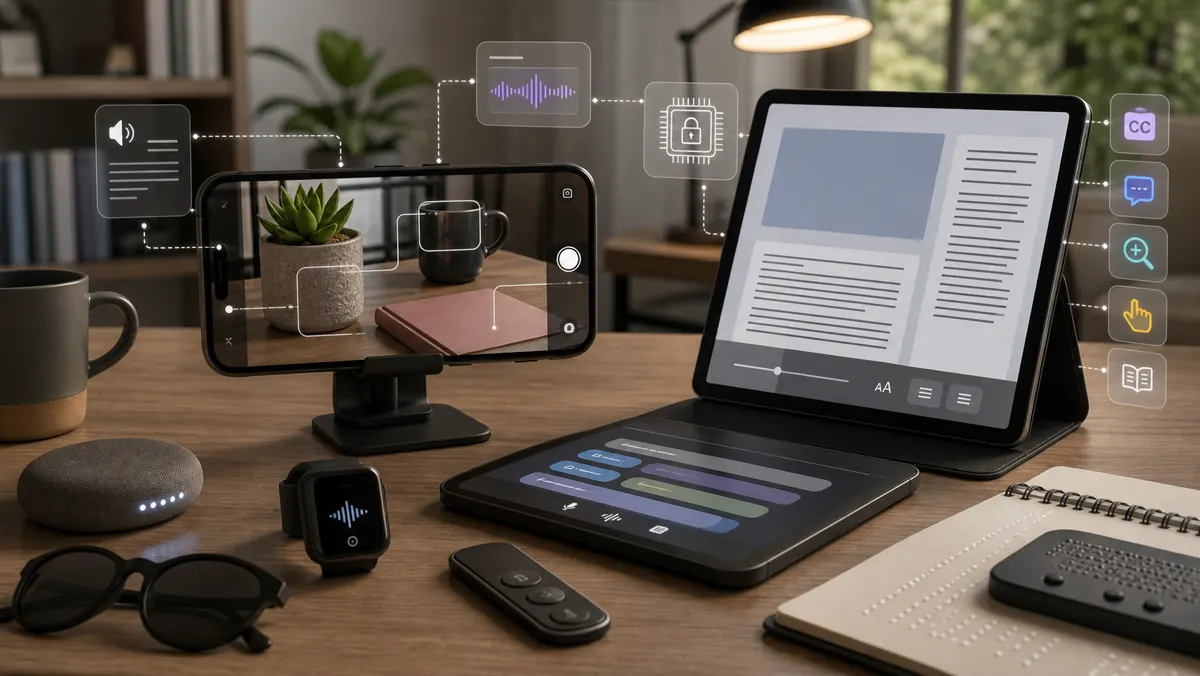
Apple's release highlights richer image descriptions, natural-language questions about what appears in the camera view, more flexible voice controls, adapted reading for complex materials such as scientific papers, automatic captions for videos without captions and even eye-based control for compatible wheelchairs in Vision Pro. The company emphasized one point in particular: privacy by design. Confirmed fact: much of the experience was presented as on-device processing or with strong privacy emphasis. Plausible inference: Apple is trying to turn assistive AI into a competitive argument where hardware, software and local execution work together to reduce friction without asking users to hand intimate context to a distant cloud.
The science behind it
What makes this update technically important is the combination of multimodality and contextual inference. Describing a scene, understanding what a user means by saying "tap the purple folder" or reformulating a scientific text into a more readable format requires connecting vision, language and interface state. In automatically generated captions, speech recognition also enters the picture with strong privacy and latency requirements. The preference for on-device processing matters because accessibility often involves sensitive data: images of the environment, personal documents, private videos and mobility routines. By pushing these capabilities to the edge, Apple tries to solve two things at once: trust and availability. Assistive resources need to work quickly, with little friction and without always depending on perfect connectivity.
Why it matters
In practice, this could change the minimum expected standard for digital accessibility. Blind and low-vision users may gain richer descriptions and more natural questions about the environment. People with motor limitations may interact without memorizing coordinates or exact labels. Users with dyslexia, deafness or hearing loss may see reading and video become more accessible in material that traditionally arrived poorly prepared. The impact also extends beyond Apple. When a company of this size turns assistive AI into a system-level feature, it pushes competitors and app developers to raise the bar. The risk remains: if the model misreads critical context or if certain languages and regions lag behind, the promise of inclusion can become unequal precisely where it matters most.
The future it anticipates
The plausible scenario is an evolution in which the best personal AI is not the one that impresses most in open conversation, but the one that perceives invisible barriers and removes friction before it becomes an obstacle. What is confirmed is the arrival of smarter assistive features in the Apple ecosystem. What still needs to be watched is language coverage, quality in ambiguous situations and consistency outside demos. A deeper question also remains: if on-device AI truly matures in this area, will accessibility stop being a collection of separate features and become a permanent adaptive layer of the interface?
What to watch
The main point to watch is the real rollout. Which devices will support all functions? In which languages? And with what quality outside English? It is also worth following the response from accessibility communities, because they often detect early the difference between a sensitive announcement and a truly reliable feature. If Apple delivers what it promised, this may become one of the most honest and transformative uses of personal AI in 2026. If there are delays, regional limitations or a wide gap between demo and daily use, criticism will arrive quickly too, because accessibility does not tolerate the kind of error margin the market still accepts in general-purpose AI productivity toys.
Sources
- https://www.apple.com/newsroom/2026/05/apple-unveils-new-accessibility-features-and-updates-with-apple-intelligence/
- https://www.apple.com/newsroom/topics/apple-intelligence/