Adobe and Gemini: when creation stops living inside an application
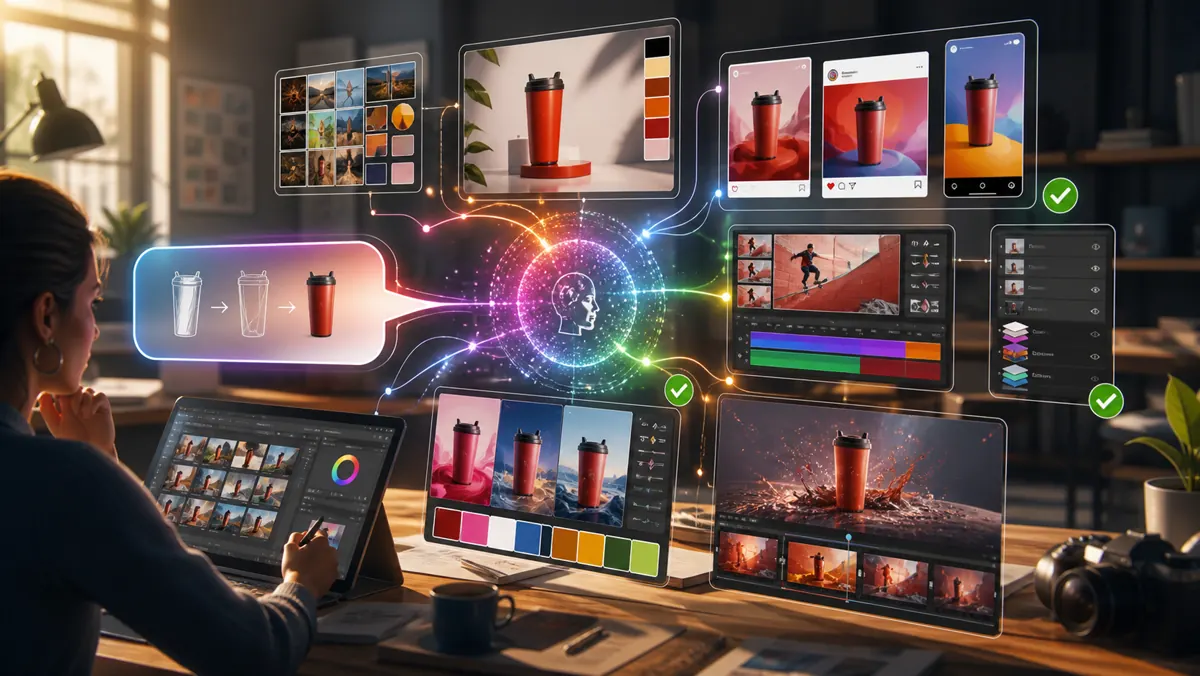
Imagine a small store preparing a campaign to launch a product over the weekend. Before, the normal path would be to open a chat to think about the concept, then switch to an image tool, go back to adjust the text, open another application to resize posts, perhaps another for video, and still finish everything in a professional editor. The promise of Adobe's new connector for Google Gemini is to shorten this maze: the person describes the result they want, and a creative agent organizes the steps behind it.
Adobe announced on May 19, 2026 that Adobe for creativity will be coming to Gemini in the coming weeks. The new feature was presented in the context of Google I/O and expands a strategy that the company had already been testing with Firefly AI Assistant and the Adobe for creativity connector for Claude. The central point is not just to generate a beautiful image. It's transforming an intention into a production flow: mockup, social piece, video format, visual variation and file that can continue to be edited.
What happened
According to Adobe, Gemini users will be able to describe what they want to create and trigger Adobe's professional image, design and video tools directly in the conversation. The company talks about professional-grade tools, agent orchestration and continuity with Firefly Boards, Photoshop, Illustrator, Premiere and Express.
The difference to a common image generator is in the chaining. Instead of just delivering a final result, the agent tries to figure out which tools to use, in what order, and when to ask for approval. Adobe describes this model as "outcome-driven creation": creation guided by the result, not by the manual path within each software.
The technique behind the change
Behind the announcement there is an idea that is becoming common in applied AI: agents are not just models responding to text, but systems capable of planning steps, calling tools, maintaining context and asking for confirmation. In the creative case, this means understanding a request such as "create a campaign for my product" and breaking it into subtasks: generating a visual concept, adapting proportions, creating variations, preserving identity, preparing video and getting the material ready for editing.
This flow requires more than prompt. It needs integration with real tools, permissions control, decision history and editable outputs. This is where Adobe has a practical advantage: it already has the ecosystem where many creators complete professional work. Gemini, on the other hand, provides the conversational surface where the idea begins.
Why this matters
Digital creation has been organized by applications for years. Anyone who mastered Photoshop, Illustrator, Premiere or Express knew where each task should happen. AI changes this logic. The user starts with the objective, not the menu. The interface becomes a conversation, and the software becomes a network of capabilities activated as needed.
For independent creators, this can reduce repetitive work. For small businesses, it can make campaigns faster and more consistent. For professionals, the value may be in exploring more variations without losing control. Adobe itself emphasizes that the user continues to direct the creative vision while the agent takes steps and asks for approval.
There is also a cultural effect. When mistakes cost less time, people test more possibilities. A piece that once seemed too laborious to try on can quickly become a variation. This can increase quality, but also increase pressure for volume: more formats, more versions, more approval cycles.
The future it anticipates
The Adobe connector in Gemini anticipates a future where professional tools appear inside wizards, not just in their traditional windows. The border between chat, briefing, editor and campaign manager becomes more porous.
The risk is that creation will become generic if everyone uses the same shortcuts. Therefore, the most important question is not whether the agent can produce a piece, but whether he preserves intention, style, context and authorship. A good creative agent should not replace judgment; it must remove friction so that judgment appears sooner.
It will also be necessary to observe licensing, traceability and trust. Who approved each step? Which model generated each asset? Is the final file still editable? Does the brand maintain control over visual identity? These answers will separate useful tools from just flashy automations.
What to watch out for
Over the next few weeks, the practical point will be to see how the connector works within Gemini: which resources arrive first, which formats will be exported, and how much control the user will have at each step. If the integration is fluid, it could show strong direction for 2026: professional creativity moving away from the "open an app" model and into the "describe the result, review the process, refine the output" model.
The question that remains is simple and uncomfortable: when the distance between idea and execution almost disappears, what differentiates a really good creation?
Sources
- https://blog.adobe.com/en/publish/2026/05/19/adobe-creativity-connector-coming-google-gemini
- https://blog.google/innovation-and-ai/technology/ai/google-io-2026-all-our-announcements/